- Nurse’s Coaching Role: How to Promote Breast Cancer Preventive Behaviors in Women
Keywords:
Coaching, Breast Cancer Preventive Behavior, WomenAbstract
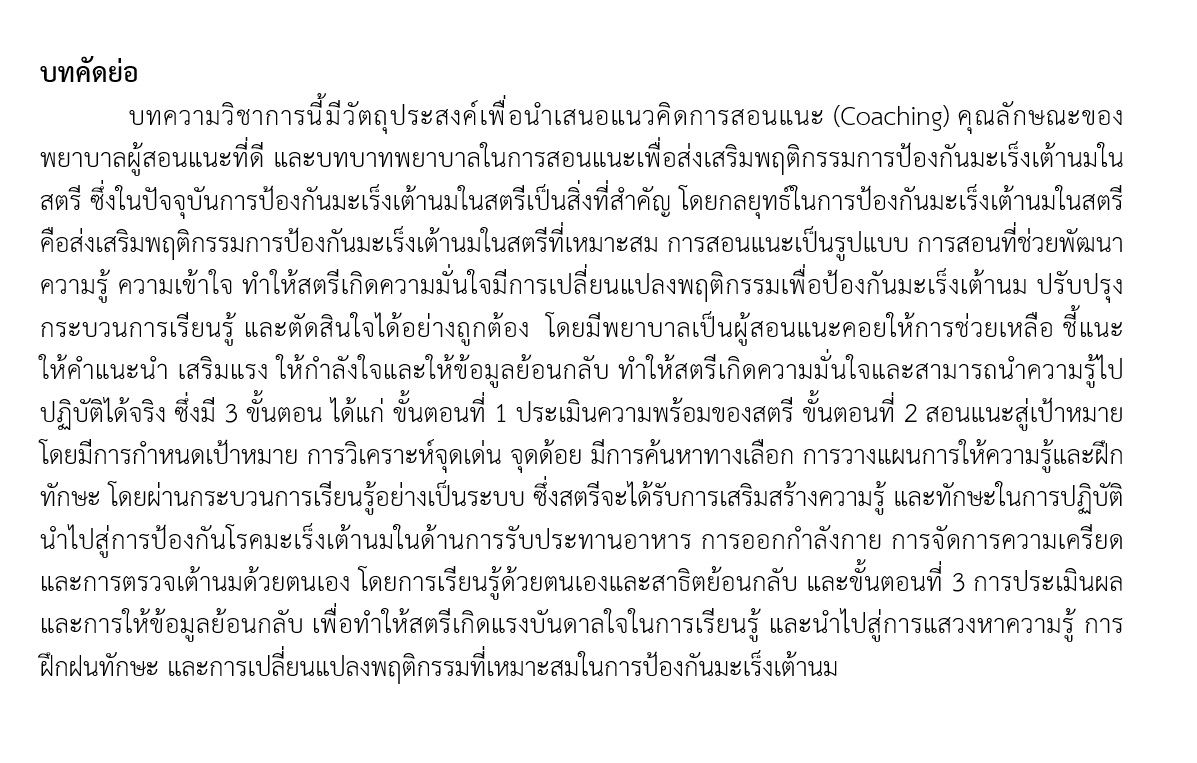
This descriptive article aimed to present the concept of coaching, applied to health promotion and nurses' role while promoting breast cancer preventive behaviors. Prevention of breast cancer is important. An efficient teaching model should include coaching strategies that improve knowledge and understanding about breast cancer, so it makes women confident. Behavior change is the key to improve learning process. It's about making the right decisions. So coaching means that nurses must teach, give advice, help, encourage and give feedback in order for women to be confident and able to put their knowledge into practice. The process of coaching composes three steps. Step 1 is an assessment of readiness. Step 2 consists in an analysis of strengths and weaknesses, including planning to develop education and training skills. A systematic learning process is put in place, which involves practical skills, knowledge on proper diet, exercise routine, stress management, and breast self-examination so to self-directed learning and assessment. Step 3 is evaluation and feedback. This way women are inspired to learn and contribute to prevent breast cancer in the future.
References
Arunjit, S., & Navicharern, R. (2019). The Effect of Coaching Program on Breast Cancer-Preventive Behaviors in Women at Risk. Journal of the Royal Thai Army Nurses. 20(2), 289-297. (in Thai)
Cancer Research UK. (2014). Diet and Breast Cancer. Retrieved 26 July, 2015, from http://www.cancerresearchuk.org/about-cancer/type/breastcancer/about/risks/diet-and breast cancer.
Catsburg, C., Miller, A. B., & Rohan, T. (2014). Adherence to Cancer Prevention Guidelines and Risk of Breast Cancer. International Journal of Cancer, 135(10), 2444-2452.
Chomchuen, T., Surath, S., & Mukchanan, B. (2016). Predicting Factors of Breast Self-Examination Effectiveness of Health Volunteers in Chiang Rai Province. Journal of Community Development and Life Quality, 4(3), 389-400. (in Thai)
Chotsangsakorn, R., Thanasilp, S., & Pudtong, N. (2019). Predicting Factors of Breast Cancer Screening Behaviors among Menopausal Women. Kuakarun Journal of Nursing, 26(2), 107-120. (in Thai)
Denieffe, S., Cowman, S., & Gooney, M. (2014). Symptoms, Clusters and Quality of Life Pripr to Surgery for Breast Cancer. Clin Nurs, 23(17-18), 2491-2502.
Jouybari, L., Naz, M. S. G., Sanagoo, A., Kiani, F., Sayehmiri, F., Sayehmiri, K., et al. (2018). Toxic Elements as Biomarkers for Breast Cancer: a Meta-Analysis Study. Cancer Management and Research and Research, 10, 69-79.
Eaton, J., & Johnson, R. (2000). Coaching Successfully. United States: Dorling Kiddersley Publishing.
Janusek, W. L., Tell, D., & Mathews, L. H. (2019). Mindfulness Based Stress Reduction Providespsychological Benefit and Restores Immune Function of Women Newly Diagnosed with Breast Cancer: A Randomized Trial with Active Control. Brain, Behavior, & Community, 80, 358-373.
Markdum, J., Thanasilp, S., & Pudtong, N. (2017). The Effects of a Shoulder Exercise Program Combined With Qigong on Ability to Shoulder Function of Breast Cancer Patients After Mastectomy. Songklanagarind Journal of Nursing, 37(1), 38-52. (in Thai)
National Health Security Office. (2011). Strategic Framework for Health Promotion and Disease Prevention at the National Level 2011-2015. Bangkok: Bureau of Policy and Strategy Ministry of Health. (in Thai)
National Breast and Ovarian Cancer Center. (2010). Breast Cancer Risk Factors a Review of Evidence July 2009. New South Wales: Crown Street Hill.
National Cancer Institute Department of Medical Services Ministry of Public Health Thailand (2019). Hospital-Based Cancer Registry. Bangkok: Information Technology Division National Cancer Institute. (in Thai)
National Cancer Institute Department of Medical Services Ministry of Public Health Thailand. (2018). Hospital-Based Cancer Registry. Bangkok: Information Technology Division National Cancer Institute. (in Thai)
Nayeri, N. D., Bakhshi, F., Khosravi, A., & Najafi, Z. (2020). The Effect of Complementary and Alternative Medicines on Quality of Life in Patients with Breast Cancer: A Systematic Review. Indian Journal of Palliative Care, 26, 95-104.
Nonthapha, S., & Navicharern, R. (2017). Factors Related to Protection Motivation Theory and Breast Cancer Prevention Behavior among Teachers in Provincial School, Central Region. Kuakarun Journal of Nursing, 24(2), 23-35. (in Thai)
Petsirasan, R., & Noonill, N. (2010). Effectiveness of a Promoting Self-Breast Examination Program for adult Women. Rama Nurs J, 16(1), 54-69. (in Thai)
Pumduang, J., Phrakrukositwatthananukul, Panasri, S., & Intongpan, P. (2019). Enhancing the Potentiality of Learning Behavior by Using Anapanasati a Case Study of Students Bhavanabhodigun Vocational College Koh Samui Surat Thani. Journal of Social Science and Cultural, 3(2), 41-53. (in Thai)
Rukyou, S., Lueboonthavatcha, O., & Navicharern, R. (2015). The Effect of Coaching Program on Caregivers’ Agency in Urinary Catheterized Care for Spinal Cord Injured Patients. Thai Journal of Cardio-Thoracic Nursing, 26(1), 45-56. (in Thai)
Saksiri, W. (2015). Knowledge, Attitude about Breast Self-Examination of Women Aged 30 Yearsand Older in the Responsibilities of the Health Promotion Hospitals Ban Don Kha. (in Thai)
Shaw, N. K., Kerman, K., & Fitness, J. (2015). Dating Concerns among Women with Breastcancer or with Genetic Breast Cancer Susceptibility: A Review and Meta-Synthesis. Health Psychol Rev, 9(4), 5-18.
Soivong, P., Sawasdisingha, P., Tanvattanagul, C., Fukul, A., Kaewinta, Y., Puangsaijai, S., et al. (2017). Efficacy of a Self-Management Program in Breast Cancer Patients. Thai Journal of Nursing Council, 32(4), 5-18. (in Thai)
Sirikunwiwat, J., & Navicharern, R. (2019). The Effect of the Coaching Program in Health Behaviors Modification on HbA1C of Persons with Pre-Diabetes. Journal of Nursing Science Chulalongkorn University, 31(2), 10-22. (in Thai)
Tritipsombut, J. (2019). The Relationships Between Knowledge, Health Perception and Breast Cancer Preventive Behaviors in Risk Group Women. The Office of Disease Prevention and Control 7 Khon Kaen, 26(3), 13-24.
Vahdaninia, M., Omidvari, S., & Montazeri, A. (2010). What do Predict Anxiety and Depression in Beast Cancer Patients? A Follow-Up Study. Soc Psychiatry Psychiatr Epidemiol, 45(3), 355-361.
Warathornpibun, T. (2015). Consumption Behavior: Consumerism Food and Health-Conscious Food. Panyapiwat Journal 2, 255-264. (in Thai)
Wang, Q., & Zhou, W. (2020). Roles and Molecular Mechanisms of Physical Exercise in Cancerprevention and Treatment. Journal of Sport and Health Science, 2020, 1-10. doi.org/10.1016/j.jshs.2020.07.008
World Health Organization. (2013). Cancer Prevention. Retrieved May 24, 2014, from http://www.who.int/cancer/prevention/en/.
World Health Organization. (2014). Breast Cancer. Retrieved August 2, 2016, from http://www.who.int/cancer/prevention/diagnosisscreening/prevention/ breast cancer/en/.
Downloads
Published
Issue
Section
License
1. บทความหรือข้อคิดเห็นใด ๆ ที่ปรากฏในวารสารเครือข่าย วิทยาลัยพยาบาลและการสาธารณสุขภาคใต้ ที่เป็นวรรณกรรมของผู้เขียน บรรณาธิการหรือเครือข่ายวิทยาลัยพยาบาลและวิทยาลัยการสาธารณสุขภาคใต้ ไม่จำเป็นต้องเห็นด้วย
2. บทความที่ได้รับการตีพิมพ์ถือเป็นลิขสิทธิ์ของ วารสารเครือข่ายวิทยาลัยพยาบาลและการสาธารณสุขภาคใต้