Shortage and Demand of Radiologic Technologists for Health Care Settings under the Jurisdiction of the Office of the Permanent Secretary, Ministry of Public Health
Keywords:
Shortage, Demand, Radiologic TechnologistAbstract
The shortage of radiologic technologists in hospitals throughout Thailand is increasing. This quantitative study aimed to investigate the current situation of shortage and demand in order to predict the number of radiological technologists in hospitals under the jurisdiction office of the permanent secretary, Ministry of Public Health (MOPH). The Human Resources Office of Permanent Secretary System (HROPS) database (30 October 2019) was used to analyze the radiology technician shortage. The demand was predicted by using both full time equivalent current need and current supply of radiology technologists. The situation on demand, supply, and lost rate of radiological technologists were presented in both number and percentage.
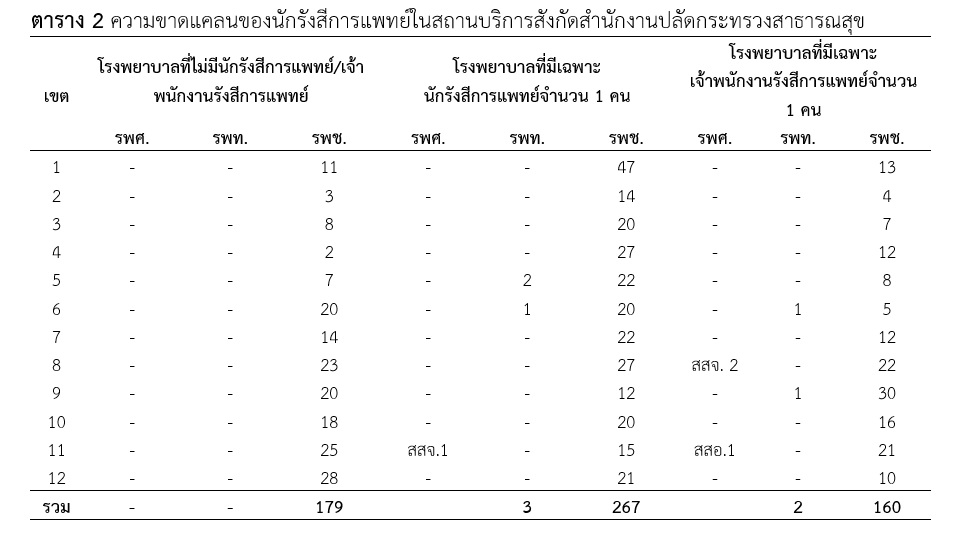
The total number of radiologic technologists and radiographer technicians is 1,759 nationally. The lost rate is 2.8 technologists per year. The number and percentage of shortage from the maximum full-time equivalent point are 1,349 and 43.40 percent, respectively; 179 hospitals work without radiologic technologists or radiographer technicians. Additionally, there are 267 hospitals working with only one radiologic technologist and 160 hospitals working with only one radiographer technician.
The predictions showed that if the MOPH recruits 50 radiologic technologists per year, they will only maintain the current level of radiological service. Moreover, to overcome this shortage situation and to meet the minimum full-time equivalent point, the MOPH will have to recruit continuously 100 radiologic technologists per year for the next 10 years.
The Ministry of public health should formulate a policy within the human resource plan, and address this shortage in health services workforce. Collaboration with universities and technical colleges should be carried out in order to meet the demand in the healthcare workforce. Meeting this demand will enhance health care services in hospitals throughout Thailand.
References
Bureau of Radiation and Medical Devices. (2015). Criteria and Guidelines on the Development of Radiological Diagnosis for the Hospital Under Ministry of Public Health. Bangkok: The Agricultural Co-Operative Federation of Thailand., LTD.
Bureau of Radiation and Medical Devices. (2019). Safety Manual of Radiation Laboratory and Medical Epuipment. Bangkok: Beyond publishing.
Chen L., Evans T., Anand S., Boufford L J., Brown H., Chowdhury M., et al. (2004). Human Resources for Health: Overcoming The Crisis. Public Health, 364, 1084-1090.
Davenport, T., & Kalakota, R. (2019). The Potential for Artificial Intelligence in Healthcare. Future Healthcare Journal, 6(2), 94-98.
Department of Medical Sciences. (2019). Quality Standards of Medical Diagnostic X-Ray Machines. Bangkok: Beyond Publishing.
Division of Human Resources MOPH. (2019a). Human Resource Reform and Health care Service Mission in Ministry of Public Health. Nonthaburi: Seatawan.
Division of Human Resources MOPH. (2019b). Manual on Human Resource Structur and Plan for Agencies in Provincial Government Service. Nonthaburi: Human Resource Management Devision.
Hongoro, C., & McPake, B. (2004). How to Bridge the Gap in Human Resources for Health. Lancert, 364, 1451-1456.
Jaiboon P., Chiangnangarm P., & Kuhirunyaratn P. (2011). The Proportion and Causes of Resignation of Nurses from Srinagarind Hospital, Khon Kaen University. Srinagarind Med J, 26(3).
Jaichuen, W. (2018). Dentist and Dental Nurse Projections for Thailand in the Year 2026. Journal of Healht System Research, 12(2), 221-231.
Kabene, M. S., Orchard, C., Howard, M. J., Soriano, A. M., & Leduc, R. (2006). The Importance of Human Resources Management in Health Care : a Global Context. Human Resources for Health, 4(20), 1-17.
Office of Atoms for Peace. (2019). Nuclear Energy for Peace Act (No. 2). Bangkok: Ministry of Higher Education, Science, Research and Innovation.
Pimthong, S. (2014). Antecedents of Employee Retention of the University Academic Staffs in Thailand. Journal of Business Administration, 37(142), 16-32.
Sawaengdee, K. (2008). The Current Nursing Workforce Situation in Thaialnd. Journal of Healht System Research, 2(1), 40-46.
Sawaengdee, K. (2017). Nursing Workforce Planing for Healthcare Facilities Under Office of the Permanent Secretary, MOPH (2017-2036) (Vol. 1). Nonthaburi: Sanswy.
Singweratham, N., & Kantabanlang, Y. (2017). Current Health Workforce and State of the Health Workforce Development Need in the Thai Health System: A Report by the Phraboromarajchanok Institure (PBRI) the Ministry of Public Healht. The Southern College Network Journal of Nursing and Public Health, 4(3), 218-225.
Thanawut, P., & Upakdee, N. (2015). Projection of Pharmacist Workforce in Thailand. Journal of Healht System Research, 9(3), 294-304.
Tursunbayeva, A. (2019). Human Resouce Technology Disruptions and Their Implications for Human Resources Management in Healtcare Organisations. BMC Health Service Research, 19(268), 1-8.
Upakdee, N., & Thanawut P. (2017). Projection of Hospital Pharmacist Workforce in Thailand for 20 Years (2015-2035). Journal of Healht System Research, 11(1), 77-90.
Virasombat, N. (2011). Physician Retaintion in Community Hospital of Thailand: A Theoretical Model. Thai Journal of Public Administation, 9(1), 131-170.
WHO. (2007). Everybody's Business-Strengthening Health Systems to Improve Health Outcomes: WHO's Framework for Action. In. Retrieved from http://www.who.int/healthsystems/strategy/everybodys_business.pdf?ua=1
WHO. (2010). Monitoring the Building Blocks of Healht Systems: A Handbook of Indicators and Their Measurement Strategies. Geneva: The WHO Document Production Services
WHO. (2016). Health Workforce Requirements for Universal Health Coverage and The Sustainable Development Goals. Switzerland: WHO.
Yamvong, C., Soivongse, P., Santati, S., Mahasidthivathm, S., & Prasert, A. (1995). Clinical Nurse Specialist and Nursing Shortage. Rama Nurse Journal, 1(2), 66-74.
Downloads
Published
Issue
Section
License
1. บทความหรือข้อคิดเห็นใด ๆ ที่ปรากฏในวารสารเครือข่าย วิทยาลัยพยาบาลและการสาธารณสุขภาคใต้ ที่เป็นวรรณกรรมของผู้เขียน บรรณาธิการหรือเครือข่ายวิทยาลัยพยาบาลและวิทยาลัยการสาธารณสุขภาคใต้ ไม่จำเป็นต้องเห็นด้วย
2. บทความที่ได้รับการตีพิมพ์ถือเป็นลิขสิทธิ์ของ วารสารเครือข่ายวิทยาลัยพยาบาลและการสาธารณสุขภาคใต้