Knowledge and Perceived Threat of Zika Virus Disease among Pregnant Women
Keywords:
Zika Virus Disease, Pregnant Women, Knowledge, Perceived ThreatAbstract
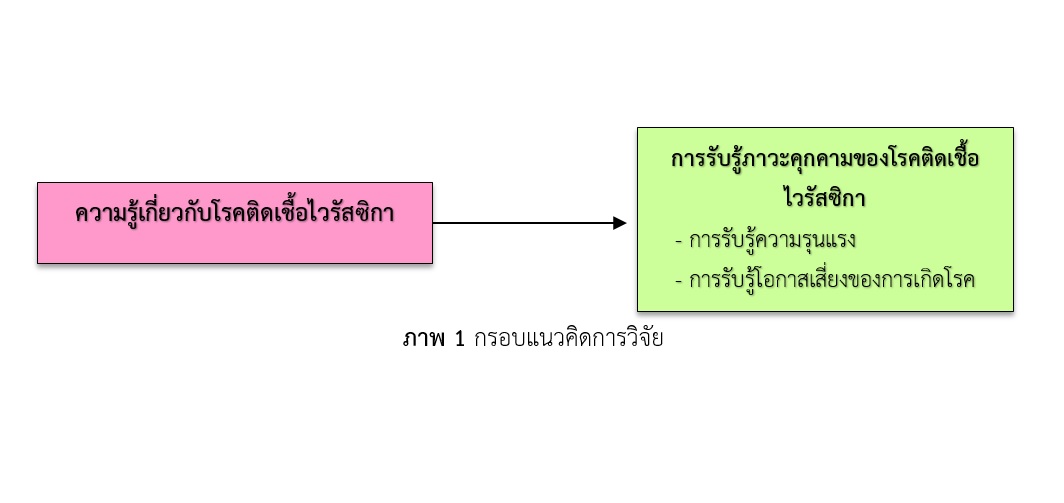
This descriptive research aimed to 1) study the level of knowledge, perceived threat of Zika virus disease among pregnant women, and 2) study the relationship between knowledge and perceived threat of Zika virus disease in pregnant women. Sample was 108 pregnant women who attended the antenatal care department, Trang Hospital during March - May 2019. The research tool was a questionnaire consisting of 4 parts: 1) general information, 2) knowledge of Zika virus disease 3) perceived severity of Zika virus disease, and 4) perceived susceptibility of Zika virus disease. The questionnaire was checked for content validity by a panel of experts. The validity index (CVI) was 0.93. Its reliability was tested using KR-20 in the part of knowledge, and Cronbach's alpha coefficient in the part of perceived threat yielding values of .64 and .74, respectively. Data were analyzed by frequency, percentage, mean, standard deviation, and Pearson's Product Moment Correlation. The study found that
1. The majority of the sample (94.4%) had knowledge about Zika virus disease at a low to moderate level. When classified by item, it was found that the top three most wrong answers were 1) Zika virus disease can be transmitted from mother to fetus (10.70%), 2) Most patients with Zika virus disease have severe symptoms that may lead to death (20.20%), and 3) exposure to blood and secretions such as saliva and nasal mucus of patients with Zika virus disease can cause the disease (23.80%).
2. Perceived threat of Zika virus disease, namely perceived severity and perceived susceptibility were at a high level (M=4.13, SD=.569 and M=3.53, SD=.529 respectively).
3. Knowledge of Zika virus disease did not correlate with perceived severity (r=0.005, p>.05), and perceived susceptibility of Zika virus disease (r=-0.034, p>.05).
The findings from this study can be further used to provide knowledge, and promote perceived threat among pregnant women.
References
Best, W. J. (1977). Research in Education. 3rd ed. Englewood Cliffs, New Jersey: Prentice-Hall.
Bureau of Emerging Infectious Diseases, Department of Disease Control, Ministry of Public Health. (2016). Movement of Zika Virus Disease. Issued on February 14, 2016 Retrieved October 31, 2017 from http://beid.ddc.moph.go.th/beid_2014/sites/default/files/files/khwaamekhluuenaihworkhtidechuueaiwraschikaa_14feb.pdf
Bureau of Emerging Infectious Diseases, Department of Disease Control, Ministry of Public Health. (2016). Knowledge of Zika Virus Disease. Retrieved October 31, 2017 from http://beid.ddc.moph.go.th/beid_2014/sites/default/files/factsheet_ zika020259.pdf
Bureau of Emerging Infectious Diseases, Department of Disease Control, Ministry of Public Health. (2017). Q&A: Zika Virus Disease and Pregnant Women. Retrieved October 31, 2017 from http://beid.ddc.moph.go.th/beid_2014/sites/default/files/QAforpreg_ Jurai_5Jan2016.pdf
Bureau of Emerging Infectious Diseases, Department of Disease Control, Ministry of Public Health. (2017). Zika Virus Disease. Situation on May 15, 2017. Retrieved October 31, 2017 from http://beid.ddc.moph.go.th/beid_2014/sites/default/files/Sitution%20 Zika150560.pdf
Chibueze, C. E., Tirado, V., Lopes, S. K., Balogun, O. O., Takemoto, Y., Swa, T., et al. (2017). Zika Virus Disease Infection in Pregnancy: a Systematic Review of Disease course and Complications. Reproductive Health (2017) 14:28. Retrieved October 31, 2017 from DOI:http://dx.doi.org/10.1186/s12978-017-0285-6
Department of Disease Control, Ministry of Public Health (2016). Manual of Zika Virus Disease Prevention and Control for Health and Public Health Personnel. Nonthaburi: The War Veterans Organization of Thailand under Royal Patronage of His Majesty the King Printing.
Government Pharmaceutical Organization. (2017). Zika Virus Disease Infection. Research & Develoment Newsletter GPO, 24 (1), 7-11.
Janpet, A., & Sivadamrongpong, W. (2009). Knowledge, Perception, and Social Support on a Preventive Behavior of Dengue Hemorrhagic Fever of People at Yala City Municipality. Boromarajonani College of Nursing, Yala.
Janyapat, P. (2017). Zika Virus Disease with Aedes Mosquito Vector: Warning for Pregnant Women in Having Baby with Microcephaly. Retrieved August 17, 2017 from http://theworldmedicalcenter.com/th/new_site/health_article/detail/?page;
Pratoomsri, N., & Silaporn, P. (2017). The Zika Virus Disease Outbreak in Health Region 4; September-December, 2016. Journal of Medical and Public Health Region 4, 7(1), 27-37. World Health Organization. (2016). Zika virus Fact Sheet. Retrieved August 17, 2017 http:// www.who.int/mediacentre/factsheets/zika/en/
Strecher, V. J., & Rosenstock, I. M. (1996). The Health Belief Model. In K. Glanz, F. Lewis, & B Rimer (Eds.). Health Behavior and Health Education: Theory, Research, and Practice (2nd ed., pp.41-59). San Francisco, CA: Jossey-Bass Publishers.
Wauters, Y., Poopattayakorn, A., & Chotibun, P. (2018). Zika Virus Disease and Pregnancy: Role of Community Health Nurse in the Disease Prevention. The Southern College Network Journal of Nursing and Public Health, 5(2), 312-321.
Wiratchai, N. (2012). Statistic in Use. (2nd ed.). Bangkok: Chulalongkorn University.
Downloads
Published
Issue
Section
License
1. บทความหรือข้อคิดเห็นใด ๆ ที่ปรากฏในวารสารเครือข่าย วิทยาลัยพยาบาลและการสาธารณสุขภาคใต้ ที่เป็นวรรณกรรมของผู้เขียน บรรณาธิการหรือเครือข่ายวิทยาลัยพยาบาลและวิทยาลัยการสาธารณสุขภาคใต้ ไม่จำเป็นต้องเห็นด้วย
2. บทความที่ได้รับการตีพิมพ์ถือเป็นลิขสิทธิ์ของ วารสารเครือข่ายวิทยาลัยพยาบาลและการสาธารณสุขภาคใต้