ภาวะผู้นำและพฤติกรรมสร้างนวัตกรรมในการทำงานในองค์กรภาครัฐ : การทบทวนอย่างเป็นระบบ
คำสำคัญ:
ภาวะผู้นำ, พฤติกรรมสร้างนวัตกรรมในการทำงาน, องค์กรภาครัฐ, การทบทวนอย่างเป็นระบบบทคัดย่อ
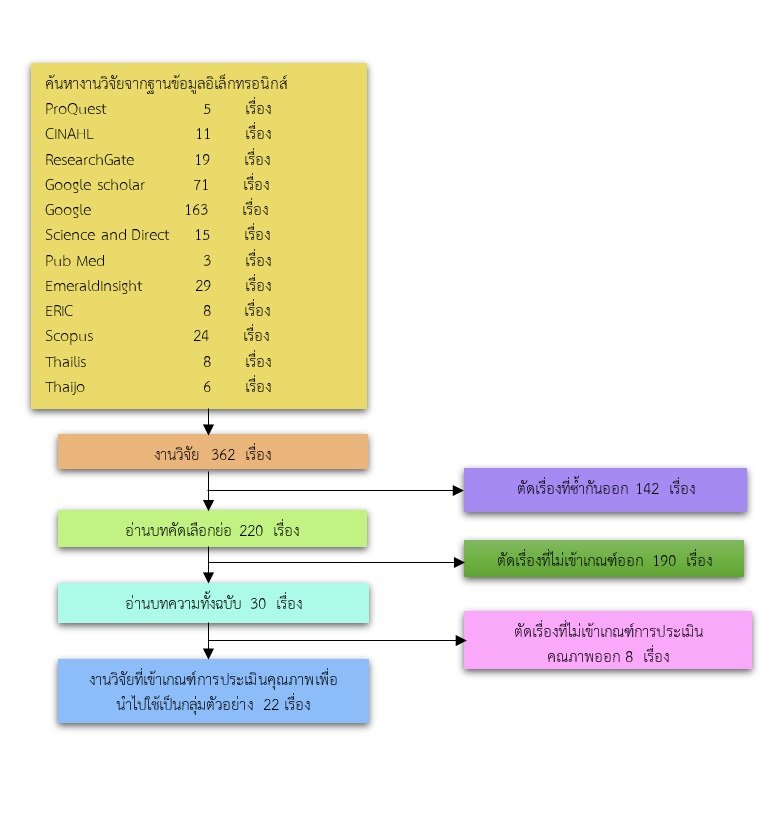
การวิจัยนี้มีวัตถุประสงค์เพื่อ สรุปองค์ความรู้ของคุณลักษณะของบทความวิจัยและสังเคราะห์การใช้ทฤษฎีที่ศึกษาเกี่ยวกับภาวะผู้นำและพฤติกรรมสร้างนวัตกรรมในการทำงานในองค์กรภาครัฐ ที่มีการตีพิมพ์เผยแพร่ในช่วงค.ศ. 2008 – 2019 โดยสืบค้นจากฐานข้อมูลบทความวิจัยทั้งในประเทศและต่างประเทศจากแหล่งข้อมูลต่าง ๆ ได้แก่ Medline/Pubmed, CINAHL, Research Gate, Google, Google Scholar, Pro Quest, Thai LIS, Thaijo, Emerald Insight, Science Direct, Scopus และฐานข้อมูลอิเล็กทรอนิกส์ของมหาวิทยาลัยที่ตรงตามเกณฑ์การเลือก มีการประเมินคุณภาพบทความวิจัยโดยใช้แบบประเมินคุณภาพของเคเมท ลีและคุ๊กและใช้สถิติแคปปา (Kappa Statistic) ทดสอบความสอดคล้องกันระหว่างผู้ประเมินรายงานและใช้สถิติเชิงพรรณนา ผลการวิจัยพบว่า
รายงานวิจัยทั้งหมดเป็นการวิจัยเชิงปริมาณ (n=22) กลุ่มตัวอย่างศึกษาในบริบทพนักงานทั่วไปมากที่สุด (n=12) ทฤษฏีภาวะผู้นำที่นิยมใช้มากที่สุดคือ ทฤษฎีภาวะผู้นำการเปลี่ยนแปลงของแบส และอโวลิโอ และแนวคิดพฤติกรรมสร้างนวัตกรรมในการทำงาน นิยมใช้แนวคิดของเดอจงและเดน ฮาท๊อกมากที่สุด ผลการวิจัยส่วนใหญ่พบว่า ภาวะผู้นำการเปลี่ยนแปลงมีความสัมพันธ์และอิทธิพลทางตรงต่อพฤติกรรมสร้างนวัตกรรมในการทำงานในองค์กรภาครัฐ
นั้น ผลการสังเคราะห์งานวิจัยครั้งนี้จึงชี้ชัดว่าภาวะผู้นำการเปลี่ยนแปลงเป็นปัจจัยที่มีความสำคัญในการเพิ่มพฤติกรรมสร้างนวัตกรรมในการทำงานในองค์กรภาครัฐ ทั้งในโรงพยาบาลและหน่วยบริการสุขภาพอื่น ๆทุกระดับ
เอกสารอ้างอิง
Afsar, B., Badir, Y. F., & Saeed, B. B. (2014). Transformational Leadership and Innovative Work Behavior. Industrial Management & Data Systems, 114(8), 1270-1300.
Ali, K. A. M., & Buang, M. (2016). Study on Factors That Influence Innovation in Malaysian Public Sector. Journal of Advanced Research in Business and Management Studies, 4(1), 60-73.
Amornpipat, I., & Sorod, B. (2016). The Study of Structural Relationships Between Thai Authentic Leadership, Follower’s Wellbeing and Innovative Work Behaviour in Thai Military Contex. Nkrafa Journal of Humanities and Social Sciences, 4(4), 5-28.
Bagheri, A., & Akbari, M. (2018). The Impact of Entrepreneurial Leadership on Nurses’ Innovation Behavior. Journal of Nursing Scholarship, 50(1), 28-35.
Cai, W., Lysova, E. I., Khapova, S. N., & Bossink, B. A. G. (2018). Servant Leadership and Innovative Work Behavior in Chinese High-Tech Firms: A Moderated Mediation Model of Meaningful Work and Job Autonomy. Frontiers in Psychology, 9(1767), 1-13.
Chatchawan, R., Trichandhara, K., & Rinthaisong, I. (2018). Factors Affecting Innovative Work Behavior of Employees in Local Administrative Organizations in the South of Thailand. Journal of Southern Technology, 11(1), 113 – 124. (In Thai)
Contreras, F., Espinosa, J. C., Dornberger, U., & Cuero Acosta,Y. A. (2017). Leadership and Employees’ Innovative Work Behavior: Test of a Mediation and Moderation Model. Asian Social Science, 13(9), 8-25.
De Jong, J. P., & Den Hartog, D. N. (2010). Measuring Innovative Work Behaviors. Creativity and Innovation Management, 19(1), 23-36.
Denti, L., & Hemlin, S. (2012). Leadership and Innovation in Organizations: A Systematic Review of Factors That Mediate or Moderate the Relationship. International journal of Innovation Management, 16(3), 1-20.
Faraz, N. A., Yanxia, C., Ahmed, F., Estifo, Z. G., & Raza, A. (2018). The Influence of Transactional Leadership on Innovative Work Behavior A-Mediation Model. European Journal of Business and Social Sciences, 7(1), 51-62.
Garg, S., & Dhar, R. (2017). Employee Service Innovative Behavior the Roles of Leader-Member Exchange (LMX), Work Engagement, and Job Autonomy. International Journal of Manpower, 38(2), 242-258.
Gifford, W., Davies, B., Tourangeau, A., & Lefebre, N. (2011). Developing Team Leadership to Facilitate Guideline Utilization: Planning and Evaluating a 3-Month Intervention Strategy. Journal of Nursing Management, 19(1),121-132.
Gumusluoglu, L., & Ilsev, A. (2009). Transformational Leadership, Creativity and Organizational Innovation. Journal of Business Research, 62(4), 461-473.
Khan, Z. A., Nawaz, A., & Khan, I. (2015). The Impact of Leadership Styles on Innovation in Health Services. Gomal University Journal of Research, 31(1), 143-154.
Khaola, P., & Coldwell, D. (2019). Explaining How Leadership and Justice Influence Employee Innovative Behaviours. European Journal of Innovation Management, 22(1), 193-212.
Kmet, L. M., Lee R. C., & Cook, L. S. (2004). Standard Quality Assessment Criteria for Evaluating Primary Research Papers from a Variety of Fields. Canada: Interpret Design Inc.
Lekhavichit, S., & Wanichtanom, R. (2017). Relationships Between Transformational Leadership and Innovative Behavior of Government Teachers: the Mediating Role of Work Environment and the Mediating Role of Psychological Empowerment. Journal of Behavioral Science, 23(1), 41-53. (In Thai)
Lilly, L., & Juma, D. (2014). Influence of Strategic Innovation on Performance of Commercial Banks in Kenya: The Case of Kenya Commercial Banks in Nairobi Country. European Journal of Business Management, 2(1), 1-19.
Majumdar, B., & Ray, A. (2011). Transformational Leadership and Innovative Work Behaviour. Journal of the Indian Academy of Applied Psychology, 37(1), 140-148.
Masood, M., & Afsar, B. (2017). Transformational Leadership and Innovative Work Behavior among Nursing Staff. Nursing Inquiry, 1-14.
Miao, Q., Newman, N., Schwarz, G., & Cooper, B. (2018). How Leadership and Public Service Motivation Enhance Innovative Behavior. Public Administration Review, 71-81.
Moher, M., Liberati, A., Tetzlaff, J., Altman, D. G., & The PRISMA Group. (2009). Preferred Reporting Items for Systematic Reviews and Meta-Analysis: The PRISMA Statement. Journal of Clinical Epidemiology, 62, 1006-1012.
Nabil, H., Abderraouf, G., & Nadira, R. (2017). The Impact of Leadership on Creativity and Innovation. International Journal of Humanities and Social Science Invention, 6(6), 55-62.
Nusair, N., Ababneh, R., & Bae, Y. K. (2012). The Impact of Transformational Leadership Style on Innovation as Perceived by Public Employees in Jordan. International Journal of Commerce and Management, 22(3), 182-201.
Palangkaraya, A., Stierwald, A., Webster, E., & Jensen, P. (2010). Examining the Characteristics of Innovative Firms in Australia. Melbourne: A Report for the Australian Government Department of Innovation, Industry, Science and Research. Intellectual Property Research Institute of Australia, The University of Melbourne.
Petchouy, S., & Sittipongpitttaya, S. (2017). Transformational Leadership, Knowledge Management, Learning Organization and Innovative Work Behavior in Secondary Education of School Office 1,2,3,4, and 6. Journal of the Association of Researchers, 22(1), 193-204.
Pieterse, A. N., Knippenberg, D. V., Schippers, M., & Stam, D. (2010). Transformational and Transactional Leadership and Innovative Behavior: The Moderating Role of Psychological Empowerment. Journal of Organizational Behavior, 31, 609-623.
Prabowo, R., Mustika, M. D., & Sjabadhyni, B. (2018). How a Leader Transforms Employees’ Psychological Empowerment into Innovative Work Behavior. Psychological Research on Urban Society, 1(2), 90-99.
Pradhan, S., & Jena, L. K. (2019). Does Meaningful Work Explains the Relationship Between Transformational Leadership and Innovative Work Behaviour. The Journal for Decision Makers, 44(1), 30-40.
Sanders, K., Moorkamp, M., Torka, N., Groeneveld, S., & Groeneveld, C. (2010). How to Support Innovative Behavior? The Role of LMX and Satisfaction with HR Practices. Technology and Investment, 01(01), 59-68.
Shi, J. (2012). Influence of Passion on Innovative Behavior: An Empirical Examination in People Republic of China. African Journal of Business Management, 6(30), 8889-8896.
Tidd, J., & Bessant, J. (2014). Management Innovation. (5thed.). West Sussex: Wiley.
Yukl, G. A. (2013). Leadership in Organizations (8thed.). New York: Pearson Education.
Zahra, T. T., & Waheed, A. (2017). Influence of Ethical Leadership on Innovative Work Behavior: Examination of Individual-Level Psychological Mediators. Pakistan Journal of Commerce and Social Sciences, 11(2), 448-470.
ดาวน์โหลด
เผยแพร่แล้ว
ฉบับ
ประเภทบทความ
สัญญาอนุญาต
1. บทความหรือข้อคิดเห็นใด ๆ ที่ปรากฏในวารสารเครือข่าย วิทยาลัยพยาบาลและการสาธารณสุขภาคใต้ ที่เป็นวรรณกรรมของผู้เขียน บรรณาธิการหรือเครือข่ายวิทยาลัยพยาบาลและวิทยาลัยการสาธารณสุขภาคใต้ ไม่จำเป็นต้องเห็นด้วย
2. บทความที่ได้รับการตีพิมพ์ถือเป็นลิขสิทธิ์ของ วารสารเครือข่ายวิทยาลัยพยาบาลและการสาธารณสุขภาคใต้