ตัวแบบในการดูแลผู้สูงอายุเชิงบูรณาการ
คำสำคัญ:
ผู้สูงอายุ, ทุนทางสังคม, การดูแลแบบบูรณาการบทคัดย่อ
การวิจัยเชิงคุณภาพนี้ มีวัตถุประสงค์เพื่อค้นหาทุนทางสังคม ศักยภาพของชุมชนในการดูแลผู้สูงอายุและสังเคราะห์ตัวแบบการดูแลผู้สูงอายุแบบบูรณาการ ผู้ให้ข้อมูลหลักเลือกแบบเฉพาะเจาะจง โดยใช้เทคนิค Snow Ball Sampling ประกอบด้วย ผู้ดูแลหลัก 11 คน บุคลากรสุขภาพ 3 คน อสม. 14 คน สมาชิกชมรมผู้สูงอายุ 6 คน ผู้นำชุมชน 8 คน และผู้รับผิดชอบการดูแลผู้สูงอายุของ อบต.ท่าเรือ 2 คน กลุ่มตัวอย่างทุกคนมีบทบาทในการดูแลผู้สูงอายุอย่างต่อเนื่อง เป็นเวลาติดต่อกันอย่างน้อย 3 ปี ยินดีเข้าร่วมในการวิจัย ทำการสัมภาษณ์จนกระทั่งผู้วิจัยได้ข้อมูลอิ่มตัว วิเคราะห์ข้อมูลโดยการวิเคราะห์เนื้อหา ผลการวิจัยพบว่า
1. ทุนทางสังคมและศักยภาพของชุมชนในการดูแลผู้สูงอายุตำบลบ้านไม้แดงประกอบด้วย 1) ต้นทุนด้านครอบครัวมีทั้งผู้ดูแลหลักและผู้ดูแลรองดูแลผู้สูงอายุตามบริบทครอบครัว 2) อสม. มีศักยภาพในการดูแลผู้สูงอายุในการเยี่ยมบ้านผู้สูงอายุ การวางแผนดูแลผู้สูงอายุอย่างครบวงจร 3) ชมรมผู้สูงอายุ มีส่วนในการดูแลสุขภาพผู้สูงอายุ และช่วยเหลือการดูแลผู้สูงอายุกลุ่มติดบ้าน ติดเตียง 4) องค์การบริหารส่วนตำบลท่าเรือ สนับสนุนงบประมาณ และบุคลากรในการดำเนินการดูแลผู้สูงอายุ 5) ผู้นำชุมชน ร่วมจัดกิจกรรมส่งเสริมสุขภาพ และศึกษาความเป็นไปได้ของโครงการต่าง ๆ ในการดูแลดูแลผู้สูงอายุ และ 6) โรงพยาบาลส่งเสริมสุขภาพตำบล ริเริ่มก่อตั้งชมรมผู้สูงอายุ อบรม อสม. ในการดูแลส่งเสริมสุขภาพผู้สูงอายุที่บ้าน ให้การรักษาเบื้องต้น การฟื้นฟูสภาพ ประสานงานด้านงบประมาณกับองค์การบริหารส่วนตำบล และดำเนินการตามนโยบายส่งเสริมสุขภาพผู้สูงอายุของรัฐบาล
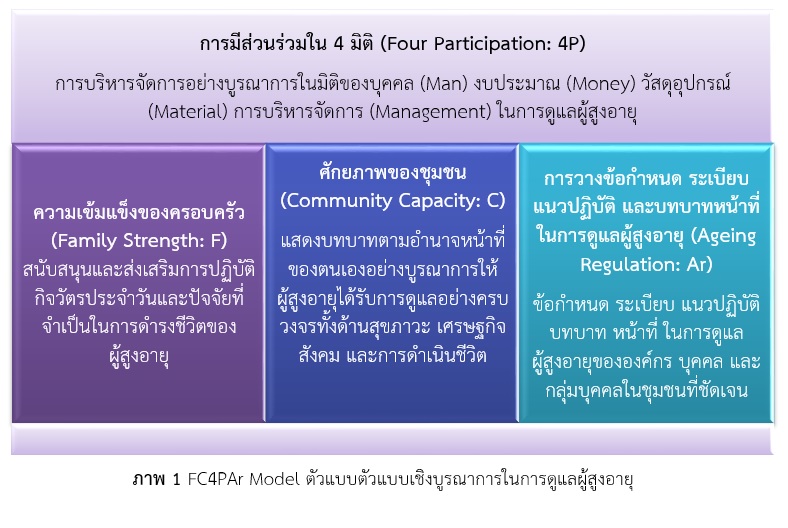
2. ตัวแบบการดูแลผู้สูงอายุแบบบูรณาการ ผลการสังเคราะห์ตัวแบบการดูแลผู้สูงอายุ สามารถนำบทบาทของการดูแลมาถอดเป็นตัวแบบเชิงบูรณาการ ในการดูแลผู้สูงอายุ คือ FC4PAr Model: Family-Community Capacity-Four Participation-Ageing Regulation
ผลการวิจัยพบว่า ตัวแบบการดูแลผู้สูงอายุแบบบูรณาการ FC4PAr Model มีผลกระทบเชิงบวกต่อการเรียนรู้การพัฒนาการดูแลผู้สูงอายุในชุมชนทั้งในด้านการแก้ปัญหาและพึ่งตนเอง ดังนั้น บุคลากรสาธารณสุข บุคลากรขององค์การบริหารส่วนตำบล และกระทรวงการพัฒนาสังคมและมนุษย์ จึงควรนำต้นแบบนี้ ไปใช้ในการดูแลผู้สูงอายุ รงมถึงการพัฒนาภาวะสุขภาพในมิติอื่น ๆ ต่อไป ให้ครอบคลุมการดูแลประชากรทุกกลุ่มวัย
เอกสารอ้างอิง
Foundation of Gerontology Research and Development Institute and Institute for Population and Social Research. (2017). Situation of the Thai Elderly 2016. Bangkok: Printery CO; LTD. (in Thai)
Health Systems Research Institute. (2012). Integrated Elderly Care in the Community. Retrieved May 15, 2019, from http://kb.hsri.or.th/dspace/handle/11228/3677.pdf.
Miller, W. L., & Crabtree, B. F., (1992). Primary Care Research: A Multimethod Typology and Qualitative Road Map. In B. F. Crabtree & W. L., Miller (Eds.), Doing Qualitative Research, 3-28. Newbury Park: SAGE.
Phalasuek, R., & Thanomchayathawatch, B. (2017). A Family Model for Older People Care. The Southern College Network Journal of Nursing and Public Health, 4(3), 135-150. (in Thai)
Phalasuek, R., Thanomchayathawatch, B., & Songloed, D. (2018). Participatory Action Research: Development of a Participatory Process for Health Promotion in the Community. The Southern College Network Journal of Nursing and Public Health, 5(1), 211-223. (in Thai)
Phalasuek, R., Thanomchayathawatch, B., & Thonglert. D. (2017). A Community Participation Process in Teenage Pregnancy Prevention. The Southern College Network Journal of Nursing and Public Health, 4(2), 256-267. (in Thai)
Ratchathawan, R., Thanomchayathawatch, B., Tongmangtunyatap, K., & Wonglamthong, S. (2019). A Care Model for Older Adults with Chronic Disease amongVillage Health Volunteers. The Southern College Network Journal of Nursing and Public Health, 6(3), 107-1250. (in Thai)
Waphatthanawong, P., & Prasartkun, P. (n.d.). Future Thai Population. Retrieved 19 August 2019 from https://www.ipsr.mahidol.ac.th/IPSR/AnnualConference/ConferenceII/Article/ Download/Article02.pdf
ดาวน์โหลด
เผยแพร่แล้ว
ฉบับ
ประเภทบทความ
สัญญาอนุญาต
1. บทความหรือข้อคิดเห็นใด ๆ ที่ปรากฏในวารสารเครือข่าย วิทยาลัยพยาบาลและการสาธารณสุขภาคใต้ ที่เป็นวรรณกรรมของผู้เขียน บรรณาธิการหรือเครือข่ายวิทยาลัยพยาบาลและวิทยาลัยการสาธารณสุขภาคใต้ ไม่จำเป็นต้องเห็นด้วย
2. บทความที่ได้รับการตีพิมพ์ถือเป็นลิขสิทธิ์ของ วารสารเครือข่ายวิทยาลัยพยาบาลและการสาธารณสุขภาคใต้