Effects of Problem-Based Learning Pedagogy in Family and Community Nursing II Course on Learning Achievement, Problem Solving Skills, Teamwork, and Satisfaction among Nursing Students at Boromarajonani College of Nursing, Surat Thani
Keywords:
Problem-Based Learning, PBL, Learning Achievement, Problem Solving Skill, Teamwork, SatisfactionAbstract
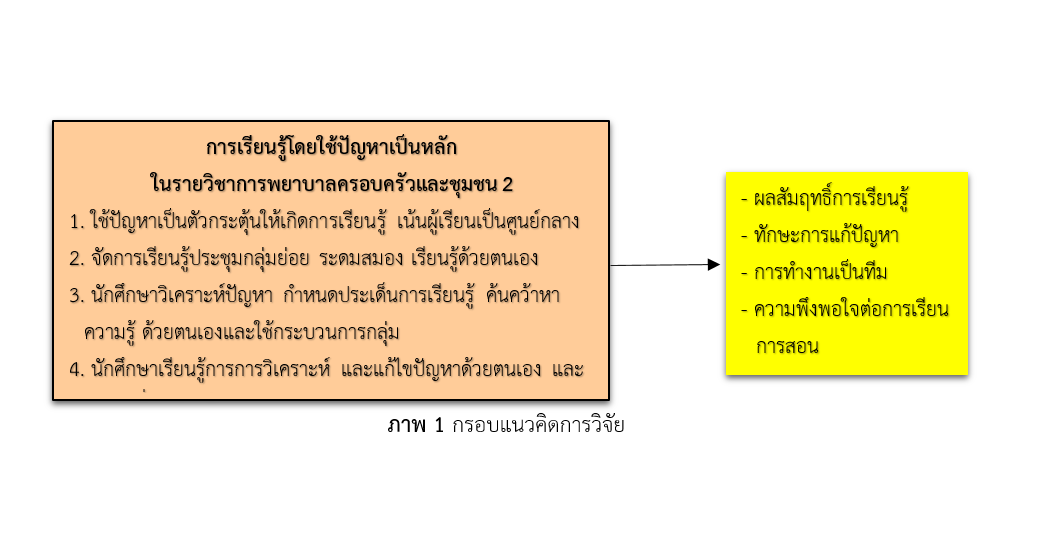
This quasi-experimental research in Family and Community Nursing II course aimed to study the effects of problem-based learning (PBL) pedagogy on learning achievement, problem solving skills, teamwork, and satisfaction of nursing students. Sample was 129 4th-year nursing students in academic year 2017 at Boromarajonani College of Nursing in Surat Thani. The experimental tool was a lesson plan using problem-based learning strategy. Data collection tools included a learning achievement test, a problem-solving skills test, a teamwork assessment, and a satisfaction questionnaire. Data were analyzed using mean, standard deviation, and paired t-test.
Results showed that learning achievements of nursing students after being taught with the PBL approach was significantly higher (M=9.35, SD=1.93) than before the experiment (M=16.50, SD=1.25) at the significance level of 0.001. The overall score of problem-solving skills was at a good level (M=3.33, SD=0.41). Teamwork score was at a very good level (Mean=3.60, SD=0.44). And students’ satisfaction was also very good (M=4.72, SD= 0.58)
Therefore, conclusion is that using the problem-based learning approach in Family and Community Nursing II course can promote effective learning achievement, problem-solving skills, and teamwork among nursing students.
References
Alavi, M., & Tiwana, A. (2002). Knowledge Integration in Virtual Teams: The Potential Role of KMS. Journal of the American Society for Information Science and Technology, 53(12), 1029-1037.
Ates, O., & Eryilmaz, A. (2010). Factors Affecting Performance of Tutors During Problem-Based Learning Implementations. Social and Behavioral Sciences, 2(2), 2325–2329.
Chumchai, P., Khumpeng, S., & Poysunnoen, Y. (2016). The Effectiveness of Occupational Health Teaching based on Problems-Based Learning Model on Achievement Outcome, Problem Solving Skill, Team Work Skill, and Satisfaction of Nursing Student, Boromrajonani College of Nursing, Phra Putthabat. Journal of Nursing and Education, 9(4), 60-73. (in Thai)
Dolmans, D. H., Grave, W., Wolfhagen, I. H., & Vleuten Vander, C. P. (2005). Problem‐Based Learning: Future Challenges for Educational Practice and Research. Journal of Medical Education, 39(7), 732-41.
Khemmanee, T. (2011). Teaching Science: Knowledge for Efficient Learning Process Management. (14th ed.). Bangkok: Chulalongkorn University Printing House. (in Thai)
Klomim, K. (2017). Problem Based Learning: A Course Design and Development for Curriculum For Teachers, Journal of Graduate Studies Valaya Alongkorn Rajabhat University In the Royal Patronage, 11(2), 179-192. (in Thai)
Nuankaew, T., & Reerachat, J. (2018). Effect of Problem-Based Learning Management in Ethics and Professional Law Course to Learning Behavior And the Ability to Make Ethical Decisions of Nursing Students. Journal of Mahasarakham Hospital, 15(2), 57-68. (in Thai)
Office of the Education Council. (2018). Education in Thailand 2018. Bangkok: Office of the Education Council. (in Thai)
Panich, V. (2013). Teachers for Pupils Build Classrooms Back. Siam Commercial Foundation, S.R. Printing Mass Products Co., Ltd. (in Thai)
Phothong, P., Chansuwan, S., Khachat, S., & Sripho, S. (2018). The Problem-Based Teaching and Learning Model to Enhance the Ability to Solve Nursing Problems of Nursing Students. Journal of Health Science Research, 12(Special), 29-38. (in Thai)
Puttiwanit, N., Puttiwanit, S., Suwanraj, M., & Kaewmahakam, O. (2017). Effect of Problem-Based Learning on Intellectual Skills of Nursing Student in Nursing of Persons with Health Problems I Subject. The Southern College Network Journal of Nursing and Public Health, 4(1), 1-14. (in Thai)
Race, P., Brown, S., & Smith, B. (2005). 500 Tips on Assessment. (2th ed.). New York: Routedgefalmer.
Sangnimitchaikul, W. (2012). Student-Centered Learning: A case Study of Instructional Model in the Nursing Care of Children and Adolescents Course at the Faculty of Nursing, Thumasat University. Journal of Nursing and Education, 1(3), 2-14.
Savery, J. R. (2006). Overview of Problem-Based Learning: Definitions and Distinctions. Interdisciplinary. Journal of Problem-learning, 1(1), 8-20.
Schmidt, H. G., & Moust, J. H. C. (2000). Processes That Shape Small-Group Tutorial Learning: A Review of Research. Mastricht: Datawyse Publishing.
Srichairattanakull, J., & Saleekul, S. (2018). Application of Problem Based Learning Concept In Family and Community Nursing I: Designing of Family Health Care. Journal of Boromarajonani College of Nursing Bangkok, 34(3), 133-144. (in Thai)
Srisaaug, B. (2017). Primary Research. (7th) ed. Bangkok: Suriyasan. (in Thai)
Tongmuangtunyatep, K., Weerawattanodome, N., Carabutr, T., & Ampankan, S. (2018). The Effects of Using Problem- Based Learning for Caring on Maternal and Fetus with Health Problem Related with Pregnancy of 4th Level Nursing Students. Journal of Nursing and Education, 11(2), 87-97. (in Thai)
Downloads
Published
Issue
Section
License
1. บทความหรือข้อคิดเห็นใด ๆ ที่ปรากฏในวารสารเครือข่าย วิทยาลัยพยาบาลและการสาธารณสุขภาคใต้ ที่เป็นวรรณกรรมของผู้เขียน บรรณาธิการหรือเครือข่ายวิทยาลัยพยาบาลและวิทยาลัยการสาธารณสุขภาคใต้ ไม่จำเป็นต้องเห็นด้วย
2. บทความที่ได้รับการตีพิมพ์ถือเป็นลิขสิทธิ์ของ วารสารเครือข่ายวิทยาลัยพยาบาลและการสาธารณสุขภาคใต้