Motives Inspiring Long-Term Care Management of Caregivers Caring for Stroke Survivors in One District of a Southern Border Province
Keywords:
Motive, Caregiver, Stroke, Long-Term Care Management, Grounded TheoryAbstract
This study applied the Straussian Grounded Theory Method to explore the perspectives of caregivers on what motives inspire their long-term care management while caring for their stroke survivor patients. Fifteen participants were recruited from the caregivers who had spent at least four hours per day on caring for their stroke patients for six months or more in a sub-district or municipality of one district of a southern border province. Data were gathered by using in-depth audio taped interviews, as well as observations and field notes that enabled concurrent data validation with methodological triangulation. Results seem to suggest the following.
The motives for caregivers’ long-term care management while caring for their stroke survivor patients could be divided in two categories. The first category of motives is marked by integrity: it consists in fundamental drive, a full-care engagement from caregivers toward their patients over the long period of care.
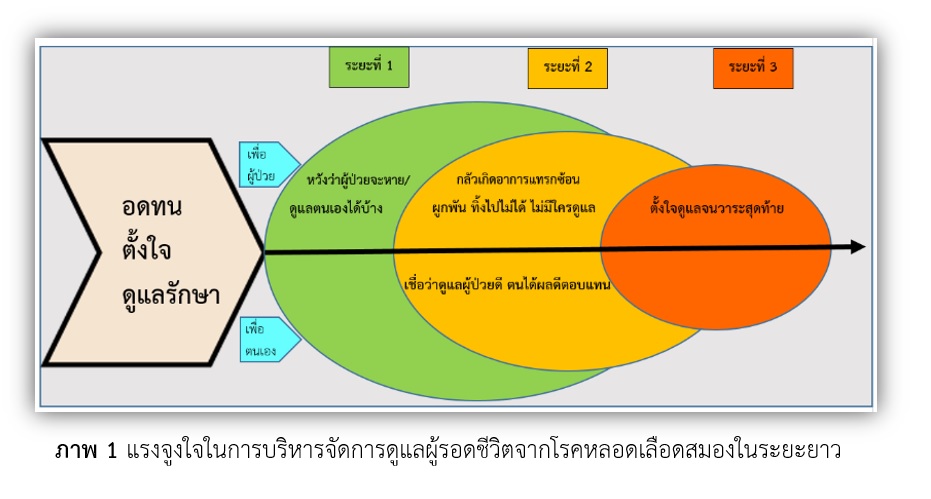
The second category follows to the patient’s condition, which usually has three stages. In the first stage, the caring practices are anticipating that the patient might make a full recovery or could be able to do some daily living activities. In the second stage, the most powerful influences reinforcing the caregivers’ attitude and behaviors where being concerned about developing complications, and the belief that good patient caring could lead them to gain benefits. Caregivers tend to assist the survivors with fluctuating symptoms, in order to maintain some degree of recovery. In the final stage, the caregivers tend to sustain their care for their patients although their cure is hopeless. They try to make their patients as comfortable as possible, until the last minute.
Findings could be applied to guide nursing administrators and nursing practitioners about how to manage the provision of corresponding long-term care for stroke survivors, caregivers, and their families when their caregivers’ motives develop and change over time throughout the stroke patients’ trajectory.
References
Abdullah, T. (2015). The Effect of Endurance. Retrieved November 3, 2019 from https://www.islammore.com/main/content.php?page=sub&category=6&id=903
Aekuwetchakul, S. (2013). Development of the Community Participatory Palliative Care for Stroke Survivors in Primary Care Network, Khon Kean Hospital. (Master of Nursing Science in Community Health Nurse Practitioner thesis), Khon Kean University, Khon Kean, Thailand. Retrieved November 3, 2019 from https://tdc.thailis.or.th/tdc/search_ result.php
At-Tuayjary, M. B. I. (2015). Key to Rissiski. Retrieved November 3, 2019 from https://www.islammore.com/view/1083
Cecil, R., Thompson, K., Parahoo, K., & McCaughan, E. (2013). Towards an Understanding of the Lives of Families Affected by Stroke: A Qualitative Study of Home Carers. Journal of Advanced Nursing, 69(8), 1761-1770.
Charoenwuttimakorn, P. (2012). Factors Related to Preparedness for Caregiving among Caregivers of Patients with Ischemic Stroke. (Master of Nursing Science in Adult Nursing Thesis), Burapha University, Chon Buri, Thailand. Retrieved November 3, 2019 from https://tdc.thailis.or.th/tdc/search_result.php
Corbin, J., & Strauss, A. (2008). Basics of Qualitative Research: Techniques and Procedures for Developing Grounded Theory (3rd ed.). Thousand Oaks, CA: Sage Publications.
De Palva, R. S., Valadares, G. V., & Pontes, J. S. (2012). The Need to Become Family Caregivers: Grounded Theory. Online Brazilian Journal of Nursing, 11(3), 607-620.
Department of Religious Affairs, M. o. C. (2014). Basic Religion Facts (Vol. 2). Bangkok, BKK: Agricultural Cooperative Printing of Thailand co., Ltd.
Hesamzadeh, A., Dalvandi, A., Maddah, S. B., Khoshknab, M. F., & Ahmadi, F. (2016). Family Caregivers’ Experiences of Stroke Recovery among Older Adults Living in Iran: A Qualitative Study. Iranian Red Crescent Medical Journal, (In Press), e27686. Retrieved November 3, 2019 from https://ircmj.portal.tools/?page=article&article_id=27686
Hongsoi, S. (2012). Effects of Program for Promoting Caregiver's Ability in Continuing Care on Caregiver's Ability, Functional Ability, and Complications in Ischemic Stroke Patients. (Master of Nursing Science in Adult Nursing Thesis), Burapha University, Chon Buri, Thailand. Retrieved from https://tdc.thailis.or.th/tdc/search_result.php
Islamic Economics. (2018). Does Riske Mean Money Only? Retrieved November 3, 2019 from https://islamhouse.muslimthaipost.com/main/index.php?page=sub&category=7&id=21603
Japakiya, I. L. (2012). Patient Handbook and Management According to Islamic Principles. In Author (Ed.). Retrieved November 3, 2019 from https://www.icenter.or.th/book /detail/65
Kaewpralad, O. (2009). The Study of Family-Centered Continuing Care in First Stroke Patients. (Master of Nursing Science in Community Nurse Practitioner Thesis), Huachiew Chalermprakiet University, Samut Prakan, Thailand. Retrieved November 3, 2019 from https://tdc.thailis.or.th/tdc/search_result.php
Krishnan, S., Pappadis, M. R., Weller, S. C., Stearnes, M., Kumar, A., Ottenbacher, K. J., & Reistetter, T. A. (2017). Needs of Stroke Survivors As Perceived by Their Caregivers: A Scoping Review. American Journal of Physical Medicine & Rehabilitation, 96(7), 487-505.
Kulsawet, S. (2014). Effectiveness of Implementing Home-Based Exercise Nursing Practice Guidelines for Stroke Patient Rehabilitation in Community, Namjo Sub-District, Mae Tha District, Lampang Province. (Master of Nursing Science in Community Nurse Practitioner Thesis), Chiang Mai University, Chiang Mai, Thailand. Retrieved November 3, 2019 from https://tdc.thailis.or.th/tdc/search_result.php
Lee, R. L. T., & Mok, E. S. B. (2011). Seeking Harmony in the Provision of Care to the Stroke-Impaired: Views of Chinese family Caregivers. Journal of Clinical Nursing, 20(9/10), 1436-1444. doi:10.1111/j.1365-2702.2010.03500.x
Lo´Pez-Espuela, F., Gonza´Lez-Gil, T., Amarilla-Donoso, J., CordovillaGuardia, S., Portilla-Cuenca, J. C., & Casado-Naranjo, I. (2018). Critical Points in the Experience of Spouse Caregivers of Patients Who Have Suffered a Stroke: A Phenomenological Interpretive Study. PLoS ONE, 13(4), e0195190. Retrieved from https://doi.org/10.1371/journal.pone.0195190
Lutz, B. J., & Camicia, M. (2016). Supporting the Needs of Stroke Caregivers Across the Care Continuum. JCOM, 23(12), 557-566.
Lutz, B. J., Young, M. E., Creasy, K. R., Martz, C., Eisenbrandt, L., Brunny, J. N., & Cook, C. (2017). Improving Stroke Caregiver Readiness for Transition from Inpatient Rehabilitation to Home. Gerontologist, 57(5), 880-889. doi:10.1093/geront/gnw135
Moeller, D., & Carpenter, C. (2013). Factors Affecting Quality of Life for People Who Have Experienced a Stroke. International Journal of Therapy & Rehabilitation, 20(4), 207-216.
Nikomrack, W. (2013). Development of Continuing Care Service System for Families with Stroke Patient. (Master of Nursing Science in Family Nursing Thesis), Khon Kaen University, Khon Kaen, Thailand. Retrieved November 3, 2019 from https://tdc.thailis.or.th/tdc /search_result.php
Pesantes, M. A., Brandt, L. R., Ipince, A., Miranda, J. J., & Diez-Canseco, F. (2017). An Exploration Into Caring for a Stroke-Survivor in Lima, Peru: Emotionalimpact, Stress Factors, Coping Mechanisms and Unmet Needs of Informal Caregivers. eNeurologicalSci, 6, 33-50. Retrieved from https://dx.doi.org/10.1016/j.ensci.2016.11.004
Pitthayapong, S., Thiangtam, W., Powwattana, A., Leelacharas, S., & Waters, C. M. (2017). A Community Based Program for Family Caregivers for Post Stroke Survivors in Thailand. Asian Nursing Research, 11, 150-157. doi:org/10.1016/j.anr.2017.05.009
Prayadsup, P. (2013). Endurance Path to Heaven. Retrieved from https://www.islammore.com /view/3147
Qiu, X., Sit, J. W. H., & Koo, F. K. (2018). The Influence of Chinese Culture on Family Caregivers of Stroke Survivors: A Qualitative Study. J Clin Nurs, 27, e309-e319. Retrieved November 3, 2019 from https://onlinelibrary.wiley.com/doi/epdf/10.1111/jocn.13947
Siriratruangsuk, R., & Phadung, N. (2012). Dhrama Book: Miracle of Merit. Songkhla: Blue Image Co., Ltd.
Social Medicine Department. (2015). Process for Practices of Home Health Care Center. Yala Regional Hospital.
Sweeny, K., & Dooley, M. D. (2017). The Surprising Upsides of Worry. Social and Personality Psychology Compass, 11(4). doi:org/10.1111/spc3.12311
Wikipedia Free Encyclopedia. (2015). Yala Province. Retrieved November 3, 2019 from https://th.wikipedia.org/wiki/
Young, M. E., Lutz, B. J., Creasy, K. R., Cox, K. J., & Martz, C. (2016). A Comprehensive Assessment of Family Caregivers of Stroke Survivors During Inpatient Rehabilitation. Disabil Rehabil, 36(22), 1892–1902. Retrieved from https://www.ncbi.nlm.nih.gov /pmc/articles/PMC4959419/
Zhang, J., & Lee, D. T. F. (2017). Meaning in Stroke Family Caregiving: A Literature Review. Geriatric Nursing, 38(1), 48-56. doi:org/10.1016/j.gerinurse.2016.07.005
Downloads
Published
Issue
Section
License
1. บทความหรือข้อคิดเห็นใด ๆ ที่ปรากฏในวารสารเครือข่าย วิทยาลัยพยาบาลและการสาธารณสุขภาคใต้ ที่เป็นวรรณกรรมของผู้เขียน บรรณาธิการหรือเครือข่ายวิทยาลัยพยาบาลและวิทยาลัยการสาธารณสุขภาคใต้ ไม่จำเป็นต้องเห็นด้วย
2. บทความที่ได้รับการตีพิมพ์ถือเป็นลิขสิทธิ์ของ วารสารเครือข่ายวิทยาลัยพยาบาลและการสาธารณสุขภาคใต้