Development of a Care Model for Preventing Repeat Pregnancy among Adolescent Mothers in Phetchaburi Province
Keywords:
Repeat Pregnancy, Model, Care, Adolescent Mothers, Semi-Permanent ContraceptionAbstract
This research and development aimed to develop and evaluate effectiveness of a care model for preventing repeat pregnancy among adolescents mothers in Phetchaburi province. The study consisted of 3 steps. First step was the situation analysis, and care service development needed for preventing repeat pregnancy among adolescent mothers. Second step was the development of the care model approved by 5 senior experts. Third step was an evaluation of effectiveness of the developed model. The sample for experiment were 30 first pregnant adolescent mothers that received antenatal care service. Research tools consisted of the developed model, the readiness ruler of long term contraception level (Pearson coefficient=0.93), and a questionnaire of adolescent mothers’ satisfaction on healthcare service (cronbach alpha coefficient=0.85). Data were analyzed by descriptive statistics, Wilcoxon signed-rank test, and content analysis. Results revealed the followings.
1. Percentage of repeat pregnancy among adolescent mothers in Phetchaburi province was 18.9%. Live birth rate in women aged 15-19 years old per 100 women aged 15-19 years old was 44.3.
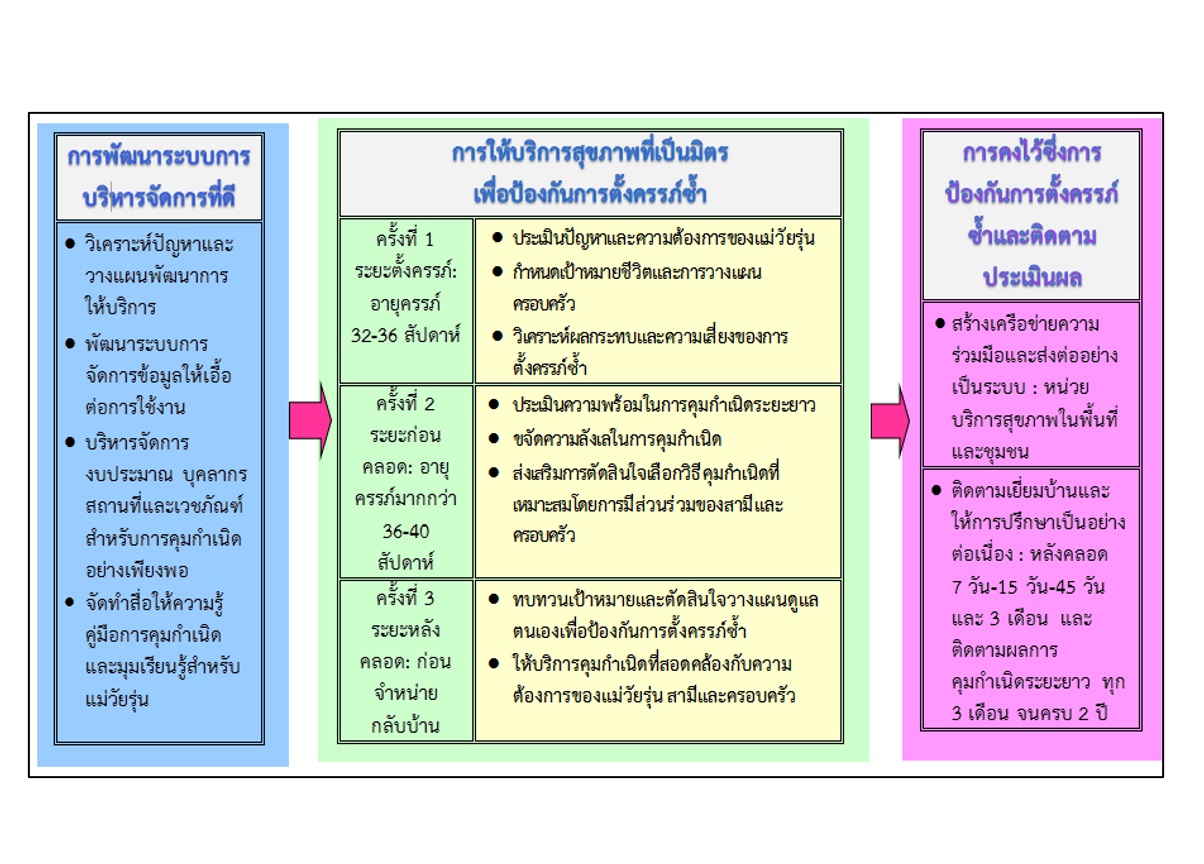
2. The developed model consisted of 3 main processes: a) developing management system, b) providing amicable care service for preventing repeat pregnancy, and c) repeat pregnancy prevention maintenance, follow-up evaluation, and consultation until 2 years after childbirth.
3. The effectiveness of developed model was evaluated by: a) the availability of long term contraception in adolescent mothers whose post-experiment's increased from pre-experiment’s at .001 statistical significant level (p<.001), b) the adolescent mothers’ satisfaction about received care service, which was at very good level (M=4.55, SD=0.49), c) the percentage of adolescent mothers with semi-permanent contraception within 3 months after childbirth, which was 67%, and d) the percentage of repeat pregnancy within 2 years in adolescent mothers, which was 10%, not exceeding department of health’s limit.
Potential development of multidisciplinary teams in consultation, husband and family participation on apparent life goal decision and family planning would help adolescent mothers decide a proper long term contraceptive method.
References
Agency for Clinical Innovation. (2013). Understanding the Process to Develop a Model of Care: An ACI Framework. Retrieved July 1, 2017, from https://www.aci.health.nsw.gov.au/__data/assets/pdf_file/0009/181935/HS13-034_Framework-DevelopMoC_D7.pdf
Albuquerque, A. P., Pitangui, A. C., Rodrigues, P. M., & Araújo, R. C. (2017). Prevalence of Rapid Repeat Pregnancy and Associated Factors in Adolescents in Caruaru, Pernambuco. Rev. Bras. Saúde Matern Infant, Recife, 17(2), 347-354. DOI:10.1590/1806-93042017000200008
Bandura, A. (1997). Self-Efficacy: The Exercise of Control. New York: W.H. Freeman
Best, J. W., & Kahn, J. V. (2006). Research in Education. (3rd ed). New Jersey: Pearson Prentice Hall.
Chunthawanich, S. (2010). Qualitative Research Methodology (17th ed). Bangkok: Chulalongkorn University. (in Thai)
Clarke, J. G., Gold, M. A., Simon, R. E., & Stein, L, A. R. (2012). Motivational Interviewing with Computer Assistance as an Intervention to Empower Women to Make Contraceptive Choices While Incarcerated: Study Protocol for a Randomized Controlled Trial. Trials, 13(101), 1-8. doi: 10.1186/1745-6215-13-101
Cohen, J. (1988). Statistical Power Analysis for the Behavioral Sciences. Hillsdale, New Jersey: Lawrence Erlbaum Associates.
Dallas, C. M. (2013). Rapid Repeat Pregnancy among Unmarried, African American Adolescent Parent Couples. West J Nurs Res, 35(2), 177-92.
Department of Health, Department of Mental Health & Department of Disease Control Ministry of Public Health. (2012). Standard of Comprehensive Youth Friendly Health Services and Self-Assessment Questionnaire. Bangkok: UNFPA. (in Thai)
Faul, F., Erdfelder E., Lang A. G., & Buchner, A. (2007). G* Power 3: A Flexible Statistical Power Analysis Program for the Social, Behavioral, and Biomedical Sciences. Behavior Research Methods 2007, 39(2), 175-91. Available at https://www.psychologie.hhu.de/fileadmin/redaktion/Fakultaeten/Mathematisch-Naturwissenschaftliche_Fakultaet/Psychologie/AAP/gpower/GPower31-BRM-Paper.pdf
Hair, F. J., Black, C. W., Babin, J. B., & Anderson, E. R. (2010). Multivariate Data Analysis (7th ed). New Jersey: Pearson Education.
Konchaiw, N., Nirattharadorn, M., Buaboon, N., & Sanguanklin, N. (2018). Effects of a Self-Efficacy Promotion Program and Husband Participation on the Repeated Pregnancy Prevention Behaviors among Adolescent mothers. Journal of The Royal Thai Army Nurses, 19(supplement), 326-335. (in Thai)
Krippendorff, K. (2013). Content Analysis: An Introduction to Its Methodology. 3rd Edition. LA: SAGE Publication.
Lewis, D. A., Martins, S. L., & Gilliam, M. L. (2012). Partner Roles in Contraceptive Use: What do Adolescent Mothers Say? J Pediatr Adolesc Gynecol, 25(6), 396-400.
Lewis L. N., Doherty D. A., Hickey, M., & Skinner, S. R. (2010). Predictors of Sexual Intercourse and Rapid-Repeat Pregnancy among Teenage Mothers: an Australian Prospective Longitudinal Study. Med J Aust, 193(6), 338-42.
Maravilla, J. C. (2016). The Role of Community Health Workers in Preventing Adolescent Repeated Pregnancies and Births. Journal of Adolescent Health, 59, 378-90.
Miller, W, R., & Rollnick, S. (1995). What is Motivational Interviewing? Behavioural and Cognitive Psychotherapy, 23, 325-34.
Ministry of Public Health. (2014). Standard of Youth Friendly Health Services (Integrated Version) and Self-Assessment Questionnaire. Bangkok: UNFPA. (in Thai)
Norton, M., Chandra-Mouli, V., & Lane, C. (2017). Interventions for Preventing Unintended, Rapid Repeat Pregnancy among Adolescents: A Review of the Evidence and Lessons from High-Quality Evaluations. Global Health: Science and Practice, 5(4), 547-570.
Petersen, R., Albright, J., Garrett, J. M., & Curtis, K. M. (2007). Pregnancy and STD Prevention Counseling Using an Adaptation of Motivational Interviewing: a Randomized Controlled Trial. Perspectives on Sexual and Reproductive Health, 39(1), 21-28.
Phetchaburi Provincial Public Health Office. (2016). Summary of Public Health Supervision. Phetchaburi: Phetchaburi Provincial Public Health Office.
Phetchaburi Provincial Public Health Office. (2017). Summary of Public Health Supervision. Phetchaburi: Phetchaburi Provincial Public Health Office.
Rollnick, S., Mason, P., & Butler, C. (1999). Health Behavior Change: A Guide for Practitioners. Edinburgh: Churchill Livingstone.
Shah, M., Prajapati, S., & Sheneeshkumar, V. (2012). Adolescent Pregnancy: Problems and Consequences. AngdoAledicine, 9(3), 176-80.
Srisathidnarakoon, B. (2553). The Methodology in Nursing Research 5th edition. Bangkok: U & I Intemedia. (in Thai)
Srivilai, K. (2016). Repeated Pregnancy among Adolescents: A Case Study in a Community Hospital, Southern Thailand. The Southern College Network Journal of Nursing and Public Health, 3(3), 142-152. (in Thai)
The Bureau of Reproductive Health, Ministry of Public Health. (2017). Reproductive Situation in Teenage. Retrieved Aug 30, 2018, from http://rh.anamai.moph.go.th/download /all_file/brochure/FinalAW.pdf (in Thai)
UNICEF. (2015). Situation Analysis of Teenage Pregnancy in Thailand. UNICEF, Bangkok.
UNFPA. (2015). Girlhood, Not Motherhood: Preventing Adolescent Pregnancy. New York: UNFPA.
WHO. (2012). Making Health Services Adolescent Friendly: Developing National Quality Standards for Adolescent Friendly Health Services. Geneva: WHO.
WHO. (2014). Adolescent Pregnancy. Retrieved December 19, 2020, from https://www.who.int/ news-room/fact-sheets/detail/adolescent-pregnancy
Downloads
Published
Issue
Section
License
1. บทความหรือข้อคิดเห็นใด ๆ ที่ปรากฏในวารสารเครือข่าย วิทยาลัยพยาบาลและการสาธารณสุขภาคใต้ ที่เป็นวรรณกรรมของผู้เขียน บรรณาธิการหรือเครือข่ายวิทยาลัยพยาบาลและวิทยาลัยการสาธารณสุขภาคใต้ ไม่จำเป็นต้องเห็นด้วย
2. บทความที่ได้รับการตีพิมพ์ถือเป็นลิขสิทธิ์ของ วารสารเครือข่ายวิทยาลัยพยาบาลและการสาธารณสุขภาคใต้