Analysis of the Elderly Clubs Capacity in Southern Region for Moving Towards Active Aging
Keywords:
Capacity of elderly clubs, Elderly club, Active agingAbstract
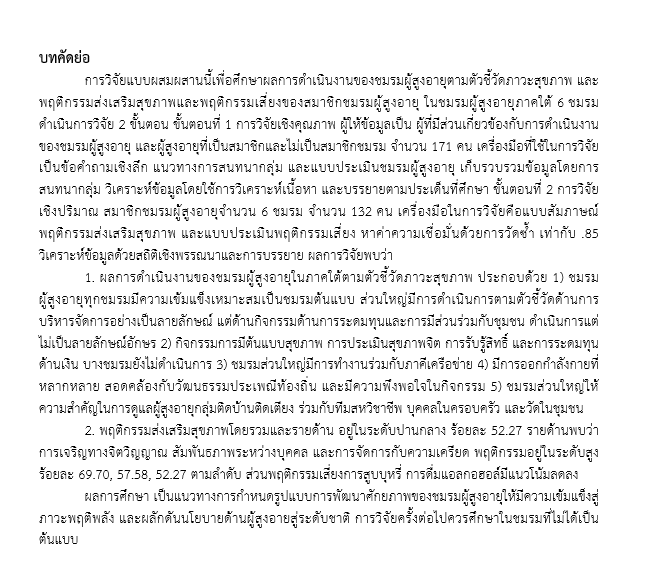
This mixed method research aimed to determine the implementation outcomes of the elderly clubs according to health indicators, health promoting behaviors, and risky behaviors among the elderly club members of the 6 elderly clubs in Southern region. Research implementation had 2 phases. Phase 1: Qualitative research, informants were those who who were involved in implementation of the elderly clubs and who were member and non-member of the elderly clubs with a total of 171. Research instruments included in-depth interview questions, guided focus group, and elderly club assessment questionnaire. Data were collected through focus group discussion and were analyzed using content analysis and description according to the topics of study. Phase 2: Quantitative research, sample were 132 the elderly club members of the 6 elderly clubs. Research instruments were health promoting behavior questionnaire and risky behavior questionnaire which had test-retest reliability of .85. Data were analyzed using descriptive statistics and description. Results revealed as follows;
1. The implementation outcomes of the elderly clubs according to health indicators consisted of 1) all elderly clubs were strengthened club for the prototype. Most elderly clubs implemented according to written administration indicator. However, club activities, fund raise, and community participation were not implemented with written administration indicator. 2) Health model activities, mental health assessment, perception of right, and fund raise were not implemented for some clubs. 3) Most clubs collaborated with networks. 4) Various types of exercise which were congruent with local culture and tradition and satisfaction of activities. 5) Most clubs emphasized care of the bed-bound elderly working in conjunction with multidisciplinary team, family members, and temples in community.
2. Overall and each aspect of health promoting behaviors were at a moderate level (52.27%). For each aspect, it was found that spiritual growth, interpersonal relationship, and stress management, behaviors were at a high level (69.70%, 57.58%, 52.27%, respectively). Risky behaviours of smoking and alcohol drinking tended to reduce.
The study findings indicated guideline for capacity development model of the elderly clubs for moving towards active aging and pushing national elderly policy. Further research should investigate clubs that are not the prototype.
References
ACSM. (2001). ACSM’S Resourse Manual for Guideline for Exercise Testing and Prescription. Philadelphia: Lippincott Williams & Wilkins.
Avani, S. (2010). Public Health Management of The Violent Situation in The Southern Border Princes. Nonthaburi: Health System Research Institute. (in Thai)
Bandura, A. (1986). Social Foundations of Thought and Action: A Social Cognitive Theory. Engle Wood Cliffs, N. J. Prentice.
Chumkaew, K., & Rangsiyatorn, C. (2014). Knowledge Attitude and Food Consumption Behaviors among Elders in Songkhla Province. Kasetsart Journal, 35, 16-29. (in Thai)
Chunharusamee, (2010). Situation of Thai Elderly. Foundation of Thai Gerontology Research and Development Institute. 2008.
College of Population Studies, Chulalongkorn University & Foundation of Thai Gerontology Research and Development Institute. (2013). The Report of the Situation of the Elderly in Thailand 2012. Nonthaburi: Es-Es Plus Media. (in Thai)
Krejcie, R. V., & Morgan, D. W. (1970). Determining Sample Size for Research Activities. Journal of Educational and Psychological Measurement, 30(3), 607-610.
Naka, K., Taboonpong, S., & Khupantavee, N. (2004). Exercise among Elderly Living in Songkhla Province. Songklanagarind Journal of Nursing, 24(3), 213-229.
National Statistical Office. (2014). The Majors Results of Drinking and Smoking Behaviors among Thai Population. Retrieved from http://service.nso.go.th/nso/nsopublish/themes/ files/smokeRep57.pdf. Retrieved from http: //216.185.112.5/presenter. Jhtml?identifer=4559. (in Thai)
Panuthai, S., Sucamvang, K., & Lasuka, D. (2008). Predictive Factors of Behavioral Modification of the Chronically Ill Elderly in Northern Region of Thailand. Faculty of Nursing, Chiang Mai University: Chiang Mai, Thailand. (in Thai)
Panya, P., Sethabouppha, H., & Jormsri, P. (2013). Experiences of Relapsing among, Elderly with Alcohol Dependence. Nursing Journal, 40(4), 45-55. (in Thai)
Pender, N. J., Murdaugh, C., & Parsons, M. A. (2006). Health Promotion in Nursing Practice (4th ed.). New Jersey: Upper Saddle River.
Polit, D. F., & Hungler, B. P. (1999). Nursing Research: Principles and Methods. (6th ed.). Philadelphia: Lippincott.
Pothiban, L. (2000). Risk Factor Prevalence, Risk Status and Perceive Risk for Coronary Heart Disease among Thai Elderly. Nursing Newsletter, 27(2), 16-28.
Pothiban, L. (2002). Health Promotion Model for Chiangmai Population. Unpublished Research Report.
Senior Citizens Council of Thailand. (2009b). National Policy on Senior Citizens Council of Thailand 2011-2015. Retrieved from https://dl.dropboxusercontent.com/u/50326557/ Khukhan-elderly-club22554-2558.pdf. (in Thai)
Sungkachat, B., Chantaveemuaeng, V., & Chuseang, S. (2012). Health Promoting Behaviors of Elderly in the Elderly Club of Songkhla Municipality. Retrieved from
httpp://1.179.130.166/manage/Research_pic/20121220170955.docx. (in Thai)
The National Committee for the Elderly. (2009).The 2nd National Committee for the Elderly (2002 – 2021) The 1st Revised Version (2009). Bangkok: Teppenvanits. (in Thai)
Walker, S. N., Sechrist, K. R., & Pender, N. J. (1987). The Health-Promoting Lifestyle Profile: Development and Psychometric Characteristics. Nursing Research, 36(2), 76-81.
Warahut, J., & Chitviboon, A. (2010). Health Promoting Behaviors of Elderly in the Elderly Club of Boromarajonani College of Nursing, Songkhla. Boromarajonani College of Nursing, Songkhla Reported. (in Thai)
Wonglamthong, S. (1999). Personal Factors Perceived Benefits of Health Promoting Behaviors and Health Promoting Behaviors of the Elderly. Master’s Thesis, Faculty of Graduate Studies, Chiang Mai University.
World Health Organization. (2002). Active Ageing: A Policy Framework (WHO/NMH/NPH/02.8). Retrieved from http://www.unati.uerj.br/doc_gov/destaque/Madri2.pdf.
Downloads
Published
Issue
Section
License
1. บทความหรือข้อคิดเห็นใด ๆ ที่ปรากฏในวารสารเครือข่าย วิทยาลัยพยาบาลและการสาธารณสุขภาคใต้ ที่เป็นวรรณกรรมของผู้เขียน บรรณาธิการหรือเครือข่ายวิทยาลัยพยาบาลและวิทยาลัยการสาธารณสุขภาคใต้ ไม่จำเป็นต้องเห็นด้วย
2. บทความที่ได้รับการตีพิมพ์ถือเป็นลิขสิทธิ์ของ วารสารเครือข่ายวิทยาลัยพยาบาลและการสาธารณสุขภาคใต้