Development of Game-Based Learning Model for Medical Coding I Class with Students in Diploma of Medical Record in Kanchanabhishek Institute of Medical and Public Health Technology
Keywords:
Instructional development, Game-Based Learning Model, Medical Coding ClassAbstract
This research and development study aimed to describe learning situations in order to develop an instructional game-based model for Medical Coding I class, and to evaluate the effects of the instructional model on knowledge of students in Diploma of Medical Record. There were 3 main steps in this study. Firstly, a learning situation was carried out using focus group discussion among 6 students in their second year, as well as 6 instructors. Secondly, the draft of an instructional game-based model was evaluated by three experts, in order to improve its proprieties and the possibility of developing an effective instructional model. Lastly, the effects of the instructional model on the knowledge of students was measured. The first year students were randomly assigned in a control group or an experimental group (50 students per group). Descriptive statistics, independent t-test and paired t-test were used to analyze data. The results of this study were as follows.
In terms of the learning situation analysis, students in Medical Coding I class reported that the lecture on the ICD-10 medical coding was boring. Moreover, at the end of the class activities, the students were not enthusiastic about finding out the answers. They were waiting to get the answer keys from instructors. Students wanted learning activities that would encourage them to improve their knowledge and memory.
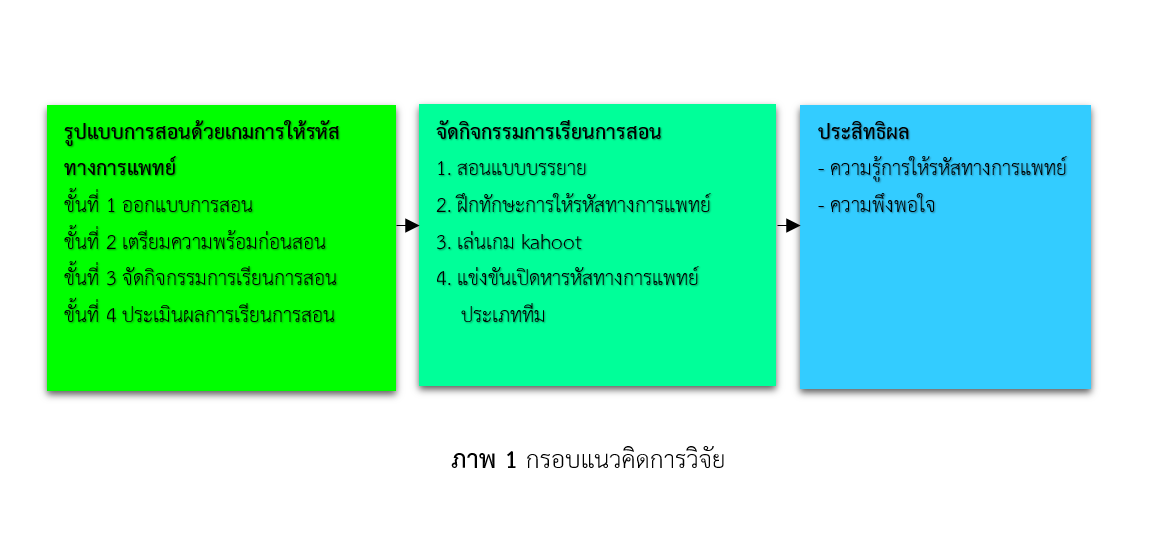
The developed game-based instructional model consisted of various activities, such as “Kahoot online program”, and “finding medical coding” competition game.
The knowledge score after using the model was higher than before using the model at the statistically significant level of .001. Moreover, the mean score on knowledge was higher after using the model (M=24.70, SD=3.68) than before (M=17.76, SD=2.99), at the significant level of .001. The game-based teaching technique on Medical Coding I Course can apply to improve class activity which is appropriate for students. Moreover, it is easy to add up some questions, and content.
References
Kaewkongphan, D. (2009). Using Games to Develop Science Process Skills of Grade Level 3 Students. Bachelor of Education College Chiang Mai University. (in Thai)
Khemmanee, T. (2004). 14 Teaching Methods for Professional Teachers. (12th ed.) Bangkok: Publisher of Chulalongkorn University. (in Thai)
Khemmanee, T. (2007). Teaching Science: Knowledge for the Process of Learning Management is Effective. (6thed.) Bangkok: Publisher of Chulalongkorn University. (in Thai)
Krachadthong, S. (2012). The Development of Computer Assisted Instruction: Game Type Subject Basic of Computer on Component of Computer for Mathayomsuksa 2 Students of Sriprachan Methipramuk School. Suphanburi Provice, Silpakorn University. (in Thai)
Moolcome, S., & Moolcome, O. (2007). 19 Learning Management Methods for Developing Knowledge and Skills. Bangkok: Publisher of Paphim. (in Thai)
Nicmanon, P. (2000). Evaluation and test Construction. Bangkok: Publisher of Aksarapipat. (in Thai)
Singwiratham, N. (2019). The Development of an Instructional Model Based on Didactic Teaching by Using VARK Learning Styles on Analytical Thinking on Public Health Program in Community Health, Supanburi. The Southern College Network Journal of Nursing and Public Health, 6(3), 27-40. (in Thai)
Upakrankew, K. (2019). The Result of Teaching by Using Kahoot Application on Science Learning Achievenment on the Diversity of Life for Grade 4 Students at Raibon School. Graduate Diploma (Teaching Profession) Southern Technological College. (in Thai)
World Health Organization. (2016). International Statistical Classification of Diseases and Related Health Problems 10th Revision. Geneva. Fifth Edition.
Downloads
Published
Issue
Section
License
1. บทความหรือข้อคิดเห็นใด ๆ ที่ปรากฏในวารสารเครือข่าย วิทยาลัยพยาบาลและการสาธารณสุขภาคใต้ ที่เป็นวรรณกรรมของผู้เขียน บรรณาธิการหรือเครือข่ายวิทยาลัยพยาบาลและวิทยาลัยการสาธารณสุขภาคใต้ ไม่จำเป็นต้องเห็นด้วย
2. บทความที่ได้รับการตีพิมพ์ถือเป็นลิขสิทธิ์ของ วารสารเครือข่ายวิทยาลัยพยาบาลและการสาธารณสุขภาคใต้