Development of a Cognitive Screening Process for Older Adults in Community
Keywords:
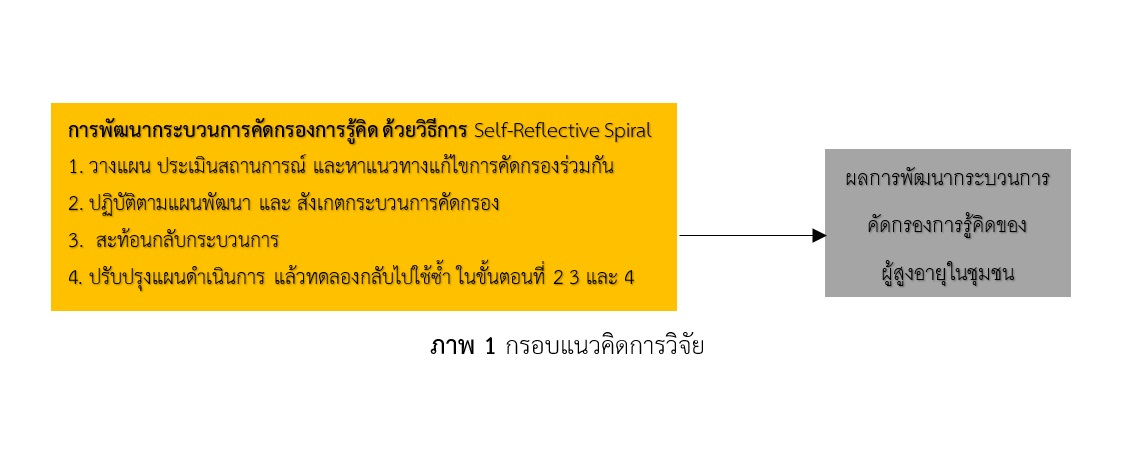
The Abbreviated Mental Test, Cognitive Screening Administration, Older Adults in CommunityAbstract
This research and development study aimed to 1) describe the situation of a cognitive screening, 2) develop a process for administrative cognitive screening, 3 validate an Abbreviated Mental Test (AMT), and 4) evaluate the outcomes of administrative cognitive screening in the community. Participants were 446 older adults recruited by cluster sampling from 200,481 adults aged more than 60 years. Measurement included a cognitive screening administration project, an Abbreviated Mental Test (AMT), a Mini-Mental State Examination, a Self-report checklist, as well as an aging survey database for Udonthani. Data were analyzed using descriptive statistics and content analysis. The study found that 1) The initial cognitive screening in the annual health examination, performed by volunteer health workers with the AMT test, found cognitive impairment in only 1.1% of the sample and 84.2% of nurses in district health promotion hospital did not have experience with cognitive screening. 2) A process for administrative cognitive screening was developed by educating the nurses and other health personnel, practicing cognitive screening and how to enter data to database and periodic evaluation. 3) The validation of the AMT test revealed that some items were contextual and cultural limitations and not appropriate for older adults in the community. 4) After training, AMT was examined to the same older adult sample, cognitive impairment was found almost 24 times greater. Most nurses and health personnel were able to administer cognitive screening according to the guidelines, except having an appropriate area to do the test. The sample population suffering from cognitive impairment, as defined by MMSE, was 12.3%. Most older adults felt more comfortable and confident having the screening test administered by trained health personnel than volunteer health workers who they felt were not as professional in giving this test. Therefore, we suggest that the Thai AMT should be modified so an appropriate screening tool would produce a scale that measures more adequately. Cognitive screening should be administered by trained nurses.
References
Alzheimer’s Disease International. (2019). World Alzheimer Report 2019: Attitude to Dementia. London: Alzheimer’s Disease International
Chayovan, N., & Knodel, J. (1993). Age and Birthdate Reporting in Thailand: Evidence from the 1987 Demorgraphic and Health Survey. Retrieved from Columbia, Maryland
Department of Medical Services Ministry of Public Health Thailand. (2015). Geriatric Screening and Assessment Tool Kit. Bangkok: WVO Officer of Printing Mill.
Folstein, M. F., Robins, L. N., & Helzer, J. E. (1983). The Mini-Mental State Examination. Arch Gen Psychiatry, 40(7), 812.
Foroughan, M., Wahlund, L. O., Jafari, Z., Rahgozar, M., Farahani, I. G., & Rashedi, V. (2017). Validity and Reliability of the Abbreviated Mental Test Score (AMTS) among Older Iranian. Psychogeriatrics, 17(6), 460-465.doi:10.1111/psyg.12276
Hodkinson, H. M. (1972). Evaluation of a Mental Test Score for Assessment of Mental Impairment in the Elderly. Age Ageing, 1(4), 233-238.
Institute of Geriatric Medicine Department of Medical Services Ministry of Public Health. (2008). Medical Technology Assessment: A Comparison of Mini-Mental State Examination-Thai (MMSEThai) 2002 and Thai Mini-Mental State Examination (TMSE) for Screening Older Persons with Dementia. Retrieved from Nonthaburi.
Jitapunkul, S., Pillay, I., & Ebrahim, S. (1991). The Abbreviated Mental Test: Its Use and Validity. Age Ageing, 20(5), 332-336.
Julayanont, P., Tangwongchai, S., Hemrungrojn, S., Tunvirachaisakul, C., Phanthumchinda, K., Hongsawat, J., et al, (2015). The Montreal Cognitive Assessment-Basic: A Screening Tool for Mild Cognitive Impairment in Illiterate and Low-Educated Elderly Adults. J Am Geriatr Soc, 63(12), 2550-2554. doi:10.1111/jgs.13820
Kardtip, T., Monkong, S., & Malathum, P. (2019). Health Status of Older Adults with Cognitive Impairmen. Journal of Thai Nursing and Midwifery Council, 34(1), 104-121.
Kemmis, S., McTaggart, R., & Nixon, R. (2014). The Action Research Planner: Doing Critical Participatory Action Research. NewYork: Springer.
Kongkirati, P. (2005). And Then the Movement Appears Politics and Culture of Students and Scholars Before 14 October (in Thai). Bangkok: Thammasat University Press.
Kusalaruk, P., & Nakawiro, D. (2012). A Validity Study of the Mini-Cog Test in Thai Dementia Patients. Ramathibodi Medical Journal, 35(4), 264-271.
Ministry of Public Health. (2014). The Guideline of Health Data Center Version 2.0. Nonthaburi: Information and Communications Technology Center.
Ministry of Public Health (2019). Health Data Center. Retrieved November 17th, 2019 from https://hdcservice.moph.go.th/hdc/reports/report.php?
source=pformated/format1.php&cat_id=6966b0664b89805a484d7ac96c6edc48&id=df0700e8e3c79802b208b8780ab64d61
Ministry of Public Health (2020). Health Data Center. Retrieved February 25th, 2020 from https://hdcservice.moph.go.th/hdc/reports/report.php?source=pformated/format1.php&cat_id=6966b0664b89805a484d7ac96c6edc48&id=df0700e8e3c79802b208b8780ab64d61
Nakawiro, D., Chansirikar, S., Srisuwan, P., Aebthaisong, O., Sudsakorn, P., Vidhyachak, C., et al. (2017). Group-Based Training of Executive Function, Attention, Memory and Visuospatial Function (Team-V) in Patients with Mild Neurocognitive Disorder. J Psychiatr Assoc Thailand, 62(4), 337-348.
Nicoles, E. (2018). Global, Regional, and National Burden of Alzheimer's Disease and Other Dementias, 1990-2016: a Systematic Analysis f the Global Burden of Disease Study 2016. Lancet Neurol, 18(1), 88-106. doi:10.1016/s1474-4422(18)30403-4
Petersen, R. C., Lopez, O., Armstrong, M. J., Getchius, T. S. D., Ganguli, M., Gloss, D, et al. (2018). Practice Guideline Update Summary: Mild Cognitive Impairment: Report of the Guideline Development, Dissemination, and Implementation Subcommittee of the American Academy of Neurology. Neurology, 90(3), 126-135. doi:10.1212/WNL.0000000000004826
Piotrowicz, K., Romanik, W., Skalska, A., Gryglewska, B., Szczerbinska, K., Derejczyk, et al. (2018). The Comparison of the 1972 Hodkinson's Abbreviated Mental Test Score (AMTS) and its variants in screening for cognitive impairment. Aging Clin Exp Res. doi:10.1007/s40520-018-1009-7
Prasartkul, P., Vapattanawong, P., Rittirong, J., Chuanwan, S., Kanchanachitra, M., Jaratsit, S., et al. (2019). The Situation of the Thai Elderly in 2017. Bangkok: Institute for Population and Social Research, Mahidol University and Foundation of Thai Gerontology Research and Development Institute (TGRI).
Rocca, W. A., Bonaiuto, S., Lippi, A., Luciani, P., Pistarelli, T., Grandinetti, A., et al (1992). Validation of the Hodkinson Abbreviated Mental Test as a Screening Instrument for Dementia in an Italian Population. Neuroepidemiology, 11(4-6), 288-295. doi:10.1159/000110943
Soontreewong, S., Suwan, P., Jantharamolee, S., & Srisupanan, M. (2019). Development of a Model for Improving Job Performance of Village Health Volunteers from in Trang Municipality, Trang Province. The Southern College Network Journal of Nursing and Public Health, 6(1) 75-88.
Taherdoost, H. (2017). Determining Sample Size; How to Calculate Survey Sample Size International Journal of Economics and Management Systems, 2.
Trongsakul, S., Lambert, R., Clark, A., Wongpakaran, N., & Cross, J. (2015). Development of the Thai Version of Mini-Cog, a Brief Cognitive Screening Test. Geriatrics & Gerontology International, 15(5), 594-600. doi:10.1111/ggi.12318
World Health Organization. (2017). Global Action Plan on the Public Health Response to Dementia 2017–2025. Geneva: World Health Organization.
World Health Organization. (2019). Fact Sheet on Dementia. Geneva. World Health Organization.
Downloads
Published
Issue
Section
License
1. บทความหรือข้อคิดเห็นใด ๆ ที่ปรากฏในวารสารเครือข่าย วิทยาลัยพยาบาลและการสาธารณสุขภาคใต้ ที่เป็นวรรณกรรมของผู้เขียน บรรณาธิการหรือเครือข่ายวิทยาลัยพยาบาลและวิทยาลัยการสาธารณสุขภาคใต้ ไม่จำเป็นต้องเห็นด้วย
2. บทความที่ได้รับการตีพิมพ์ถือเป็นลิขสิทธิ์ของ วารสารเครือข่ายวิทยาลัยพยาบาลและการสาธารณสุขภาคใต้