Learning Management Guidelines for Using PBL with Nursing Students
Keywords:
Problem-Based Learning, Learning Management, PBL, Nursing StudentsAbstract
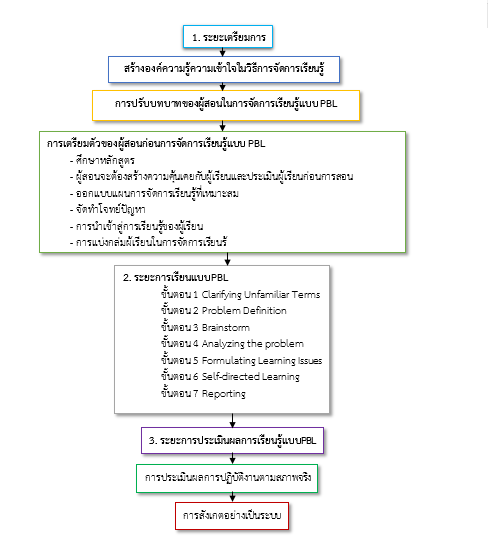
Problem-based learning (PBL) is a student-centered pedagogy in which students learn about a subject through the experience of solving an open-ended problem found in trigger material. The PBL process does not focus on problem solving with a defined solution, but it allows for the development of other desirable skills and attributes. This includes knowledge acquisition, enhanced group collaboration and communication. The PBL process was developed for medical education. It is therefore a suitable teaching method for nursing students to learn how to be a knowledgeable worker and a learning person. Nursing students must develop skills such as critical thinking, communication, adaptation, acceptance of patients’ feelings, and working together with others in a healthcare team as well as nursing care based on caring principles. Teachers should have proper knowledge and understanding of PBL, in order to reach the highest learning achievements. This article aims to present learning management guidelines for using PBL with nursing students. Guidelines have 3 phases, including: 1) phase of preparation, 2) phase of PBL consisting of 7 steps, 3) phase of evaluation of PBL, using authentic assessment and systematic observation. These learning management guidelines for using PBL with nursing students include preparation material for teachers and students, and learning resources. They also include continuous learning activities to develop critical thinking learning, which leads to lifelong learning.
References
Ar-yuwat, S. (2017). Problem-Based Learning (PBL): The Challenges of Nursing Education to Foster The 21st Century Learning Nursing. Journal of the Ministry of Public Health, 27(2), 15-30. (in Thai)
Bachelor of Nursing Science Program B.E. (2016). Boromarajonani Nursing Colleage, Songkhla.
FakKhao, S. (2015). 21st Century Skills. [Internet] .2015 {cited 2019 May 9}. Retrieved from http://web.chandra.ac.th/blog/wp-content/uploads/2015/10/21st Century Skills.pdf
Katwibun, D. (2009). Problem-Based Learning Approach (PBL) in Education Research. Journal of Education and Research Volume, 6(1), 14-22. (in Thai)
Ken Masters. (2013). Edgar Dale's Pyramid of Learning in medical education: A Literature Review. Journal Medical Teacher, 35(11), e1584-e1593.
Lekhakula, A. (2015). Problem-Based Learning. [internet] .2015 {cited 2018 Jan 15}. Retrieved from http://teachingresources.psu.ac.th/document/2548/Le_Kha_Kun/PBL.pdf. (in Thai)
Ministry of Education, (1999). National Education Act. Office of the National Education Commission and Office of Prime Minister, Thailand.
Mohamed Ali. W. G. El Sedi. NAM. (2010). Effect of Problem Based Learning on Nursing Students. Approaches to Learning and Their self Directed Learning Abilities. International Journal of Academia research, 2(4), 185-195.
Pailitponganpim, P. (2012). New Future Skills: Education for the 21st Century 21st Century Skills: Rethinking How Students Learn (Editors: James Bellanca and Ron Brandt) Open Worlds PBL.WU Newsletter Walailak University, 5(1), 19 (in Thai)
Puttiwanit, N. (2017). Effect of Problem-Based Learning on Intellectual skills of Nursing Student in Nursing of Persons with Health Problems 1 subject. The Southern College Network Journal of Nursing and Public Health, 4(1), 1-14. (in Thai)
Sanguanthai, K. (2011). Active Learning. PBL. WU Newsletter Walailak University, 4(2), 4-6. (in Thai)
Sirisupluxana, P. (2013). Teaching Nursing Students to Develop Critical Thinking Skills. The Journal of Boromarajonani College of Nursing, Nakhonratchasima, 19(2), 5-19. (in Thai)
Suwannoi, P. (2016). Problem–Based Learning: PBL. [Internet] . Retrieved June 12, 2012 from https://ph.kku.ac.th/thai/images/file/km/pbl-he-58-1.pdf. (in Thai)
Thabet, M. (2017). Effect of Problem Based Learning Management on Critical Thinking Skills of Nursing Students. The Influence of Problem Based Learning on Critical Thinking Skills of Nursing Students. Journal of nursing and education, 5(2), 32-45. (in Thai)
Thiankamsri, K., & Sitisongkrame, S. (2015). Problem-Based Learning on Knowledge of Diabetes Mellitus Care Among Nursing Students. Annual national academic Conferencein 2015: Diversity in Health and Well-Being.
Wanchai, A., Kaewsasri, A., Kuljoo, A., & Vichitkaew, N. (2018). The Effects of the Project Based-Learning on Reflection Thinking’s Behaviors of Nursing Students. Songklanagarind Journal of Nursing, 38(2), 11-19. (in Thai)
Downloads
Published
Issue
Section
License
1. บทความหรือข้อคิดเห็นใด ๆ ที่ปรากฏในวารสารเครือข่าย วิทยาลัยพยาบาลและการสาธารณสุขภาคใต้ ที่เป็นวรรณกรรมของผู้เขียน บรรณาธิการหรือเครือข่ายวิทยาลัยพยาบาลและวิทยาลัยการสาธารณสุขภาคใต้ ไม่จำเป็นต้องเห็นด้วย
2. บทความที่ได้รับการตีพิมพ์ถือเป็นลิขสิทธิ์ของ วารสารเครือข่ายวิทยาลัยพยาบาลและการสาธารณสุขภาคใต้