Effects of a Participatory Promotion Program for Early Adolescents on Sex Education, Life Skills, and Unplanned Pregnancy Preventing Behaviors
Keywords:
Participatory Life Skills Promotion Program, Sex Education, Unplanned Pregnancy Preventing Behavior, Early AdolescentsAbstract
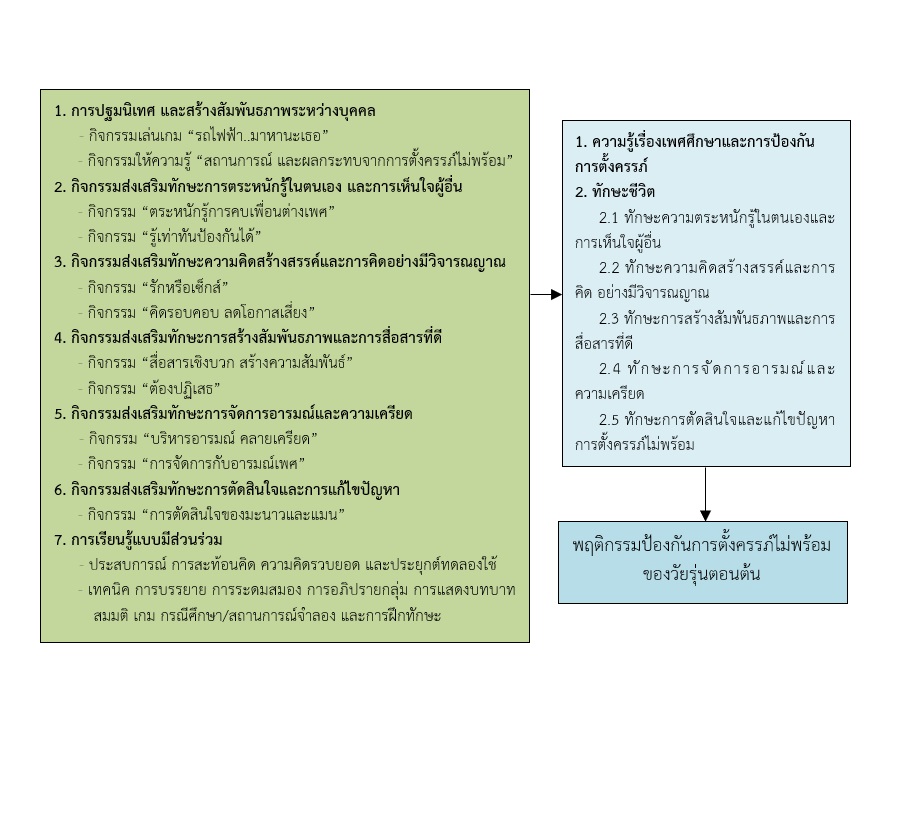
The purposes of this quasi-experimental research, two group pretest-posttest design, were to compare the knowledge about sex education, life skills, and unplanned pregnancy preventing behaviors among early adolescents. Participants were 50 students who were in grade 8, and enrolled in the academic year of 2018 at a secondary school in Thungsong district of Nakhonsrithammarat province. They were selected using simple random sampling technique, and then randomly assigned into either in an experimental or comparative group 25 participants/group). The G* power program was used. Duration of participatory life skills promotion program, which was developed based on the life skills as defined by the Mental Health Department, was 6 weeks. Research consisted of a handbook with worksheets for using the program, as well as questionnaires which comprised 3 parts: a) knowledge about sex education, b) life skills, and c) unplanned pregnancy preventing behaviors. Content validity yielded values of .97, .98, and .94, respectively while reliability of three parts of the questionnaire were .60, .90, and .70, respectively. Data were analyzed by descriptive statistics and t-test.
The result revealed that after attending the program, in the experimental group, knowledge about sex education (M=8.08, SD=1.15), life skills (M=319.12, SD=6.36), and unplanned pregnancy preventing behaviors (M=93.92, SD=3.79) of early adolescents were statistically significant higher than before attending the program (M=5.80, SD=1.44, M=278.40, SD=20.49, and M=77.88, SD=5.55) (p<.001). The experimental group had also statistically significant higher knowledge about sex education, life skills, and unplanned pregnancy preventing behaviors than in the comparative group (p<.001) after attending the program (M=5.92, SD=1.07, M=292.80, SD=20.27, and M=74.88, SD=5.55, respectively).
The findings suggest that this participatory life skills promotion program for preventing unintended pregnancy in early adolescents should be applied in schools to promote sex education, resulting in preventing teenage pregnancy among students.
References
Bloom, B. S., Hastings, T. J., & Madaus, G. F. (1971). Hand Book on Formative and Summative Evaluation of Student Learning. New York: McGraw – Hill Book Compaany Inc.
Chiraporn, A. (2017). Safe Sex. Retrieved October 30, 2018 from https://med.mahidol.ac.th/ ramachannel/home/article/safe-sex-.
Cohen, J. (1988). Statistical Power Analysis for the Behavioral Sciences. 2nd ed. Hillsdale, New York: Lawrence. Erlbaum Associates, Publishers.
Department of Mental Health, Ministry of Public Health. (2000). Participatory Learning Training Manual. Retrieved October 30, 2017 from www.dmp.ac.th.
HDC Permanent Secretary Office of the Permanent Secretary. (2018). HDC Annual Report 2018 Retrieved June 25, 2018. http://203.157.229.18/inspec/2561/inspec1/doc22dec/.
Jetnipit, S. (2007). The Effectiveness of Life Skills Enhancement Program and Partipatory Learning on Preventive Sexual Behaviors of Junior High School Students in One High School Muang District Khonkaen Province. A Thesis Submitted in Partial Fulfilment of the Reouirements for the Degree of Master of Public Health in Health Education and Health Promotion Graduate School, Khonkaen University. (in Thai).
Lamchiek, K. (2014). How to Prevent Unwanted Teenage Pregnancy. Journal of Boromarajonani College of Nursing, Bangkok, 30(3), 97-105.
Nedsine, P. (2009). Life Skills Promoting Program to Prevent Sexual Behavior Among Female Junior High School Students in Prajuabkirikan Province. Public Health Major in Health Education and Health Behavioral Sciences, Mahidol University. (in Thai)
PATH. (2007). Guide to Learning Process of Sex Education for Youth Level 3 Secoundary 1 Through Mattayom 3. Bangkok: Urgent Tag CO.
Phataraporn, S. (2014). Life Skills Promotion with Group Process and Reinforcement for Sexual Premature Prevention among the Sixth Grade Students. A Thesis for the Degree of Master of Public Health Graduate School, Khonkaen University. (in Thai)
Prathya, S. (2015). Teenage Pregnancy. Retrieved October 30, 2018 from https://www.slideshare.net/prachayasriswang3/ppt-51936232.
Puncharas, S. (2012). Knowledge Attitude and Pregnancy Prevention Behavior of Students Secondary Education in Nakhon Chai Burin Area. Regional Health Promotion Center 5 Journal, 6(13), 8-25. (in Thai)
Tiyapon, K. (2017). Faculty of Industriol Education and Technology King Mongkut,s Institute of Technology Ladkrabong Indicating Solutions and Prevention “Sex in Teen, Fails”. Retrieved August 30, 2017 from https://siamrath.co.th/n/9522.
Unicef Thailand. (2015). To Analyze the Situation of Teenagers in Thailand 2015-2016. Retrieved October 30, 2017 from https://www.unicef.org/thailand/th/reports /%E0%B8%.
Unicef Thailand. (2017). Analysis of the Situation of Adolescents in Thailand 2015-2516. Retrieved https://www.unicef.org/thailand/th/reports/%E0%B8%
World Health Organization. (1994). Life Skills Education for Children and Adolescents in School. Geneva Switzerland.
Downloads
Published
Issue
Section
License
1. บทความหรือข้อคิดเห็นใด ๆ ที่ปรากฏในวารสารเครือข่าย วิทยาลัยพยาบาลและการสาธารณสุขภาคใต้ ที่เป็นวรรณกรรมของผู้เขียน บรรณาธิการหรือเครือข่ายวิทยาลัยพยาบาลและวิทยาลัยการสาธารณสุขภาคใต้ ไม่จำเป็นต้องเห็นด้วย
2. บทความที่ได้รับการตีพิมพ์ถือเป็นลิขสิทธิ์ของ วารสารเครือข่ายวิทยาลัยพยาบาลและการสาธารณสุขภาคใต้