Relationships between Emotional Quotient and Alcohol Consumption among Teenagers in Mueang Lampang
Keywords:
Teenager, Alcohol Consumption, Emotional Quotient, EQ, AUDITAbstract
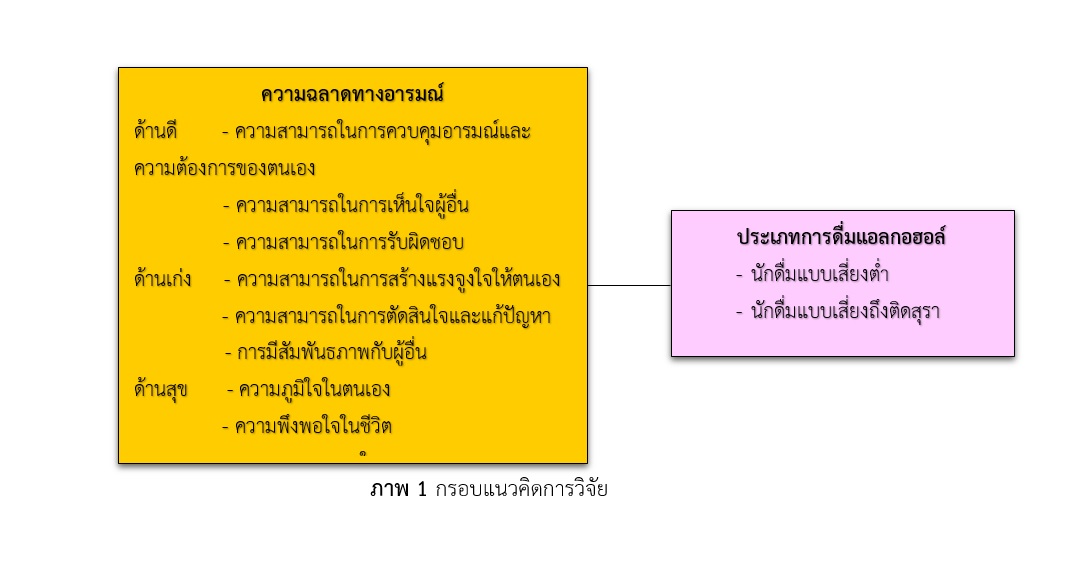
This descriptive study aimed to examine relationships between emotional quotient and alcohol consumption among teenagers in Lampang City. Participants were 444 teenagers, aged between 12-18, who were recruited from six academic institutes, using multi-stage random sampling method. Instruments included: 1) a demographic questionnaire and a questionnaire on alcohol consumption, 2) an emotional Quotient (EQ) Test, as well as 3) the Alcohol Use Disorders Identification Test (AUDIT). Cronbach’s alpha scores of 0.90 and 0.89 were reported on AUDIT and EQ, respectively. Descriptive and chi-square test were used for examining levels of EQ and different types of alcohol drinkers. Results showed the following.
1. Most of the participants (52.2%) had a normal score of Emotional Quotient.
2. About 51 % were alcohol drinkers. Most of them were male, and liked to drink beer. Participants reported that the youngest age of drinking alcohol for the first time was 12 years old. Average for their first drinking was 14.7 years old (SD=1.39). Most of them were alcohol independent (86.26%).
3. The relationship between EQ and types of alcohol drinkers was not associated (χ2=3.44, p=.58), but self-control was significantly related to some types of alcohol drinkers (χ2=5.57, p=.02).
The findings suggest that developing emotional quotient among teenagers could assist them being able to control their emotion in an appropriate manner.
References
Bogg, T., Lasecki, L., & Vo, P., (2016). School Investment, Drinking Motives, and High-Risk, High-Reward Partying Decisions Mediate the Relationship Between Trait Self-Control and Alcohol Consumption among College Drinkers. Journal of Studies on Alcohol and Drugs, 77(1), 133-142. Abstract Retired May 5, 2020 from jsad.com
Department of Mental Health. (2003). Guideline for Emotional Quotient. Retired August 20, 2019 from www.dmh.go.th. (in Thai)
Department of Mental Health. (2020). Intelligent and Emotional Quotient Survey in Primary First Year Students in B.C. 2559. Retired April 26, 2019 from www.dmh.go.th. (in Thai)
Homsin, P., & Srisuriyawet, R., (2019). Life Assets and Risk Factors among Hearing Impaired Adolescents in Central and East Thailand. The Public Health Journal of Burapha University, 14(1), 93-105. (in Thai)
Laosabcharoen, S., Sangon, S., & Nintachan, P. (2013). A Synthesis of Research on Promoting Emotional Intelligence for Adolescents. Rama Nursing Journal, 9(1), 31-47. (in Thai)
Leeviroj, P., Pichai, P., Singhasem, P., & Rungchamrat. (2016). Acceptance and Development of Alcohol Policy. Journal of Thonburi University, 10(2), 28-39. (in Thai)
Lekfuangfu, N., Tharnpanich, N., Tacharoen, K., & Witvorapong, N. (2015). Status Report on Alcoholic Beverages in Northern Region B.E. 2558. Retired August 21, 2019 from www.thaihealth.or.th. (in Thai)
Lekfuangfu, N., Tharnpanich, N., Tacharoen, K., & Witvorapong, N. (2016). Facts about Alcohol: Status Report on Alcoholic Beverages in Thailand B.E. 2558. Retired August 21, 2019 from www.thaihealth.or.th. (in Thai)
National Statistical Office. (2019). Statistical Year Book Thailand B.E. 2558. Retired August 27, 2019 from www.nso.go.th. (in Thai)
Osgood, J., & Muraven, M., (2018). Self-Control and Alcohol Consumption. In D. de Ridder, M. Adriaanse, M., & K. Fujita (Ed.). Routledge International Handbook of Self-Control in Health and Well-Being. (pp. 251-263). New York, NY: Routledge/Taylor & Francis Group.
Ridder, D., Adriaanse, M., & Fujita, K. (2018). Self-Control in Health and Well-Being: Concepts, Theories, and Central Issues. In D. de Ridder, M. Adriaanse, & K. Fujita (Ed.). Routledge International Handbook of Self-Control in Health and Well-Being. (pp. 1-8). New York, NY: Routledge/Taylor & Francis Group.
Silpakit, P., & Kittirattanapaiboo, P. (2009). The Alcohol Use Disorders Identification Test: Guidelines for Use in Primary Care 2nd ed. Bangkok: Tartawan. (in Thai)
Songklang, S., & Yangyuen, S., (2020). Correlations Between Social Environment Factors and Alcohol Use among Adolescents. The Southern College Network Journal of Nursing and Public Health, 7(1), 32-44. (in Thai)
Suwanbamrung, C. (2016). Research Process: An Implementation for Health and Nursing. Nakhon Si Thammarat: Ko. Pornkarnpim. (in Thai)
Thaikla, K., & Aekplakorn, W. (2017). Health Behavior. In W. AekPlakorn (Ed). Report: Health Survey for Thai People by Physical Examination 5th B.E. 2557. Nonthaburi: Health Systems Research Institute. (in Thai)
Thammaraksa, P., & Powwattana, A., (2019). Emotional Intelligence and Risk Behaviors in Adolescents. Journal of Health and Nursing Research, 35(3), 212-223. (in Thai)
Treepatree, S., (2019). Development and Adaptation for Teenagers. Retired September 2, 2019 from nicfd.cf.mahidol.ac.th. (in Thai)
World Health Organization. (2018). Global Status Report on Alcohol and Health 2018. Retired August 27, 2019 from who.int/substance_abuse/publications/global_ alcohol_report/gsr_2018/en.
Downloads
Published
Issue
Section
License
1. บทความหรือข้อคิดเห็นใด ๆ ที่ปรากฏในวารสารเครือข่าย วิทยาลัยพยาบาลและการสาธารณสุขภาคใต้ ที่เป็นวรรณกรรมของผู้เขียน บรรณาธิการหรือเครือข่ายวิทยาลัยพยาบาลและวิทยาลัยการสาธารณสุขภาคใต้ ไม่จำเป็นต้องเห็นด้วย
2. บทความที่ได้รับการตีพิมพ์ถือเป็นลิขสิทธิ์ของ วารสารเครือข่ายวิทยาลัยพยาบาลและการสาธารณสุขภาคใต้