Hypertension and type 2 Diabetes Mellitus Patients: A Systematic Review on the Chronic Care Model (CCM) and Self-Management Support (SMS)
Keywords:
Chronic Care Model, Self-Management Support, Diabetes Type 2, HypertensionAbstract
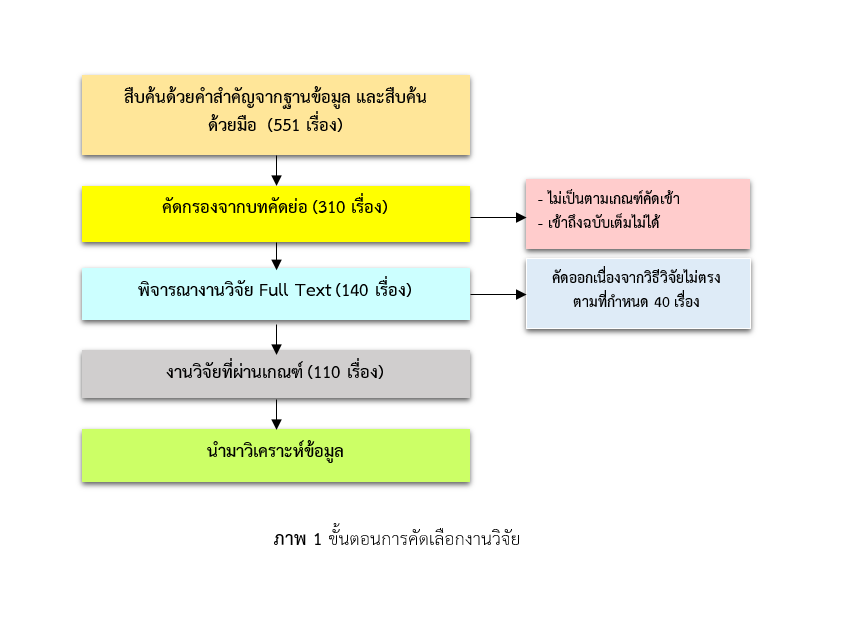
Chronic care model (CCM) and self-management support (SMS) are concepts to improve health care system and patients’ outcomes. The aims of this systematic review was to assess the effects of CCM and SMS in hypertension (HT) and type2 diabetes mellitus (T2DM) patients, by using PICO framework, and assessing quality of the studies and level of evidence method (DiCenso ,Guyatt, & Ciliska, 2005). An electronic search of the databases was conducted as well as a hand search. All studies published in both Thai and English, from B.E. 2547 to 2557, were included. The keywords relating to CCM, self-management support, hypertension and type 2 diabetes were used in the searching process.
Results revealed that from a total of 110 eligible studies in the review, 36 focusing on HT, and 74 focusing on type 2 DM, were analyzed. Results showed that the CCM and SMS intervention with at least 2 elements was effective to outcomes in term of care, including: self-efficacy, glycemic control, blood pressure lowering, and good behaviors, although some studies showed unclear clinical outcomes. Result suggest that the CCM and SMS approaches for HT and T2DM patients should be considered and adopted in Thai primary healthcare settings, where appropriate.
References
Adepu, R., Rasheed, A., & Nagavi, B.G. (2007). Effect of Patient Counseling on Quality of Life in Type-2 Diabetes Mellitus Patients in Two Selected South Indian Community Pharmacies: A Study. Indian Journal of Pharmaceutical Sciences, 69(4), 519.
Aekplakorn, W. (Ed.). (2004). Thai National Health Examination Survey, NHES V. Nontaburi: Health Systems Research Institute. (in Thai)
American Diabetes Association. (2019). Improving Care and Promoting Health in Populations: Standards of Medical Care in Diabetes 2019. Diabetes Care, 42(Supplement1), S7-S12.
Angell, S., Guthartz, S., Dalal, M., Foster, V., Pogue, V., Wei, A., et al. (2013). Integrating Self Blood Pressure Monitoring Into the Routine Management of Uncontrolled Hypertension: Translating Evidence to Practice. The Journal of Clinical Hypertension, 15(3), 180-185.
Brownson, C. A., & Heisler, M. (2009). The Role of Peer Support in Diabetes Care and Self- Management. The Patient: Patient-Centered Outcomes Research, 2(1), 5-17.
Bureau of Non Communicable Disease. (2015). Annual Report. Bangkok: WVO Officer of Printing Mill. (in Thai)
Coleman, K., Austin, B., Brach, C., & Wagner, E. H. (2009). Evidence on the Chronic Care Model in the New Millennium. Health Affairs (Project Hope), 28(1), 75-85.
DiCenso, A., Guyatt, G., & Ciliska, D. (2005). Evidence-Based Nursing: A Guide to Clinical Practice. St. Louid, Mo: Elsevier/Mosby.
Embrey, N. (2008). A Concecpt Analysis of Self-Management in Long-Term Condition. British Journal of Neuroscience Nursing, 10(2), 507-513.
Gihan, S. M., & Nadia, E. L. Sayed Ahmed. (2013). Effect of Aerobic Exercise with DASH on Blood Pressure and Lipid Profile in Prehypertensive Women. Bulletin of Faculty of Pharmacy, Cairo University, 18(1), 101-108.
Glasgow, R. E., Askew, S., Purcell, P., Levine, E., Warner, E. T., Stange, K. C., et al. (2013). Use of REAIM to Address Health Inequities: Application in a Low-Income Community Health Center-Based Weight Loss and Hypertension Self-Management Program. Translational Behavioral Medicine, 3(2), 200-210.
International Diabetes Federation. (2017). IDF Diabetes Atlas, 8th ed. Brussels, Belgium: International Diabetes Federation.
Kamlungdee, U., Bunmusik, P., & Watcharawiwat, A. (2017). The Development of Home Visit Guidelines for Patients with Type 2 Diabetes Mellitus or Hypertension Run by Family Care Team. The Southern College Network Journal of Nursing and Public Health, 4s, 34-45. (in Thai)
Kanfer, F. (1988). Self-Management Methods. In. Kanfer & A.P. Goldstein. (Eds.). Helping People Change: A Textbook of Methods. (3rd ed). New York: Pergamon.
Lee, A., Siu, C. F., Leung, K. T., Lau, L. C., Chan, C. C., & Wong, K. K. (2011). General Practice and Social Service Partnership for Better Clinical Outcomes, Patient Self-Efficacy and Lifestyle Behaviours of Diabetic Care: Randomized Control Trial of a Chronic Care Model. Postgrad Med J, 87(1032), 688-693.
Melnyk, B. M., & Fineout-Overholt E. (2011). Evidence-Based Practice in Nursing & Healthcare: A Guide to Best Practice: Lippincott Williams & Wilkins.
Moonsarnand, S., & Sumpowthong, K. (2016). Effects of Dietary Behavior Modification Program Guideline of the DASH with Self-Efficacy Theory and Social Support on Reducing the Risk of Hypertension among Pre-Hypertensive Patients. The Public Health Journal of Burapha University, 11(1), 87-98.
Phunsuwan, N., Sumattana, G., & Tewthong, K. (2015). Effectiveness of Change Management Health Beliefs and Health Behaviors Self Risk Essential Hypertension Disease at Kokmamaung Subdistrict, Pakham District, Buriram Province. Thaksin University Journal, 18(2), 70-78. (in Thai)
Piatt, G. A., Anderson, R. M., Brooks, M. M., Songer, T., Siminerio, L. M., Korytkowski, M. M., et al. (2010). 3-Year Follow-Up of Clinical and Behavioral Improvements Following a Multifaceted Diabetes Care Intervention: Results of a Randomized Controlled Trial. Diabetes Educ, 36(2), 301-309.
Puwarawuttipanit, W., Musikthong, J., Sriprasong, S., Phligbua, W., Kasetkala, P., Hanlop, K., at al. (2015). A Systematic Review of Chronic Care Model and Self- Management Support in Chronic Illness. Health Syatem Research Reports. (Thai HSRI) Retrieved June 9, 2019 from https://kb.hsri.or.th /dspace/handle/11228/4368. (in Thai)
Ryan, P., & Swin, K. J. (2009). The Individual and Family Self-Management Theory: Background and Perspectives on Context, Process, and Outcomes. Nursing Outlook, 57, 217-225.
Siminerio, L., Ruppert, K. M., & Gabbay, R. A. (2013). Who Can Provide Diabetes Self-Management Support in Primary Care?: Findings From a Randomized Controlled Trial. Diabetes Educator, 39(5), 705-713.
Sornchamni, C., & Prakeechip, S. (2007). Chronic Disease Management Holistic High Cost Diseases. Nonthaburi: S. Phichit Printing. (in Thai)
Tang, T. S., Gillard, M. L., Funnell, M. M., Nwankwo, R., Parker, E., Spurlock, D., et al. (2005). Developing a New Generation of Ongoing Diabetes Self-Management Support Interventions: a Preliminary Report. Diabetes Educator, 31(1), 91-97.
Tongpeth, J. (2013). Effectiveness of Self - Management Promoting Potential Program on Blood Sugar Control and Quality of Life Among Diabetes Mellitus Type 2 Patients. Journal of The Royal Thai Army Nurses, 14(2), 69-78. (in Thai)
Wagner, E. H., Davis, C., Schaefer, J., VonKorff, M., & Austin, B. (1998). A Survey of Leading Chronic Disease Management Programs: Are They Consistent with the Literature. Managed Care Quarterly, 7(3), 56-66.
Wagner, E. H., Austin, B. T., Davis, C., Hindmarsh, M., Schaefer, J., & Bonomi, A. E. (2001). Improving Chronic Illness Care: Translating Evidence Into Action. Health Affairs, 20(6), 64-78.
Wang, V., Smith, V. A., Bosworth, H. B., Oddone, E. Z., Olsen M. K., McCant, F., et al. (2012). Economic Evaluation of Telephone Self-Management Interventions for Blood Pressure Control. American heart journal, 163(6), 980-986.
World Health Organization. (2018). Non Communicable Disease Countries Profile 2018. Geneva: World Health Organization.
World Health Organization. (2019). Hypertension. Retrieved May 11, 2019 from https:// www.who.int/news-room/fact-sheets.
Xue, F., Yao, W., & Lewin, RJ. (2008). A Randomised Trial of a 5 Week, Manual Based, Self-Management Programme for Hypertension Delivered in a Cardiac Patient Club in Shanghai', BMC Cardiovascular Disorders, 10(8), 1-11.
Downloads
Published
Issue
Section
License
1. บทความหรือข้อคิดเห็นใด ๆ ที่ปรากฏในวารสารเครือข่าย วิทยาลัยพยาบาลและการสาธารณสุขภาคใต้ ที่เป็นวรรณกรรมของผู้เขียน บรรณาธิการหรือเครือข่ายวิทยาลัยพยาบาลและวิทยาลัยการสาธารณสุขภาคใต้ ไม่จำเป็นต้องเห็นด้วย
2. บทความที่ได้รับการตีพิมพ์ถือเป็นลิขสิทธิ์ของ วารสารเครือข่ายวิทยาลัยพยาบาลและการสาธารณสุขภาคใต้