ผลของการใช้ Line Official Account “Malnutrition” ต่อความรู้ ความพึงพอใจ และประสบการณ์ของผู้ดูแลเด็กวัยหัดเดินในเขตเทศบาลเมือง จังหวัดนราธิวาส
คำสำคัญ:
เด็กวัยหัดเดิน , Line Official Account , ภาวะโภชนาการ, ผู้ดูแลบทคัดย่อ
การวิจัยแบบผสมผสานนี้ มีวัตถุประสงค์เพื่อเปรียบเทียบคะแนนเฉลี่ยความรู้ของผู้ดูแลระหว่างก่อนและหลังให้ความรู้ภาวะโภชนาการเด็กวัยหัดเดินผ่าน Line Official Account “Malnutrition” เพื่อประเมินความพึงพอใจการใช้ Line Official Account “Malnutrition” และเพื่อศึกษาประสบการณ์ของผู้ดูแลในการดูแลเด็กวัยหัดเดินให้มีภาวะโภชนาการปกติ กลุ่มตัวอย่างคือผู้ดูแลเด็กวัยหัดเดิน จำนวน 27 คน จากศูนย์พัฒนาเด็กเล็ก 6 แห่งในเขตเทศบาลเมือง จังหวัดนราธิวาส เครื่องมือวิจัยประกอบด้วย Line Official Account “Malnutrition” แบบทดสอบความรู้ก่อนและหลัง แบบสอบถามความพึงพอใจ และแบบสัมภาษณ์ประสบการณ์ของผู้ดูแลเด็กวัยหัดเดินที่มีภาวะโภชนาการปกติ เครื่องมือผ่านการตรวจสอบความตรงเชิงเนื้อหา ได้ค่าดัชนีความตรงตามเนื้อหาเท่ากับ .86 ความเชื่อมั่นของแบบทดสอบความรู้เท่ากับ .83 (KR-20) และแบบสอบถามความพึงพอใจด้วยสูตรสัมประสิทธิ์แอลฟาของครอนบาค เท่ากับ .89 วิเคราะห์ข้อมูลเชิงปริมาณด้วยสถิติเชิงพรรณนาและ Paired t-test และข้อมูลเชิงคุณภาพด้วยการวิเคราะห์เชิงเนื้อหา ผลการวิจัยพบว่า
1. ความรู้ของผู้ดูแลเพิ่มขึ้นอย่างมีนัยสำคัญทางสถิติหลังการใช้งาน (p-value < .001) โดยมีคะแนนเฉลี่ยจาก 6.11 (SD = 1.36) เพิ่มเป็น 7.96 (SD = 1.31)
2. ความพึงพอใจต่อการใช้งาน Line Official Account “Malnutrition” อยู่ในระดับสูง โดยเฉพาะด้านการนำเนื้อหาไปใช้จริง (M = 4.93, SD = 0.26)
3. ผู้ดูแลมีประสบการณ์ในการดูแลเด็กวัยหัดเดินให้มีภาวะโภชนาการปกติ มีการดูแลการจัดอาหาร การสังเกตพฤติกรรมการกิน และการใช้เทคโนโลยีที่เข้าใจง่ายและนำไปใช้ได้จริง
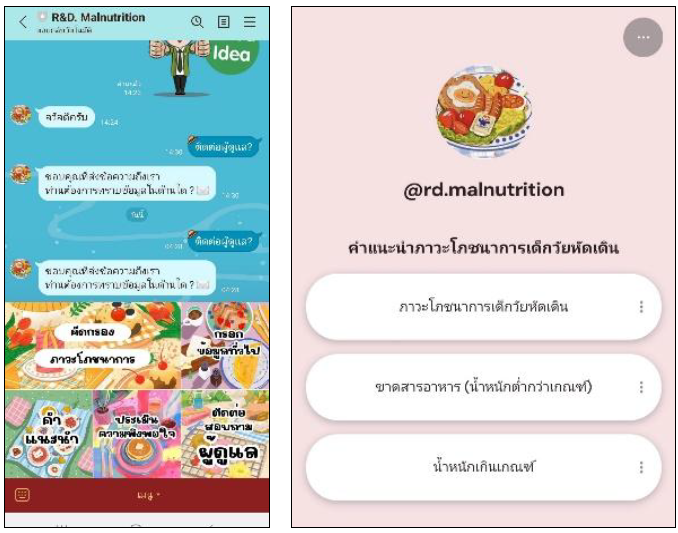
ผลการวิจัยครั้งนี้แสดงให้เห็นว่า Line Official Account “Malnutrition” เป็นสื่อดิจิทัลที่สามารถใช้คัดกรองภาวะโภชนาการของเด็กวัยหัดเดินผ่านการกรอกข้อมูลด้านน้ำหนัก ส่วนสูง อายุ และเพศ ซึ่งสามารถประเมินและแปลผลออกมาได้อย่างชัดเจน พร้อมทั้งให้คำแนะนำด้านโภชนาการที่เหมาะสมแก่ผู้ดูแล
เอกสารอ้างอิง
Ahmed, M. (2024). Criteria for establishing trustworthiness in qualitative research. Qualitative Research Journal, 24(2), 123–135.
Alqahtani, N., Al Ghamdi, S., Al Qahtani, A., Al Humaidi, M., & Al Qahtani, M. (2021). The role of culturally tailored digital health interventions in improving caregiver engagement. BMC Health Services Research, 21, 1245.
Bandura, A. (1977). Social Learning Theory. Englewood Cliffs, NJ: Prentice Hall.
Bandura, A. (1997). Self-efficacy: The Exercise of Control. W.H. Freeman.
Barrera, M., Rothenberg, S. J., Barrows, C., & Dominguez, B. (2020). Nutrition and early childhood development: A global perspective. Early Childhood Research Quarterly, 52, 23–35.
Chen, B., Guedes, C., Cooper, S., & Lung, C. (2022). Malnutrition and cognitive development in early childhood. Child: Care, Health and Development, 48(4), 485–492.
Cohen, J. (1988). Statistical Power Analysis for The Behavioral Sciences (2nd ed.). Lawrence Erlbaum.
Díaz-Rizzolo, D. A., Llauradó, E., Falguera, M., & Farran-Codina, A. (2021). Childhood obesity and risk factors for type 2 diabetes. Nutrients, 13(5), 1605.
Elo, S., Kääriäinen, M., Kanste, O., Pölkki, T., Utriainen, K., & Kyngäs, H. (2014). Qualitative content analysis: A focus on trustworthiness. SAGE Open, 4(1), 1–10.
Faul, F., Erdfelder, E., Lang, A. G., & Buchner, A. (2007). G*Power 3: A flexible statistical power analysis program for the social, behavioral, and biomedical sciences. Behavior Research Methods, 39(2), 175–191.
Hassandra, M., Kalajas-Tilga, H., & Koka, A. (2022). The impact of bilingual digital health education on caregivers' knowledge. Health Education Research, 37(2), 105–117.
Health Data Center. (2022). Child Health Statistics: Narathiwat Province. Ministry of Public Health, Thailand.
Limvongvatana, M., Pithan, P., & Yodchai, K. (2022). Development of a Line Official Account for mothers of premature infants: Enhancing knowledge, confidence, and reducing stress. Journal of Nursing Science, 40(3), 15–28.
Mangmee, T., Perngyai, C., Chumprasert, W., & Kherlee, C. (2024). The effectiveness of a preschool child development promotion program combined with social support on caregivers’ knowledge, behavior, and skills in Chaiburi Subdistrict, Phatthalung Province. The Southern College Network Journal of Nursing and Public Health, 11(3), e270777.
Nguyen, T. H., Do, H. L., Tran, Q. M., & Le, A. T. (2023). Interactive online media and caregiver motivation: Implications for child health. JMIR Pediatrics and Parenting, 6, e42984.
Phan, T. T., Nguyen, T. H., Tran, Q. M., & Do, H. L. (2022). Digital health communication and parental satisfaction: Evidence from Vietnam. Journal of Medical Internet Research, 24(8), e35678.
Phongphuttha, S., Sittichai, R., & Yusoh, S. (2022). Nutritional status among children under 5 years old in Narathiwat province, Thailand. Journal of Health Research, 36(5), 897–906.
Puder, J. J., & Munsch, S. (2022). Psychological correlates of childhood obesity. International Journal of Obesity, 46, 1–10.
Rosanbalm, K. D., & Murray, D. W. (2020). Promoting self-regulation in early childhood: The role of nutrition and sleep. Early Childhood Education Journal, 48, 653–663.
Sukonthaman, P., Thavorncharoensap, M., & Teerawattananon, Y. (2020). Empowering caregivers through digital health interventions: A Thai perspective. Health Policy and Technology, 9(4), 100486.
Thongsri, N., Bao, Y., & Chongsuphajaisiddhi, T. (2021). Factors influencing satisfaction with e-health services in Thailand. International Journal of Environmental Research and Public Health, 18(14), 7483.
UNICEF Thailand. (2023). The State of Children in Thailand 2023. UNICEF Thailand.
UNICEF, World Health Organization, & World Bank Group. (2023). Levels and Trends in Child Malnutrition: UNICEF/WHO/World Bank Group Joint Child Malnutrition Estimates. UNICEF. https://data.unicef.org
Wang, H., Zhang, J., Chen, Y., & Liu, Y. (2023). Improving child nutrition knowledge through mobile health: Evidence from a quasi-experimental study. Nutrients, 15(2), 376.
Wang, L., Zhang, X., Li, Y., & Sun, J. (2023). Mobile nutrition applications and caregiver knowledge: A randomized controlled trial. BMC Public Health, 23, 456.
Wu, Y., Li, X., Xu, Q., & Zhao, H. (2023). Mobile application-based malnutrition screening for preschool children in rural China. Public Health Nutrition, 26(5), 1123–1133.
ดาวน์โหลด
เผยแพร่แล้ว
ฉบับ
ประเภทบทความ
สัญญาอนุญาต
ลิขสิทธิ์ (c) 2025 วารสารเครือข่ายวิทยาลัยพยาบาลและการสาธารณสุขภาคใต้

อนุญาตภายใต้เงื่อนไข Creative Commons Attribution-NonCommercial-NoDerivatives 4.0 International License.
1. บทความหรือข้อคิดเห็นใด ๆ ที่ปรากฏในวารสารเครือข่าย วิทยาลัยพยาบาลและการสาธารณสุขภาคใต้ ที่เป็นวรรณกรรมของผู้เขียน บรรณาธิการหรือเครือข่ายวิทยาลัยพยาบาลและวิทยาลัยการสาธารณสุขภาคใต้ ไม่จำเป็นต้องเห็นด้วย
2. บทความที่ได้รับการตีพิมพ์ถือเป็นลิขสิทธิ์ของ วารสารเครือข่ายวิทยาลัยพยาบาลและการสาธารณสุขภาคใต้