การพัฒนารูปแบบการสร้างความรอบรู้ด้านสุขภาพโดยใช้สื่อออนไลน์ในหญิงตั้งครรภ์ที่มีภาวะเสี่ยงสูง โรงพยาบาลปทุมธานี
คำสำคัญ:
รูปแบบการสร้างความรอบรู้ด้านสุขภาพ , หญิงตั้งครรภ์ที่มีภาวะเสี่ยงสูง , สื่อออนไลน์บทคัดย่อ
การวิจัยและพัฒนาครั้งนี้มีวัตถุประสงค์เพื่อวิเคราะห์สถานการณ์ สร้างและพัฒนารูปแบบ ทดลองใช้ และศึกษาประสิทธิผลของการสร้างความรอบรู้ด้านสุขภาพโดยใช้สื่อออนไลน์ในหญิงตั้งครรภ์ที่มีภาวะเสี่ยงสูง โรงพยาบาลปทุมธานี การดำเนินงานแบ่งออกเป็น 4 ระยะ ได้แก่ ระยะที่ 1 การศึกษาสภาพการณ์ ปัญหา และความต้องการจากเจ้าหน้าที่ จำนวน 12 คน ระยะที่ 2 การพัฒนารูปแบบโดยอาศัยข้อมูลจากแบบบันทึกประวัติและการรักษาของผู้ป่วย รวมถึงการสนทนากลุ่ม ระยะที่ 3 การทดลองใช้รูปแบบกับกลุ่มตัวอย่างหญิงตั้งครรภ์ที่มีภาวะเสี่ยง จำนวน 30 ราย และระยะที่ 4 การประเมินผล เครื่องมือที่ใช้ประกอบด้วยแบบประเมินความรอบรู้ด้านสุขภาพ และแบบสนทนากลุ่ม โดยมีการตรวจสอบความตรงเชิงเนื้อหา (IOC) อยู่ระหว่าง .67 – 1.00 และค่าความเชื่อมั่นของแบบสอบถามด้วยสัมประสิทธิ์แอลฟาของครอนบาคเท่ากับ .86 การวิเคราะห์ข้อมูลเชิงปริมาณใช้สถิติเชิงพรรณนาและ Paired T Test ขณะที่ข้อมูลเชิงคุณภาพใช้การวิเคราะห์เชิงประเด็น ผลการวิจัยพบว่า
1. หญิงตั้งครรภ์ขาดความรู้และความเข้าใจในการดูแลตนเอง มีพฤติกรรมสุขภาพที่ไม่เหมาะสม รวมทั้งขาดการสนับสนุนจากผู้ใกล้ชิด และบุคลากรทางการแพทย์มีข้อจำกัดด้านเวลาและแนวปฏิบัติในการให้คำปรึกษา
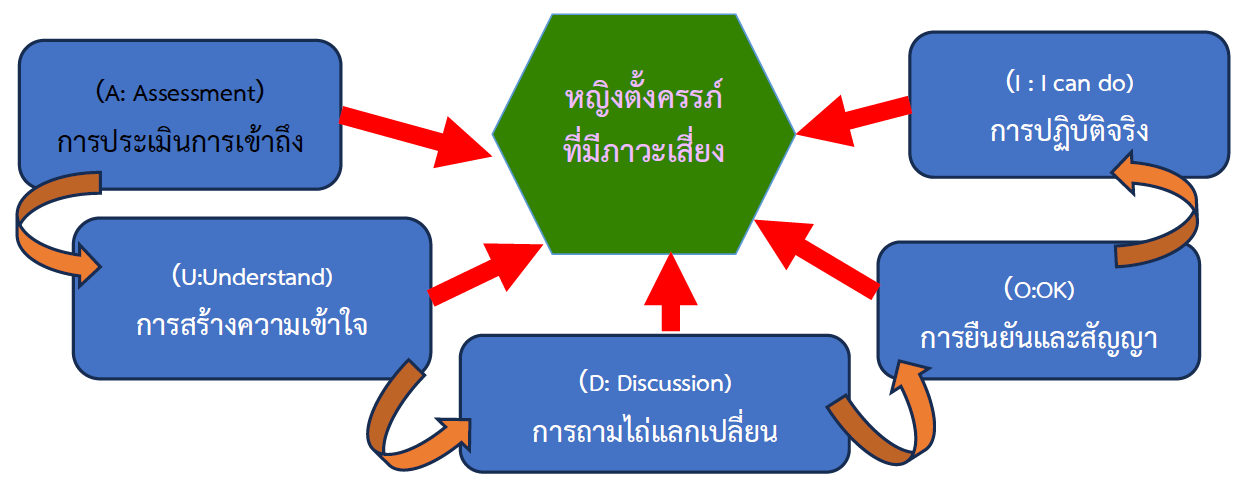
2. ได้รูปแบบการสร้างความรอบรู้ด้านสุขภาพโดยใช้สื่อออนไลน์ในหญิงตั้งครรภ์ที่มีภาวะเสี่ยงสูงที่เรียกว่า AUDOI Model ประกอบด้วย 5 องค์ประกอบ ได้แก่ การประเมินการเข้าถึง (Assessment) การสร้างความเข้าใจ (Understand) การถามไถ่แลกเปลี่ยน (Discussion) การยืนยันและสัญญาใจ (OK) และการปฏิบัติจริง (I Can Do)
3. ภายหลังการใช้รูปแบบฯ พบว่า คะแนนความรอบรู้ด้านสุขภาพและพฤติกรรมการดูแลสุขภาพเพิ่มขึ้นอย่างมีนัยสำคัญทางสถิติที่ระดับ .01 และ .001
ดังนั้นการส่งเสริมความรอบรู้ด้านสุขภาพในหญิงตั้งครรภ์ที่มีภาวะเสี่ยงสูง ควรใช้สื่อที่เหมาะสมกับบริบทของผู้ใช้ และควรพัฒนาให้สามารถเข้าถึงได้ง่าย มีเนื้อหาที่เชื่อถือได้ และสอดคล้องกับความต้องการเฉพาะกลุ่ม เพื่อเพิ่มประสิทธิภาพในการดูแลตนเองและลดความเสี่ยงต่อภาวะแทรกซ้อนที่อาจเกิดขึ้น
เอกสารอ้างอิง
American College of Obstetricians and Gynecologists. (2020). Obstetric Care for High-Risk Pregnancies. ACOG Publications.
Asadi, L., Amiri, F., & Safinejad, H. (2020). Investigating the effect of health literacy level on improving the quality of care during pregnancy in pregnant women covered by health centers. Journal of Education and Health Promotion, 9(1), 286.
Faul, F., Erdfelder, E., Lang, A.-G., & Buchner, A. (2007). G*Power 3: A flexible statistical power analysis program for the social, behavioral, and biomedical sciences. Behavior Research Methods, 39(2), 175-191. doi.org/10.3758/BF03193146
Ghanbari, S., Majlessi, F., Ghaffari, M., & Mahmoodi Majdabadi, M. (2020). Evaluation of health literacy of pregnant women in urban health centers of Shahid Beheshti Medical University. Daneshvar Medicine, 19(6), 1-12.
Guler, D. S., Sahin, S., Ozdemir, K., Unsal, A., & Uslu Yuvacı, H. (2021). Health literacy and knowledge of antenatal care among pregnant women. Health & Social Care in the Community, 29(6), 1815-1823.
Jia, X., Pang, Y., & Liu, L. S. (2021). Online health information seeking behavior: A systematic review. Healthcare (Basel, Switzerland), 9(12), 1740. doi.org/10.3390/healthcare9121740
Juangtrakul, C. (2010). Research Methodology in Social Sciences. O.S. Printing House. (in Thai)
Karabutr, T., Klomyong, S., Sripum, J., Ngarmkhum, R., & Prasertsri, U. (2025). The effects of a Preventive Program on the intention behaviors to prevent preterm labor and rate of preterm birth. The Southern College Network Journal of Nursing and Public Health, 12(1), e272388.
Kitcharoentanarux, P. (2024). Factors associated with preterm birth among pregnant women at Sisaket Hospital. Medical Journal of Sisaket Surin Buriram Hospitals, 39(3), 631–640.
Liu, L., Oza, S., Hogan, D., Perin, J., Rudan, I., Lawn, J. E., et al. (2019). Global, regional, and national causes of under-5 mortality in 2000–15: An updated systematic analysis with implications for the Sustainable Development Goals. The Lancet, 388(10063), 3027–3035. doi.org/10.1016/S0140-6736(16)31593-8
Nola Holness, C. N. M. (2018). High-risk pregnancy. Women’s Health Across the Lifespan, An Issue of Nursing Clinics, E-Book, 53(2), 241.
Nutbeam, D. (2000). Health literacy as a public health goal: A challenge for contemporary health education and communication strategies into the 21st century. Health Promotion International, 15(3), 259-267. doi.org/https://doi.org/10.1093/heapro/15.3.259
Nutbeam, D. (2008). The evolving concept of health literacy. Social Science & Medicine, 67(12), 2072-2078.
Samlee, S., Hirunwatthanakul, P., & Promasatayaprot, V. (2024). Results of the health literacy program for pregnant women in Borabue hospital, Borabue district, Mahasarakham province. Lampang Medical Journal, 45(1), 9–17.
Seechalee, P., & Duangsong, R. (2022). The effects of pregnancy prevention program by application of health literacy concept among secondary school female students in Udon Thani province. KKU Journal for Public Health Research, 15(1), 24-36. (in Thai)
Songsermpong, S., Rodphothong, J., & Piriyaudomporn., P. (2023). Development of a care model for high-risk pregnant women in the digital transformation era. Journal of Health Science, 32(1), s125-s137. (in Thai)
Souza, F. M. L. C., Santos, W. N., Dantas, J. C., Sousa, H. R. A., Moreira, O. A. A., & Silva, R. A. R. (2022).
Development of a mobile application for prenatal care and content validation. Acta Paul Enferm, 35, eAPE01861.
Suwanampa, T., & Purksametanan, T. (2023). Effects of a mobile application-based health education program on health literacy in pregnant women. Journal of Thailand Nursing and Midwifery Council, 38(1), 98-111. (in Thai)
Tachasuksri, T., Siriarunrat, S., Suppasri, P., Suppaseemanont, W., Boonnate, N., & Kwannate, C. (2017). Causal model for quality of life among pregnant women. The Southern College Network Journal of Nursing and Public Health, 4(1), 28-46. (in Thai)
Tavananezhad, N., Bolbanabad, A. M., Ghelichkhani, F., Effati-Daryani, F., & Mirghafourvand, M. (2022). The relationship between health literacy and empowerment in pregnant women: A cross-sectional study. BMC Pregnancy and Childbirth, 22(1), 351.
World Health Organization. (2017). Managing Complications in Pregnancy and Childbirth. Retrieved September 1, 2025 from https://www.who.int/publications/i/item/WHO-MCA-17.02
Zibellini, J., Muscat, D. M., Kizirian, N., & Gordon, A. (2021). Effect of health literacy interventions on pregnancy outcomes: A systematic review. Women and Birth, 34(2), 180-186.
ดาวน์โหลด
เผยแพร่แล้ว
ฉบับ
ประเภทบทความ
สัญญาอนุญาต
ลิขสิทธิ์ (c) 2025 วารสารเครือข่ายวิทยาลัยพยาบาลและการสาธารณสุขภาคใต้

อนุญาตภายใต้เงื่อนไข Creative Commons Attribution-NonCommercial-NoDerivatives 4.0 International License.
1. บทความหรือข้อคิดเห็นใด ๆ ที่ปรากฏในวารสารเครือข่าย วิทยาลัยพยาบาลและการสาธารณสุขภาคใต้ ที่เป็นวรรณกรรมของผู้เขียน บรรณาธิการหรือเครือข่ายวิทยาลัยพยาบาลและวิทยาลัยการสาธารณสุขภาคใต้ ไม่จำเป็นต้องเห็นด้วย
2. บทความที่ได้รับการตีพิมพ์ถือเป็นลิขสิทธิ์ของ วารสารเครือข่ายวิทยาลัยพยาบาลและการสาธารณสุขภาคใต้