ผลการใช้แนวปฏิบัติการจัดการภาวะคลื่นไส้อาเจียนในผู้ป่วยที่ได้รับการรักษาด้วยเคมีบำบัด : การใช้แนวปฏิบัติที่ดีในบริบทประเทศไทย
คำสำคัญ:
แนวปฏิบัติ, การจัดการภาวะคลื่นไส้อาเจียน, การรักษามะเร็ง, เคมีบำบัดบทคัดย่อ
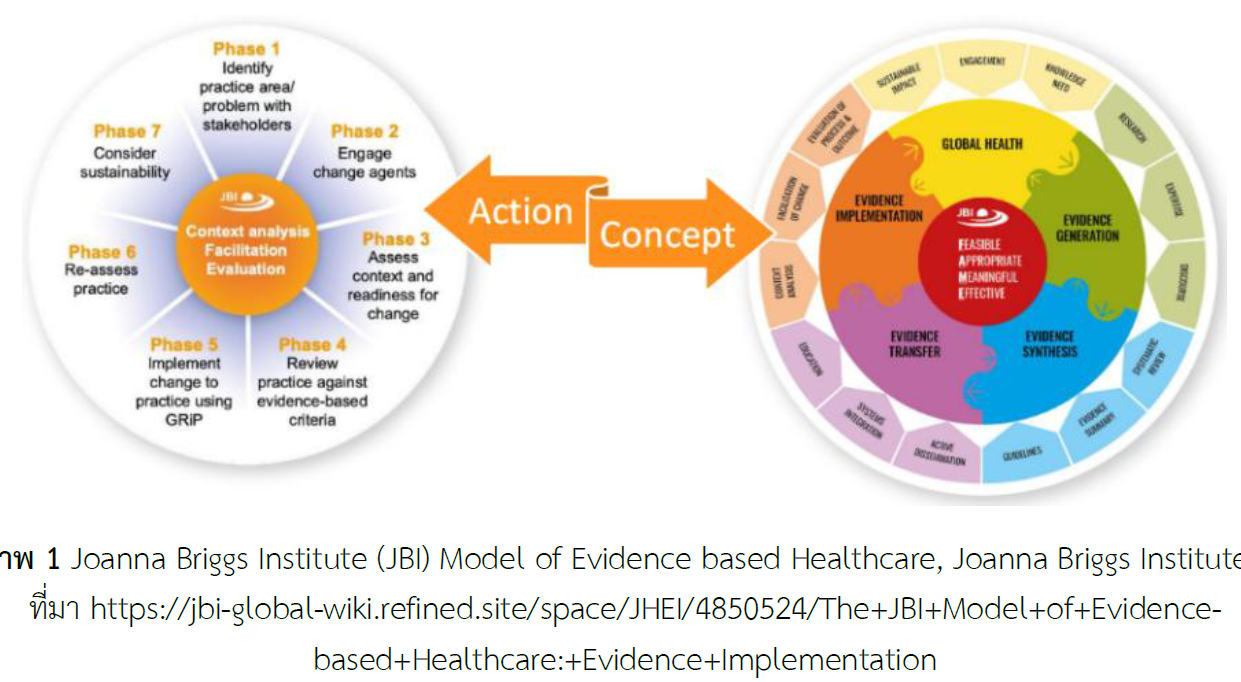
การวิจัยเชิงทดลองนี้มีวัตถุประสงค์เพื่อศึกษาประสิทธิผลของการใช้แนวปฏิบัติการจัดการภาวะคลื่นไส้อาเจียนในผู้ป่วยมะเร็งที่ได้รับการรักษาโดยใช้เคมีบำบัดในผู้ป่วยมะเร็งในบริบทประเทศไทย ทำการศึกษาในกลุ่มผู้ป่วยมะเร็งที่มารับการรักษาด้วยเคมีบำบัดที่โรงพยาบาลสมเด็จพระยุพราชท่าบ่อ จังหวัดหนองคาย จำนวน 120 รายกรณี ด้วยวิธีสุ่มแบบสะดวก ระหว่างเดือนมกราคม - กรกฎาคม 2567 การใช้แนวปฏิบัติประยุกต์ตามกรอบแนวคิดหลักฐานเชิงประจักษ์ทางสุขภาพโดยใช้กระบวนการแนวปฏิบัติตามหลักฐานสุขภาพ 7 ขั้นตอนของสถาบันโจแอนนาบริค ประเทศออสเตรเลีย เครื่องมือที่ใช้ในการวิจัยคือแนวปฏิบัติการจัดการภาวะคลื่นไส้อาเจียนในผู้ป่วยที่ได้รับการรักษาด้วยเคมีบำบัด และรวบรวมข้อมูลโดย 1) แบบประเมินความเสี่ยงของการเกิดอาการคลื่นไส้อาเจียนจากเคมีบำบัด 2) แบบบันทึกอาการคลื่นไส้อาเจียนจากเคมีบำบัด 3) แบบประเมินดัชนีการใช้ชีวิตขณะมีอาการคลื่นไส้และอาเจียน 4) การตรวจสอบการปฏิบัติตามเกณฑ์ประเมิน วิเคราะห์ข้อมูลโดยสถติเชิงพรรณนา ความถี่ ร้อยละ และ สถิติ Chi-square ผลการศึกษาพบว่า
กลุ่มตัวอย่างที่ไม่มีอาการคลื่นไส้หรือมีอาการคลื่นไส้แต่ไม่รุนแรง มีจำนวนเพิ่มขึ้นจาก ร้อยละ 40 เป็นร้อยละ 95 (p-value < .001) และกลุ่มตัวอย่างที่ไม่มีอาการอาเจียนและมีอาการอาเจียนเพียงเล็กน้อยที่ไม่จำเป็นต้องได้รับยามีจำนวนเพิ่มขึ้นจากร้อยละ 65 เป็นร้อยละ 100 (p-value < .001) การประเมินคุณภาพชีวิตเนื่องจากผลกระทบของอาการคลื่นไส้และอาเจียนจากเคมีบำบัดที่มีต่อชีวิตประจำวัน พบว่าทั้งก่อนและหลังการใช้แนวปฏิบัติฯ กลุ่มตัวอย่างมีคะแนนมากกว่าเกณฑ์ ซึ่งถือว่ามีคุณภาพชีวิตในระดับดีและไม่ได้รับผลกระทบจากอาการข้างเคียง การประเมินการเปลี่ยนแปลงจากการปฏิบัติตามเกณฑ์ประเมินพบว่า มีการการปรับปรุงเพิ่มขึ้นร้อยละ 100 ในเกณฑ์การประเมินที่ 1 และ 4
สรุปว่าแนวปฏิบัติฯ นี้มีประสิทธิผลและสามารถนำมาประยุกต์ใช้ในบริบทของการดูแลสุขภาพต่อไป
เอกสารอ้างอิง
Chanthawong, S., (2019). Prevention of chemotherapy-induced nausea and vomiting. Srinagarind Medical Journal, 34(1), 115-126.
Damschroder, L. J., Aron, D. C., Keith, R. E., Kirsh, S. R., Alexander, J. A., & Lowery, J. C., (2009). Fostering implementation of health services research findings into practice: a consolidated framework for advancing implementation science. Implementation Science, 4(50), 1-15. doi.org/10.1186/1748-5908-4-50
Dielenseger, P., Börjeson, S., Vidall, C., Young, A., & Jahn, P., (2019). Evaluation of antiemetic practices for prevention of chemotherapy-induced nausea and vomiting (CINV): results of a European oncology nurse survey. Supportive Care in Cancer, 27(11), 4099-4106. doi.org/10.1007/s00520-019-04697-1.
Dranitsaris, G., Molassiotis, A., Clemons, M., Roeland, E., Schwartzberg, L., Dielenseger, P., et al. (2017). The development of a prediction tool to identify cancer patients at high risk for chemotherapy-induced nausea and vomiting. Annals of Oncology, 28(6), 1260–1267. doi.org/10.1093/annonc/mdx100
Einhorn, L. H., Rapoport, B., Navari, R. M., Herrstedt, J., & Brames, M. J. (2017). 2016 updated MASCC/ESMO consensus recommendations: prevention of nausea and vomiting following multiple-day chemotherapy, high-dose chemotherapy, and breakthrough nausea and vomiting. Supportive Care in Cancer, 25, 303-308. https://www.ncbi.nlm.nih.gov/pubmed/27815710
Hashimoto, H., Abe, M., Tokuyama, O., Mizutani, H., Uchitomi, Y., Yamaguchi, T., et al., (2020). Olanzapine 5 mg plus standard antiemetic therapy for the prevention of chemotherapy-induced nausea and vomiting (J-FORCE): a multicentre, randomised, double-blind, placebo-controlled, phase 3 trial. The Lancet Oncology, 21(2), 242-249.
Hesketh, P. J., Kris, M. G., Basch, E., Bohlke, K., Barbour, S. Y., Clark-Snow, R. A., et al., (2020). Antiemetics: ASCO guideline update. Journal of Clinical Oncology, 38(24), 2782–2797. doi.org/10.1200/JCO.20.01296
Lindley, C. M., Hirsch, J. D., O’Neill, C. V., Transau, M. C., Gilbert, C. S., Osterhaus, J. T., (1992). Quality of life consequences of chemotherapy-induced emesis. International journal of quality of life aspects of treatment, care and rehabilitation, 1(5), 331-334. doi.org/10.1007/BF00434947
Maher, L., Gustafson, D., & Evans, A. (2010). NHS Sustainability Model and Guide. Institute for Innovation and Improvement. Retrieved March 20, 2024 from https://www.ktpathways.ca/system/files/resources/2019-11/nhs_sustainability_model_-_february_ 2010_1_.pdf
Martin, A. R., Pearson, J. D., Cai, B., Elmer, M., Horgan, K., Lindley, C., (2003). Assessing the impact of chemotherapy-induced nausea and vomiting on patients' daily lives: a modified version of the Functional Living Index-Emesis (FLIE) with 5-day recall. Journal of Multinational Association Supportive Care in Cancer. 11, 522–527. doi.org/10.1007/s00520-003-0482-4
National Cancer Institute. (2017). Common Terminology Criteria for Adverse Events (CTCAE) Version 5.0., U.S. Department of Health and Human Services. Retrieved June 20, 2024 from https://ctep.cancer.gov/protocoldevelopment/electronic_applications/docs/CTCAE_v5_Quick_Reference_8.5x11.pdf
National Comprehensive Cancer Network (NCCN), (2023). NCCN Clinical Practice Guidelines in Oncology Version 2. Antiemesis. National Comprehensive Cancer Network. Retrieved May 15, 2024 from http://www.nccn.org/ professionals/physician_gls/pdf/antiemesis.pdf.
Patel, P., Robinson, P.D., Wahib, N., Cheung, P., Wong, T., Cabral, S., et al., (2022). Interventions for the prevention of acute phase chemotherapy-induced nausea and vomiting in adult and pediatric patients: a systematic review and meta-analysis. Support Care Cancer. 30, 8855–8869. doi.org/10.1007/s00520-022-07287-w
Piechotta, V., Adams, A., Haque, M., Scheckel, B., Kreuzberger, N., Monsef, I., et al. (2021). Antiemetics for adults for prevention of nausea and vomiting caused by moderately or highly emetogenic hemotherapy: a network meta-analysis. Cochrane Database of Systematic Reviews, 11, CD012775. doi.org/10.1002/14651858.CD012775.pub2
Schleicher, S. M., Bach, P. B., Matsoukas, K., & Korenstein, D. (2018). Medication overuse in oncology: current trends and future implications for patients and society. The Lancet Oncology, 19(4), e200-e208. doi.org/10.1016/S1470-2045(18)30099-8.
Schwartzberg, L., Harrow, B., Lal, L. S., Radtchenko, J., & Lyman, G. H. (2015). Resource utilization for chemotherapy-induced nausea and vomiting events in patients with solid tumors treated with antiemetic regimens. American Health & Drug Benefits, 8(5), 273-282.
Sommariva, S., Pongiglione, B., & Tarricone, R. (2016). Impact of chemotherapy-induced nausea and vomiting on health-related quality of life and resource utilization: a systematic review. Critical reviews in oncology/hematology, 99, 13-36. doi:10.1016/j.critrevonc.2015.12.001.
Wang, D. S., Hu, M. T., Wang, Z. Q., Ren, C., Qiu, M. Z., Luo, H. Y., et al., (2021). Effect of aprepitant for the prevention of chemotherapy-induced nausea and vomiting in women: A randomized clinical trial. JAMA Network Open, 4(4), e215250. doi.org/10.1001/jamanetworkopen.2021.5250
Wu, Y. (2024). Massive multi-site audit projects: preparation, organization, and project management. JBI Evidence Implement, 22, 119. doi.org/10.1097/XEB.0000000000000427
ดาวน์โหลด
เผยแพร่แล้ว
ฉบับ
ประเภทบทความ
สัญญาอนุญาต
ลิขสิทธิ์ (c) 2025 วารสารเครือข่ายวิทยาลัยพยาบาลและการสาธารณสุขภาคใต้

อนุญาตภายใต้เงื่อนไข Creative Commons Attribution-NonCommercial-NoDerivatives 4.0 International License.
1. บทความหรือข้อคิดเห็นใด ๆ ที่ปรากฏในวารสารเครือข่าย วิทยาลัยพยาบาลและการสาธารณสุขภาคใต้ ที่เป็นวรรณกรรมของผู้เขียน บรรณาธิการหรือเครือข่ายวิทยาลัยพยาบาลและวิทยาลัยการสาธารณสุขภาคใต้ ไม่จำเป็นต้องเห็นด้วย
2. บทความที่ได้รับการตีพิมพ์ถือเป็นลิขสิทธิ์ของ วารสารเครือข่ายวิทยาลัยพยาบาลและการสาธารณสุขภาคใต้