ผลของโปรแกรมการเสริมสร้างความแข็งแกร่งในชีวิตต่อพฤติกรรมติดเกมของวัยรุ่นตอนต้น
คำสำคัญ:
โปรแกรมการเสริมสร้างความแข็งแกร่งในชีวิต , พฤติกรรมติดเกม , วัยรุ่นตอนต้นบทคัดย่อ
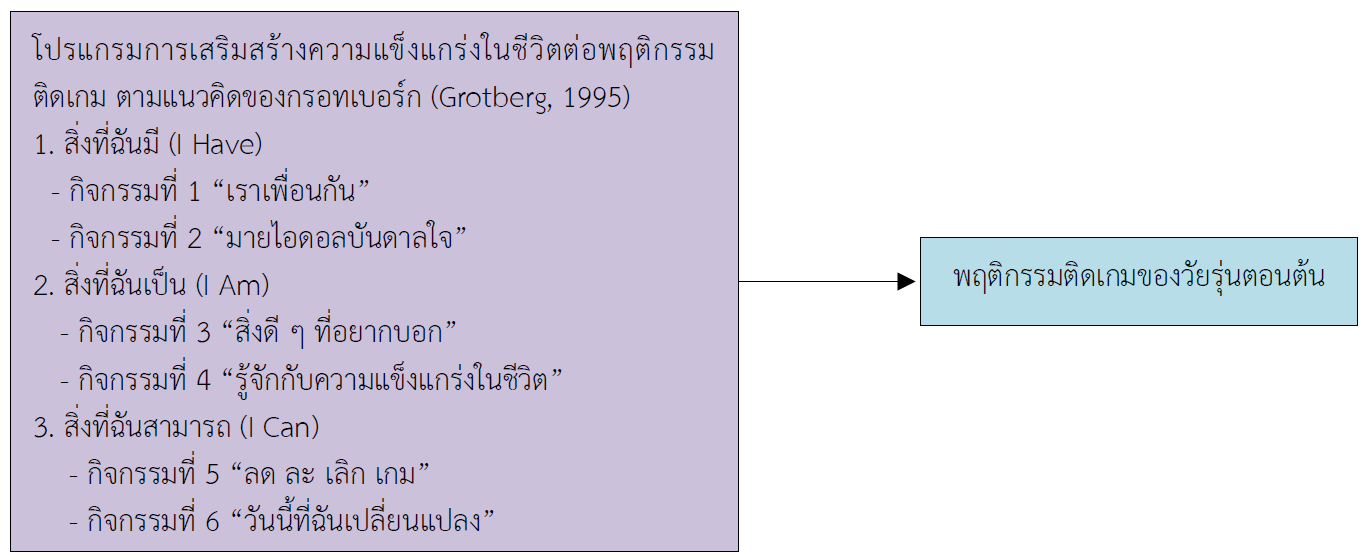
การวิจัยครั้งนี้เป็นวิจัยเชิงทดลอง 2 กลุ่มวัดก่อนและหลังการทดลอง มีวัตถุประสงค์เพื่อศึกษาผลของโปรแกรมการเสริมสร้างความแข็งแกร่งในชีวิตต่อพฤติกรรมติดเกมของวัยรุ่นตอนต้น กลุ่มตัวอย่างเป็นวัยรุ่นตอนต้นอายุ 13 - 15 ปี ทั้งเพศชายและเพศหญิง โดยแบ่งเป็นกลุ่มทดลอง 13 คน และกลุ่มควบคุม 13 คน รวมทั้งหมด 26 คน ที่กำลังศึกษาในสถานศึกษาสังกัดพื้นที่การศึกษามัธยมศึกษาในจังหวัดเชียงใหม่ เครื่องมือที่ใช้ในการวิจัยประกอบด้วย 1) เครื่องมือเก็บรวบรวมข้อมูล ได้แก่ แบบสอบถามข้อมูลส่วนบุคคล แบบทดสอบการติดเกม และแบบประเมินความเข้มแข็งทางใจในเด็กที่ใช้ประเมินความแข็งแกร่งในชีวิต ซึ่งมีค่าสัมประสิทธิ์อัลฟาของครอนบาคเท่ากับ .90 และ .85 ตามลำดับ และ 2) เครื่องมือที่ใช้ในการทดลอง ได้แก่ โปรแกรมการเสริมสร้างความแข็งแกร่งในชีวิตต่อพฤติกรรมติดเกม ซึ่งผู้วิจัยพัฒนาขึ้นตามแนวคิดของกรอทเบอร์ก (Grotberg, 1995) ประกอบด้วยการบำบัด 6 ครั้ง ใช้เวลาครั้งละ 60 - 90 นาที ดำเนินกิจกรรม 2 ครั้งต่อสัปดาห์ ผ่านการพิจารณาผู้ทรงคุณวุฒิ 6 ท่าน ได้ค่าดัชนีความตรงเนื้อหาเท่ากับ .97 วิเคราะห์ข้อมูลโดยใช้สถิติเชิงพรรณนา การทดสอบสถิติวิลคอกชัน และการทดสอบสถิติแมน-วิทนีย์ ผลการวิจัยพบว่า
1. คะแนนพฤติกรรมติดเกมของวัยรุ่นตอนต้นหลังได้รับโปรแกรมการเสริมสร้างความแข็งแกร่งในชีวิต 1 เดือน ต่ำกว่าก่อนได้รับโปรแกรมอย่างมีนัยสำคัญทางสถิติที่ระดับ .05
2. คะแนนพฤติกรรมติดเกมของวัยรุ่นตอนต้นกลุ่มที่ได้รับโปรแกรมการเสริมสร้างความแข็งแกร่งในชีวิตต่ำกว่ากลุ่มที่ไม่ได้รับโปรแกรมหลังการทดลอง 1 เดือน อย่างมีนัยสำคัญทางสถิติที่ระดับ .05
ผลการศึกษาครั้งนี้แสดงให้เห็นว่า โปรแกรมการเสริมสร้างความแข็งแกร่งต่อพฤติกรรมติดเกมสามารถลดพฤติกรรมติดเกมในวัยรุ่นตอนต้นได้ จึงควรมีการนำโปรแกรมนี้ไปใช้ในการลดพฤติกรรมติดเกมในกลุ่มนี้ต่อไป
เอกสารอ้างอิง
BLT Bangkok. (2019). Thailand's Esports are the Best in ASEAN, with the Market Value Soaring to 22 Billion Baht. Retrieved April 20, 2023 from https://www.bltbangkok.com (in Thai)
Charoenwanit, S. (2014). Gaming behavior: Impacts and prevention. Journal of Science and Technology, 22(6), 872-879. (in Thai)
Chen, J., Tong, K., Wu, A., Lau, J., & Zhang, M. (2018). The comorbidity of gambling disorder among Macao adult residents and the moderating role of resilience and life purpose. International Journal of Environmental Research and Public Health, 15(12), 2774. doi.org/10.3390/ijerph15122774
Department of Mental Health. (2019). Resilience scale: RS-15. Retrieved April 20, 2023 from https://mhc5.dmh.go.th (in Thai)
Department of Mental Health. (2020). Survey on the Situation of Thai Children and Online threats 2020. Bangkok: XL Imaging. (in Thai)
Grotberg, E. H. (1995). The International Resilience Project: Promoting resilience in children. Bernard Van Leer Foundation.
Internet Foundation for Development Thailand. (2020). Survey on the Situation of Thai Children and Online Threats 2020. Bangkok: XL Imaging. (in Thai)
Kabir, L. (2021). Video Game Addiction Statistics 2021: Is the World Addicted to Video Games. Retrieved October 19, 2023 from https://www.healthygamer.gg/blog/video-game-addiction statistics.
Kim, A., & Yoo, J. (2019). The relationship between resilience and life strength in early adolescents aged 12-15 years. Journal of Youth Studies, 25(4), 321-335.
Market Splash. (2024). Interesting Gaming Statistics: 2023. Retrieved October 19, 2023 from https://marketsplash.com/th/sthiti-kar-len-kem/#link4.
Poonswadi, S. (2012). The Effects of Reality-Based Group Counseling on the Mental Health Empowerment of Drug Addicts in the Vivat Phumiang School of the Royal Thai Navy Special Class. A Thesis Submitted in Partial Fulfillment of the Requirement for the Master of Science Degree in Counseling Psychology, Ramkhamhaeng University. (in Thai)
Prayai, P., Srikos, W., & Wongpakaran, N. (2021). Motivational interviewing (MI): A review article. Thai Journal of Clinical Psychology, 52(1), 62-74. (in Thai)
Robertson, W. T., Yan, Z., & Rapoza, A. K. (2018). Is resilience a protective factor of internet addiction?. Computers in Human Behavior, 78, 255–260. doi.org/10.1016/j.chb.2017.09.027
Schneider, A., Hommel, G., & Blettner, M. (2019). Linear regression analysis: Part 14 of a series on evaluation of scientific publications. Deutsches Ärzteblatt International, 106(44), 755–760. doi.org/10.3238/arztebl.2009.0755
Sutthirat, C. (2012). 80 Innovations in Learner-Centered Learning Management (5th ed.). Bangkok: Danex Intercorporation. (in Thai)
ThaiHealth Official. (2019). Game Addiction: A Health Threat to Thai Children that Parents Must Help Monitor and Prevent. Retrieved October 19, 2023 from doi.thaihealth.or.th/Media/Index/af40d329-6de5-e911-80e8-00155d09b41f. (in Thai)
Turan, M. E. (2021). Empathy and video game addiction in adolescents: Serial mediation by psychological resilience and life satisfaction. International Journal of Progressive Education, 17(4), 282-296. doi:10.29329/ijpe.2021.366.17
Verywellhealth. (2024). Psychotropic Medications: Uses, Types, Side Effects, and Administration. Retrieved December 15, 2024 from https://www.verywellhealth.com/psychotropic-medications-uses-types-side-effects-administration-8400783.
ดาวน์โหลด
เผยแพร่แล้ว
ฉบับ
ประเภทบทความ
สัญญาอนุญาต
ลิขสิทธิ์ (c) 2024 วารสารเครือข่ายวิทยาลัยพยาบาลและการสาธารณสุขภาคใต้

อนุญาตภายใต้เงื่อนไข Creative Commons Attribution-NonCommercial-NoDerivatives 4.0 International License.
1. บทความหรือข้อคิดเห็นใด ๆ ที่ปรากฏในวารสารเครือข่าย วิทยาลัยพยาบาลและการสาธารณสุขภาคใต้ ที่เป็นวรรณกรรมของผู้เขียน บรรณาธิการหรือเครือข่ายวิทยาลัยพยาบาลและวิทยาลัยการสาธารณสุขภาคใต้ ไม่จำเป็นต้องเห็นด้วย
2. บทความที่ได้รับการตีพิมพ์ถือเป็นลิขสิทธิ์ของ วารสารเครือข่ายวิทยาลัยพยาบาลและการสาธารณสุขภาคใต้