
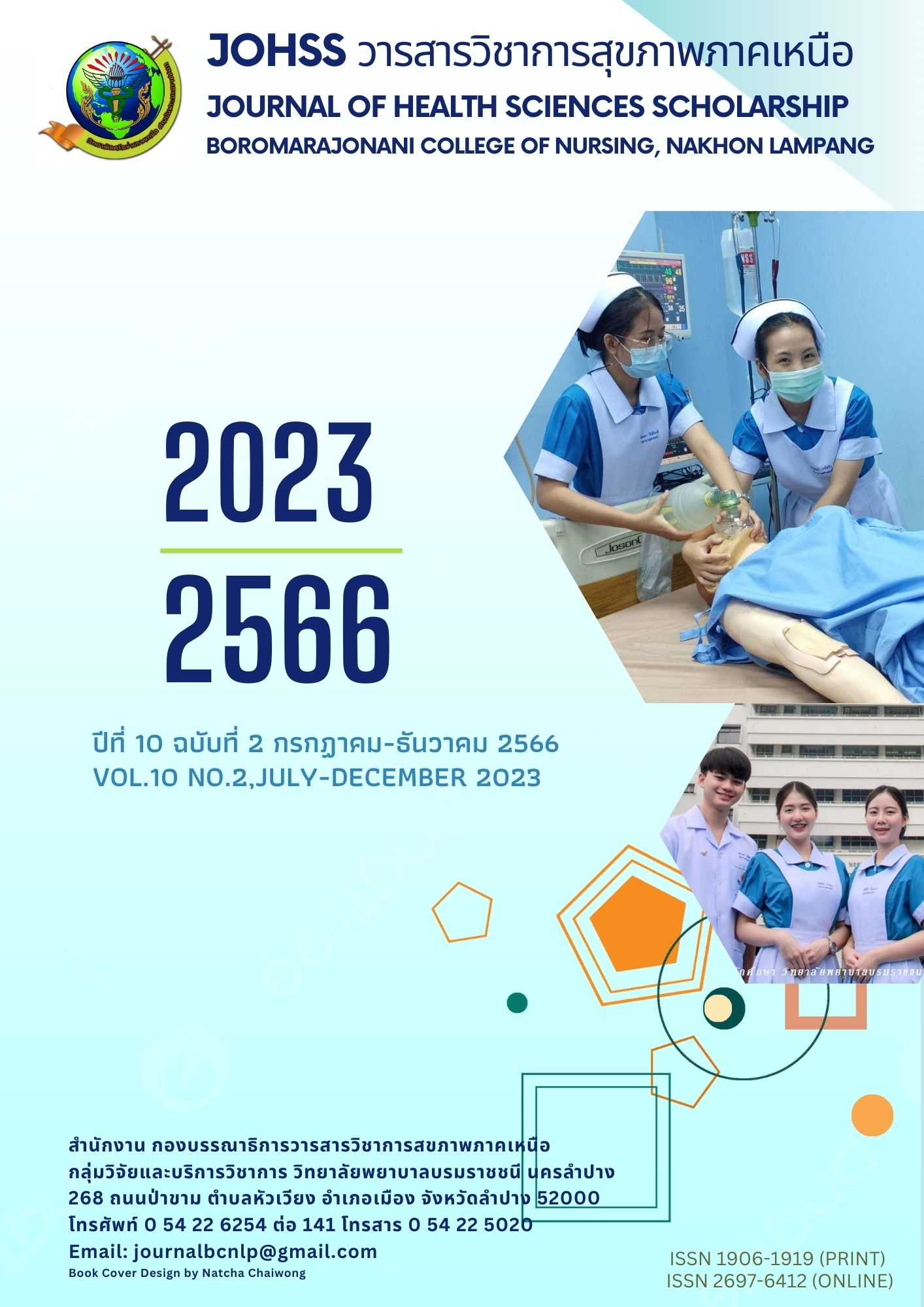
The Effect of program knowledge and skills for basic life support of Nursing Practice Course of 1st year nursing students
Keywords:
Knowledge, Skills, Basic life supportAbstract
This research is a one-group pre-test- post-test quasi-experimental research to study the effect of teaching and learning programs on knowledge and basic life support skills of 1st year nursing students. Data was collected from August to October 2023. The study samples from 50 people the 1st year nursing student who had never received basic life support training. The experimental tools were basic life support programs, pretest and posttest questionnaire, and skills questionnaire with reliability of 1.0, 0.95, and 0.91 respectively. Data were analyzed by descriptive and paired sample t–test.
The results of the study after the experiment, the mean scores of basic life support knowledge of the first-year nursing students (M=17.2, SD=4.84) was significantly higher than before (M=2.52, SD=1.76) (t=20.08, p<.05). The mean scores for basic life support skills after program (M=9.40, SD=0.75) was significantly higher than before (M=3.48, SD=1.19), (t=30.94, p<.05).
Therefore, program knowledge and skills for basic life support of nursing practice course of 1st year nursing students can be utilized to develop accurate decision-making, critical thinking, and proper practical skills. The emphasis of the program lies in processing information effectively, highlighting the efficiency of correct practices.
References
American Heart Association. (2020). High lights of the 2020 American Heart Association guidelines for CPR and ECC. Retrieved from https://cpr.heart.org/-/media/cpr-files/cpr-guidelines-files/highlights/hghlghts_2020_ecc_guidelines_english.pdf
Anderson, LW., & David, K. (2001). A taxonomy for learning, teaching, and assessing: a revision of Bloom's taxonomy of educational objectives. Retrieved from https://cft.vanderbilt.edu/guides-sub-pages/blooms-taxonomy/
Bloom, B.S. (1975). Taxonomy of Education. New York: David McKay Company.Chaiwong, N., Phakpho, K., Kraisin, W., Sakha, M., Kambang, W., Phimathai, P., & Pakdelun, K. (2021, July 29-30). The Effects of Learning Skill Development of Basic Life Support to Sudden Cardiac Arrest Program for Student of Buriram Rajabhat University, Ubon Ratchathani Rajabhat University, Ubon Ratchathani. (in Thai).
Division of Non Communicable Disease. (2022). The report non communicable diseases. Retrieved 23 June 2023, from http://www.thaincd.com/document/file/download/paper-manual/Report2565NCDs.pdf. (in Thai)
Huang, Y., He, Q., Yang, L. J., Liu, G. J., & Jones, A. (2014). Cardiopulmonary resuscitation (CPR) plus delayed defibrillation versus immediate defibrillation for out-of-hospital cardiac arrest. The Cochrane database of systematic reviews, 2014(9), CD009803. https://doi.org/10.1002/14651858.CD009803.pub2
Meaney, P. A., Bobrow, B. J., Mancini, M. E., Christenson, J., de Caen, A. R., Bhanji, F., Abella, B. S., Kleinman, M. E., Edelson, D. P., Berg, R. A., Aufderheide, T. P., Menon, V., Leary, M., & CPR Quality Summit Investigators, the American Heart Association Emergency Cardiovascular Care Committee, and the Council on Cardiopulmonary, Critical Care, Perioperative and Resuscitation (2013). Cardiopulmonary resuscitation quality: [corrected] improving cardiac Patel , K., & Hipskind, J. E. (2023). Cardiac Arrest. In StatPearls. StatPearls Publishing. resuscitation outcomes both inside and outside the hospital: a consensus statement from the American Heart Association. Circulation, 128(4), 417–435.
Norkaeo, D., Treenon, P., Nattaya, C., Kanbupar, N., Teanthong, S., & Kaewmanee, C. (2018). Nursing students knowledge and skills about Basic Life Support (BLS): The effects of simulation-based learning, The Southern College Network Journal of Nursing and Public Health, 5(3), 84-95. (in Thai).
Partiprajak, S. (2015). Relationship between knowledge, perceived self-efficacy in Basic Life Support (BLS) and chest compression performance among undergraduate nursing students. Songklanagarind Journal of Nursing, 35(1), 119-134. (in Thai).
Patel , K., Hipskind, J. E., & Akers, S. W. (2023). Cardiac Arrest (Nursing). In StatPearls. StatPearls Publishing.Robkob, W.,Inchaithep, S. & Thinwang, W. (2022). Development of learning outcomes based on learning and evaluation redesigned using standardized patient in Simulation-Based Learning (SBL) in mental health and psychiatric nursing courses. Journal of Health Sciences Scholarship, 9(1), 228-252. (in Thai).
Ruangrit, R., Keawpimon, P., & Sengloiluean, K. (2021). Knowledge, skills and self-confidence in Basic Life Support and Automated External Defibrillator (AED) using among under graduated nursing students, Princess of Naradhiwas University Journal, 13(2), 125-141. (in Thai).
Saengpanit, C. (2018). Factors associated with successful prehospital resuscitation of out of hospital cardiac arrest by emergency medical service, Uttaradit hospital. Boromarajonani College of Nursing, Uttaradit Journal, 85-96. (in Thai).
Srisuk, P., Apiratwarakul, K., Ienghong, K., Rattanaseeha, W., Kotruchin, P., & Buranasakda, M. (2017). Effectiveness of Basic Life Support and Automated External Defibrillator short-course training in undergraduate students. Srinagarind Medical Journal, 32(4), 332-337. (in Thai).
Tsao, C. W., Aday, A. W., Almarzooq, Z. I., Anderson, C. A. M., Arora, P., Avery, C. L., Baker-Smith, C. M., Beaton, A. Z., Boehme, A. K., Buxton, A. E., Commodore-Mensah, Y., Elkind, M. S. V., Evenson, K. R., Eze-Nliam, C., Fugar, S., Generoso, G., Heard, D. G., Hiremath, S., Ho, J. E., Kalani, R., … American Heart Association Council on Epidemiology and Prevention Statistics Committee and Stroke Statistics Subcommittee (2023). Heart Disease and Stroke Statistics-2023 Update: A Report From the American Heart Association. Circulation, 147(8), e93–e621.
Downloads
Published
Issue
Section
License
Copyright (c) 2023 Boromarajjonani College of Nursing, Nakhon Lampang

This work is licensed under a Creative Commons Attribution-NonCommercial-NoDerivatives 4.0 International License.
Articles, information, images, etc., published in the Journal of Health Sciences Scholarship is the copyright of the Journal of Health Sciences Scholarship. If any person or entity wants to bring all or part of it to publish or to do any action must be authorized by a letter from the Journal of Health Sciences Scholarship. The content and information in the article published in the Journal of Health Sciences Scholarship is considered and the responsibility of the author of the article directly, which editorial journals, no need to agree or share any responsibility.
Messages and Comments The author of the article. This is not the opinion of the journal, and the journal does not need to agree with the text and any comments of the author. The magazine reserves the right to consider publication as appropriate include the correct or refine the language to meet the criteria.

