
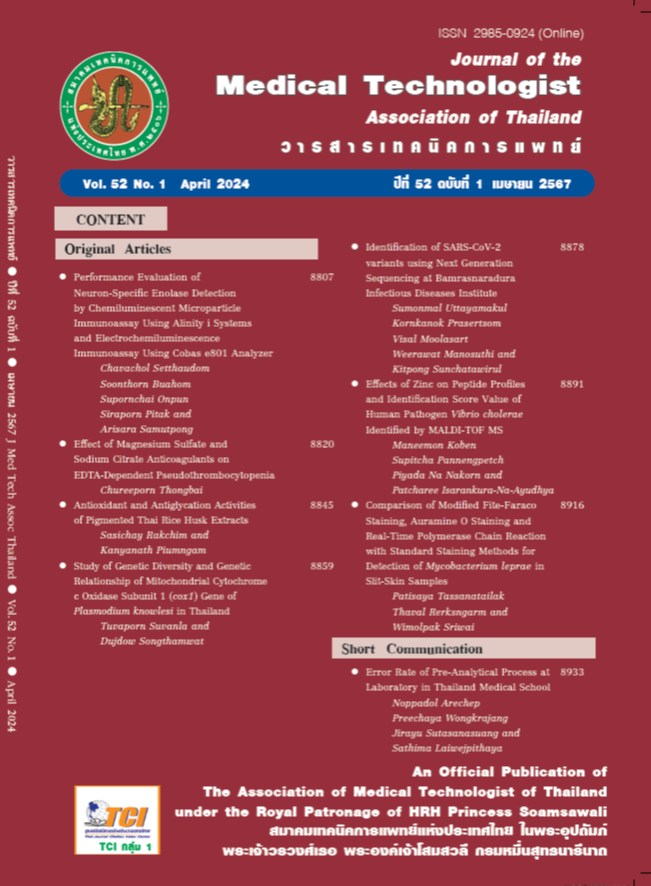
ผลกระทบของสังกะสีต่อรูปแบบเปปไทด์และค่าคะแนนในการระบุชื่อเชื้อก่อโรค Vibrio cholerae ด้วยเครื่อง MALDI-TOF MS
คำสำคัญ:
MALDI-TOF MS, สังกะสี, Vibrio cholerae, ค่าคะแนนที่ใช้ระบุเชื้อจุลชีพ, Biotyperบทคัดย่อ
เครื่อง Matrix-assisted laser desorption/ionization time-of-flight mass spectrometry (MALDI-TOF MS) สามารถระบุจีนัสและสปีชีส์ของจุลชีพได้อย่างรวดเร็วและแม่นยำ โดยวิเคราะห์รูปแบบเปปไทด์ (mass spectra) ของแบคทีเรียและเปรียบเทียบกับฐานข้อมูล ด้วยความไวสูง ทำให้สามารถตรวจจับการเปลี่ยนแปลงของเปปไทด์ได้อย่างมีประสิทธิภาพ ปัจจุบันนิยมใช้สังกะสีเป็นอาหารเสริม และผสมในเครื่องดื่มหลายชนิด เนื่องจากมีคุณสมบัติในการเสริมสร้างระบบภูมิคุ้มกัน ความงามและใช้ลดความรุนแรงของโรคท้องร่วงได้ อย่างไรก็ตามผลกระทบของสังกะสีต่อการระบุเชื้อโรค เช่น Vibrio cholerae โดยใช้เทคนิค MALDI-TOF MS ยังไม่ชัดเจน ดังนั้น การวิจัยนี้มีวัตถุประสงค์เพื่อศึกษาผลกระทบของสังกะสีต่อรูปแบบเปปไทด์ และค่าคะแนนที่ใช้ในการระบุเชื้อจุลชีพ V. cholerae ระหว่างสายพันธุ์ที่มีและไม่มียีนก่อโรค โดยได้รับสังกะสีที่ความเข้มข้น 0.2 ถึง 0.8 มิลลิโมลาร์ และวิเคราะห์ด้วย MALDI-TOF MS พบว่าค่าคะแนนที่ใช้ในการระบุเชื้อจุลชีพทั้งสองสายพันธุ์มีแนวโน้มลดลงตามการเพิ่มขึ้นของความเข้มข้นสังกะสีอย่างมีนัยสำคัญ (p < 0.05) อย่างไรก็ตามยังสามารถระบุจีนัสและสปีชีส์ได้ถูกต้อง ผลการวิเคราะห์นี้สอดคล้องกับผลการวิเคราะห์รูปแบบเปปไทด์โดย principal component analysis (PCA) โดยพบการเปลี่ยนแปลงรูปแบบเปปไทด์ตามความเข้มข้นของสังกะสีอย่างมีนัยสำคัญ เฉพาะในสายพันธุ์ที่มียีนก่อโรคเท่านั้น (p < 0.01) นอกจากนี้พบว่าสังกะสีที่ความเข้มข้น 0.8 มิลลิโมลาร์ ส่งผลทำให้เกิดการระบุสายพันธุ์ (strain) ที่ผิดพลาด โดยพบว่ามีเปปไทด์ที่มีความจำเพาะกับผลของสังกะสีต่อเชื้อนี้ที่ตำแหน่ง m/z 4745, 5122, 6275 และ 7160 ดาลตัน ผลการวิจัยนี้ทำให้เกิดองค์ความรู้เกี่ยวกับผลกระทบของสังกะสีที่มีต่อการระบุชนิดของแบคทีเรียโดยใช้เทคนิคMALDI-TOF MS นำไปสู่การวินิจฉัยเชื้อที่ถูกต้องแม่นยำ กรณีที่มีการรบกวนจากสังกะสีในสิ่งส่งตรวจ
เอกสารอ้างอิง
Azman AS, Rudolph KE, Cummings DA, et al. The incubation period of cholera: a systematic review. J Infect 2013; 66: 432-8.
Kimberlin DW, Brady MT, Jackson MA, Long SS. Vibrio infections. American Academy of Pediatrics; 2015: p. 860-3.
Loharikar AR, Menon MP, Tauxe RV, Mintz ED. Principles and practice of pediatric infectious diseases. 4th ed. New York, NY: Elsevier Saunders; 2012: 849-54.
Ali M, Lopez AL, You YA, et al. The global burden of cholera. Bull World Health Organ 2012; 90: 209-18A.
Epidemiology Bureau, Department of Disease Control, Ministry of Public Health. Summary of the analysis guidelines for the surveillance system of the five groups of diseases in five dimensions in the year 2016: Results of the risk analysis of abnormal events in public health. Available from: https://ddc.moph.go.th/doe/journal_detail.php?publish=10165
Ziegler TR, Evans ME, Fernandez-Estivariz C, Jones DP. Trophic and cytoprotective nutrition for intestinal adaptation, mucosal repair, and barrier function. Annu Rev Nutr 2003; 23: 229-61.
Oforka N, Osuji L, Onwuachu U. Estimation of dietary intake of cadmium, lead, manganese, zinc and nickel due to consumption of chicken meat by inhabitants of Port-Harcourt Metropolis, Nigeria. Arch Appl Sci Res 2012; 4: 675-84.
Canani RB, Cirillo P, Buccigrossi V, et al. Zinc inhibits cholera toxin-induced, but not Escherichia coli heat-stable enterotoxin-induced, ion secretion in human enterocytes. JID 2005; 191: 1072-7.
Bhattaram V, Upadhyay A, Yin HB, Mooyottu S, Venkitanarayanan K. Effect of dietary minerals on virulence attributes of Vibrio cholera. Front Microbiol 2017; 8. 911. doi:10.3389/fmicb.2017.00911.
WHO/UNICEF Joint statement. Clinical management of acute diarrhea. Available from: https://www.unicef.org/publications/files/ENAcute_Diarrhoea_reprint.pdf [cited 13 January 2023]. Available from: https://www.who.int/publications/i/item/WHO_FCH_CAH_04.7
Singhal N, Kumar M, Kanaujia PK, Virdi JS. MALDI-TOF mass spectrometry: An emerging technology for microbial identification and diagnosis. Front Microbiol 2015; 6: 791. doi:0.3389/ fmicb.2015.00791.
Steensels D, Verhaegen J, Lagrou K. Matrix-assisted laser desorption ionization-time of flight mass spectrometry for the identification of bacteria and yeasts in a clinical microbiological laboratory. Acta Clin Belg 2011; 66: 267-73.
Chudobova D, Dostalova S, Ruttkay-Nedecky B, et al. The effect of metal ions on Staphylococcus aureus revealed by biochemical and mass spectrometric analyses. Microbiol Res 2015; 170: 147- 56. doi: 10.1016/j.micres.2014.08.003.
Wongprasert K, Pannengpetch P, Kumar T, Songthong P, Indrawattana N, Isarankura-Na-Ayudhya P. Effects of cadmium on peptide profiles and Biotyper score value of Escherichia coli O157:H7 identified by matrix-assisted laser desorption/ionization time-of-flight mass-spectrometry (MALDI-TOF/MS). J Med Tech Assoc Thailand 2020; 48: 7264-80
Laengsri V, Nuchnoi P, Isarankura-Na-Ayudhya C, Isarankura-Na-Ayudhya P. Proteomics and bioinformatics analysis reveal potential roles of cadmium-binding proteins in cadmium tolerance and accumulation of Enterobacter cloacae. Peer J 2019; 7: e6904. doi: 10.7717/peerj.6904.
Dec M, Puchalski A, Urban-Chmiel R, Wernicki A. 16S-ARDRA and MALDI-TOF mass spectrometry as tools for identification of Lactobacillus bacteria isolated from poultry. BMC Microbiol 2016; 16: 105.
Dilger T, Melzl H, Gessner A. Rapid and reliable identification of waterborne Legionella species by MALDI-TOF mass spectrometry. Microbiological Meth 2016; 127: 154-9.
Suarez S, Ferroni A, Lotz A, et al. Ribosomal proteins as biomarkers for bacterial identification by mass spectrometry in the clinical microbiology laboratory. Microbiol Meth 2013; 94: 390-6.
Pineda FJ, Antoine MD, Demirev PA, et al. Microorganism identification by matrix-assisted laser/desorption ionization mass spectrometry and model-derived ribosomal protein biomarkers. Anal Chem 2003; 75: 3817-22.
Schulthess B, Brodner K, Bloemberg GV, Zbinden R, Böttger EC, Hombach M. Identification of Gram-positive cocci by use of matrix-assisted laser desorption-time of flight mass spectrometry: comparison of different preparation methods and implementation of a practical algorithm for routine diagnostics. J Clin Microbiol 2013; 51: 1834-40.
Niyompanich S, Srisanga K, Jaresitthikunchai J, Roytrakul S, Tungpradabkul S. Utilization of whole-cell MALDI-TOF mass spectrometry to differentiate Burkholderia pseudomallei wild-type and constructed mutants. PloS one 2015; 10: e0144128. doi.org/10.1371/journal
Paauw A, Trip H, Niemcewicz M. et al. OmpU as a biomarker for rapid discrimination between toxigenic and epidemic Vibrio cholerae O1/O139 and non-epidemic Vibrio cholerae in a modified MALDI-TOF MS assay. BMC Microbiology 2014; 14: 158. doi.org/10.1186/1471- 2180-14-158.
Schirmeister F, Dieckmann R, Bechlars S, Bier N, Faruque SM, Strauch E. Genetic and phenotypic analysis of Vibrio cholerae non-O1, non-O139 isolated from German and Austrian patients. Eur J Clin Microbiol Infect Dis 2014; 33: 767-78. doi: 10.1007/s10096-013-2011-9
Ianeva OD. Mechanisms of bacteria resistance to heavy metals. Mikrobiol Z 2009; 71: 54-65. 25. Chudobova D, Dostalova S, Ruttkay-Nedecky B, et al. The effect of metal ions on Staphylococcus aureus revealed by biochemical and mass spectrometric analyses. Microbiol Res 2015; 170: 147- 56. doi: 10.1016/j.micres.2014.08.003.
Faiz U, Butt T, Satti L, Hussain W, Hanif F. Efficacy of zinc as an antibacterial agent against enteric bacterial pathogens. J Ayub Med Coll Abbottabad 2011; 23: 18-21.
Sheng Y, Fan F, Jensen O, et al. Dual zinc transporter systems in Vibrio cholerae promote competitive advantages over gut microbiome. Infect Immun 2015; 83: 3902-8. doi: 10.1128/IAI.00447-15.
Arnoldini M, Cremer J, Hwa T. Bacterial growth, flow, and mixing shape human gut microbiota density and composition. Gut Microbes 2018; 9: 559-66. doi: 10.1080/19490976.2018.1448741.
Ma T, Verkman AS. Aquaporin water channels in gastrointestinal physiology. J Physiol 1999; 517: 317-26. doi: 10.1111/ j.1469-7793.
Drinker KR, Fehnel JW, Marsh M. The normal excretion of zinc in the urine and feces of man. J Biol Chem 1927; 72: 375- 83.
Teramoto K, Horiguchi S, Ninomiya K. Zinc content in Japanese food and estimated average daily intake. Asia Pac J Public Health 1987; 1: 32-42. doi: 10.1177/101053958700100306. #in2 66-4.indd 8915 29/2/2567 BE 11:5
ดาวน์โหลด
เผยแพร่แล้ว
รูปแบบการอ้างอิง
ฉบับ
ประเภทบทความ
สัญญาอนุญาต
ลิขสิทธิ์ (c) 2024 วารสารเทคนิคการแพทย์

อนุญาตภายใต้เงื่อนไข Creative Commons Attribution-NonCommercial-NoDerivatives 4.0 International License.


