
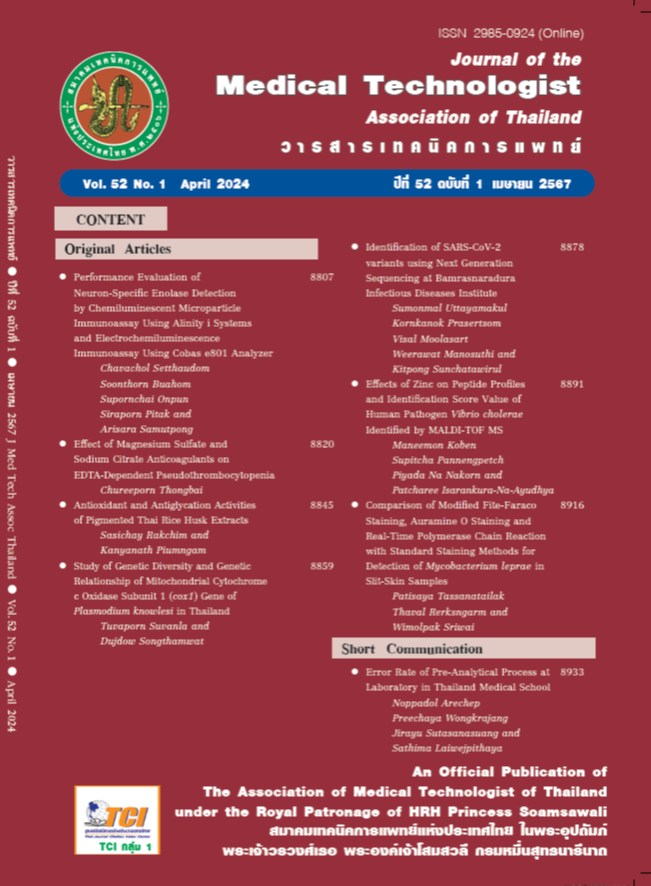
Comparison of Modified Fite-Faraco Staining, Auramine O Staining and Real-Time Polymerase Chain Reaction with Standard Staining Methods for Detection of Mycobacterium leprae in Slit-Skin Samples
Keywords:
Slit-skin smear, Acid fast bacilli staining, Fluorescence, Leprosy, Modified Fite-Faraco, Real-time PCRAbstract
Detection of Mycobacterium leprae by modified Fite-Faraco (FF), fluorescent Auramine O (AO) method, real-time polymerase chain reaction (PCR) of Pra gene and the standard Ziehl Neelsen (ZN) staining were compared in slit-skin samples from 32 leprosy patients attending the Raj Pracha Samasai Institute. Scraped incision method was performed to collect tissue fluid and dermal tissue from the same 4 sites including two from both ear lobes and two from the active lesions. Slit-skin smears (SSS) were prepared and stained by ZN, FF and AO methods. The collected specimens were evaluated for the present of Pra gene using real-time PCR method. Fite-Faraco was modified by omitting the deparaffinization instead submerge the slide in soybean oil for 10 minutes. There was a very good correlation among all methods. Out of 32 samples, 7 showed organisms by ZN method, 9 showed organisms by FF method, 11 showed organisms by AO method and 9 showed organisms by real-time PCR method. FF and AO stains were found to be superior to ZN in detecting leprae bacilli in SSS. Moreover, sensitivity was identical for real-time PCR, FF, and AO methods for multibacillary (MB) cases suggesting that real-time PCR, FF and AO techniques on the SSS could replace ZN without any loss of sensitivity. FF procedure uses simple equipment, easy to carry out, and convenient procedure. Therefore, the modified Fite-Faraco method described here can be used for the confirmation of the clinical diagnosed case of leprosy in resource-limited hospitals.
References
World Health Organization. Guidelines for the diagnosis, treatment and prevention of leprosy. 2017 [cited 2023 April 30]:[106 p.]. Available from: https://www.who.int/ publications/i/item/9789290226383.
World Health Organization. Global leprosy (Hansen disease) update, 2021: moving towards interruption of transmission. Wkly Epidemiol Rec 2022; 97: 429-50.
WHO Expert Committee on Leprosy & World Health Organization. WHO Expert Committee on Leprosy [meeting held in Geneva from 17 to 24 November 1987]: sixth report. Geneva: World Health Organization; 1988.
WHO Expert Committee on leprosy & World Health Organization. WHO Expert Committee on leprosy: eighth report. WHO Technical Report Series [Internet]. 2012 [cited 2023 April 25]:[72 p.]. Available from: https://apps.who.int/iris/handle/10665/75151.
Buhrer-Sekula S, Smits HL, Gussenhoven GC, et al. Simple and fast lateral flow test for classification of leprosy patients and identification of contacts with high risk of developing leprosy. J Clin Microbiol 2003; 41: 1991-5.
Burgess PJ, Fine PE, Ponnighaus JM, Draper C. Serological tests in leprosy. The sensitivity, specificity and predictive value of ELISA tests based on phenolic glycolipid antigens, and the implications for their use in epidemiological studies. Epidemiol Infect 1988; 101: 159-71.
Martinez AN, Britto CF, Nery JA, et al. Evaluation of real-time and conventional PCR targeting complex 85 genes for detection of Mycobacterium leprae DNA in skin biopsy samples from patients diagnosed with leprosy. J Clin Microbiol 2006; 44: 3154-9.
Reja AH, Biswas N, Biswas S, et al. Fite-Faraco staining in combination with multiplex polymerase chain reaction: a new approach to leprosy diagnosis. Indian J Dermatol Venereol Leprol 2013; 79: 693- 700.
Job CK, Jayakumar J, Williams DL, Gillis TP. Role of polymerase chain reaction in the diagnosis of early leprosy. Int J Lepr Other Mycobact Dis 1997; 65: 461-4.
Bishop PJ, Neumann G. The history of the Ziehl-Neelsen stain. Tubercle 1970; 51: 196-206.
Tharinjaroen CS. Review article: Tuberculosis diagnosis: From knowledge to innovation in public health. JAMS 2017; 50: 1-21. (in Thai)
Adiga DS, Hippargi SB, Rao G, Saha D, Yelikar BR, Karigoudar M. Evaluation of Fluorescent Staining for Diagnosis of Leprosy and its Impact on Grading of the Disease: Comparison with Conventional Staining. J Clin Diagn Res 2016; 10: EC23- EC6.
Ngamwachiraporn S, Chomean S, Rerksngarm T. Screening test of Mycobacterium leprae infection in paubacillary Leprosy patients by Rapid serological test. TSTJ 2018; 26: 1253-63. (in Thai)
Nayak SV, Shivarudrappa AS, Mukkamil AS. Role of fluorescent microscopy in detecting Mycobacterium leprae in tissue sections. Ann Diagn Pathol 2003; 7: 78-81.
Ulukanligil M, Aslan G, Tasci S. A comparative study on the different staining methods and number of specimens for the detection of acid fast bacilli. Mem Inst Oswaldo Cruz 2000; 95: 855-8.
Kalagarla S, Alluri R, Saka S, Godha V, Undavalli N, Kolalapudi SA. Efficacy of fluorescent microscopy versus modified Fite-Faraco stain in skin biopsy specimens of leprosy cases - a comparative study. Int J Dermatol 2022; 61: 595-9.
Swamy AKC, Patra AK. A Study on Comparison between Ziehl Neelsen Staining with Auramine Rhodamine Staining in Diagnosis of Paucibacillary Leprosy. IJSR 2019; 10: 177-81.
World Health Organization. Laboratory techniques for leprosy.: World Health Organization; 1987. 177 p.
Clapasson A, Canata S. Laboratory investigations in leprosy. In: Nunzi E, Massone C, Portaels F, editors. Leprosy and buruli ulcer: a practical guide. Cham: Springer International Publishing; 2022. p. 61-70.
Rajapracha Samasai Institute. Guidelines for diagnosis of leprosy by slit-skin smear. 1st ed. Nonthaburi: National Buddhism Printing House; 2004. 73 p. (in Thai)
Truant JP, Brett WA, Thomas W, Jr. Fluorescence microscopy of tubercle bacilli stained with auramine and rhodamine. Henry Ford Hosp Med Bull 1962; 10: 287-96.
Girma S, Avanzi C, Bobosha K, et al. Evaluation of Auramine O staining and conventional PCR for leprosy diagnosis: A comparative cross-sectional study from Ethiopia. PLoS Negl Trop Dis 2018; 12: e0006706.
Wichitwechkarn J, Karnjan S, Shuntawuttisettee S, Sornprasit C, Kampirapap K, Peerapakorn S. Detection of Mycobacterium leprae infection by PCR. J Clin Microbiol 1995; 33: 45-9.
Landis JR, Koch GG. An application of hierarchical kappa-type statistics in the assessment of majority agreement among multiple observers. Biometrics 1977; 33: 363-74.
Hayes AF, Krippendorff K. Answering the Call for a Standard Reliability Measure for Coding Data. Commun Methods Meas 2007; 1: 77-89.
Pattyn SR. The problem of cultivation of Mycobacterium leprae. A review with criteria for evaluating recent experimental work. Bulletin of the World Health Organization 1973; 49: 403-10.
Jariwala HJ, Kelkar SS. Fluorescence microscopy for detection of M. leprae in tissue sections. Int J Lepr Other Mycobact Dis 1979; 47: 33-6.
Pollock HM, Wieman EJ. Smear results in the diagnosis of mycobacterioses using blue light fluorescence microscopy. J Clin Microbiol 1977; 5: 329-31.
Martinez AN, Talhari C, Moraes MO, Talhari S. PCR-based techniques for leprosy diagnosis: from the laboratory to the clinic. PLoS Negl Trop Dis 2014; 8: e2655.
Dehe BR, Coulibaly NgD, Kouakou H, et al. Comparative assessments of polymerase chain reaction (PCR) assay of repetitive sequence (RLEP) and proline rich antigen (PRA) gene targets for detection of Mycobacterium leprae DNA from paucibacillary (PB) and multibacillary (MB) patients in Côte d’Ivoire. GSCBPS 2020; 11: 085-92.
Downloads
Published
How to Cite
Issue
Section
License
Copyright (c) 2024 Journal of the Medical Technologist Association of Thailand

This work is licensed under a Creative Commons Attribution-NonCommercial-NoDerivatives 4.0 International License.


