
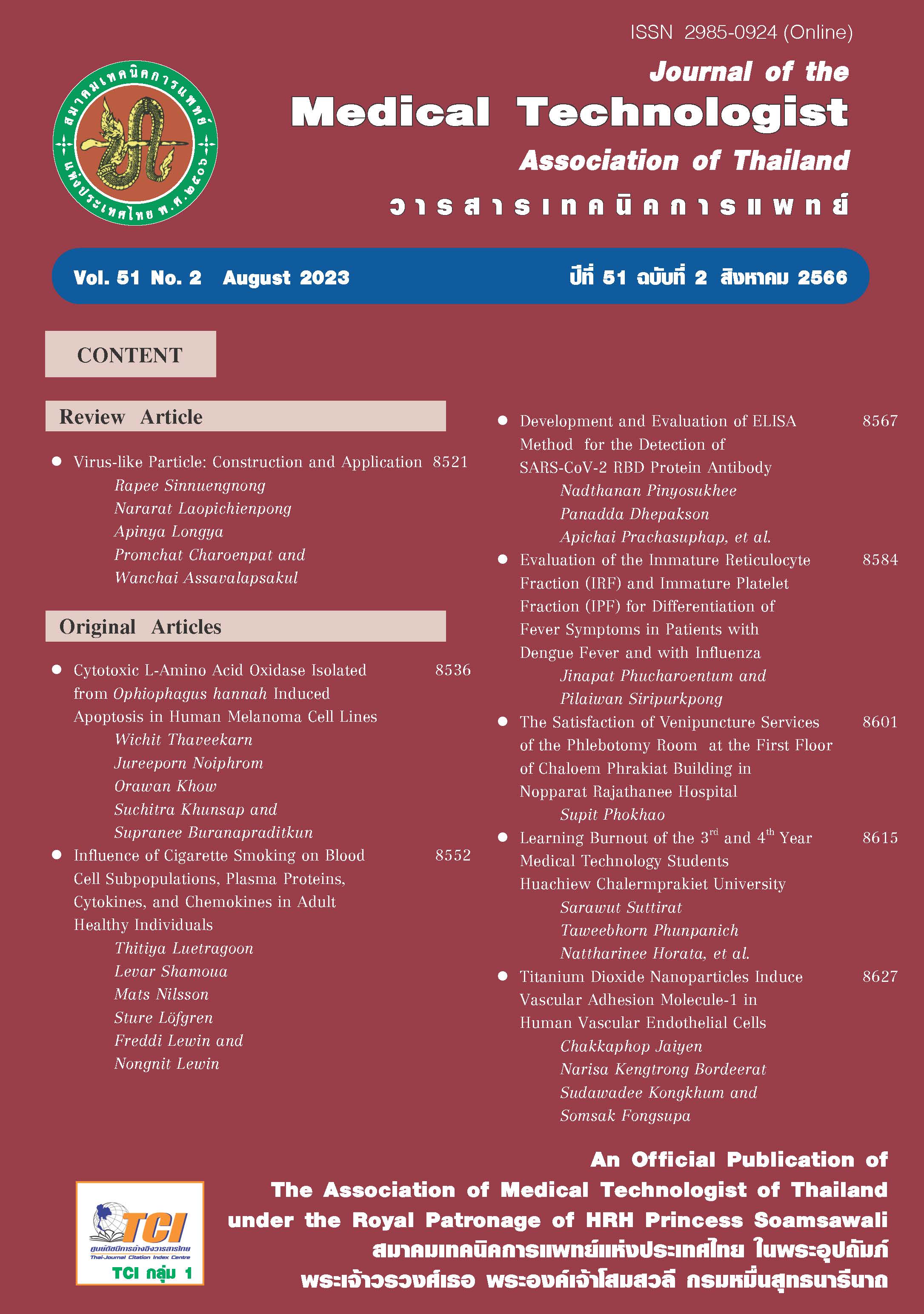
การประเมินค่าตัวอ่อนของเรติคูโลไซต์ (IRF) และค่าตัวอ่อน ของเกล็ดเลือด (IPF) เพื่อจำแนกอาการไข้ในผู้ป่วยโรคไข้เดงกีออกจากโรคไข้หวัดใหญ่
คำสำคัญ:
ตัวอ่อนของเรติคูโลไซต์ , ตัวอ่อนของเกล็ดเลือด , ไข้เดงกีบทคัดย่อ
โรคไข้เดงกีเกิดจากการติดเชื้อไวรัสเดงกีที่มียุงลายเพศเมียเป็นพาหะนำโรค หนึ่งในพยาธิสภาพของโรคคือการกดการทำงานของไขกระดูกที่ส่งผลต่อการสร้างเซลล์เม็ดเลือดและเกล็ดเลือด ค่าตัวอ่อนของเรติคูโลไซต์ (immature reticulocyte fraction; IRF) และค่าตัวอ่อนของเกล็ดเลือด (immature platelet fraction; IPF) เป็นพารามิเตอร์ที่บ่งชี้การทำงานของไขกระดูก โดยค่า IRF ใช้ในการประเมินและติดตามการรักษาผู้ป่วยที่ปลูกถ่ายไขกระดูกและผู้ป่วยที่มีภาวะซีด ในขณะที่ค่า IPF ใช้ประเมินการให้เกล็ดเลือดแก่ผู้ป่วยที่ได้เปลี่ยนถ่ายเกล็ดเลือด งานวิจัยนี้ศึกษาในกลุ่มตัวอย่างที่มีอายุ 18-34 ปีจำนวน 122 คน โดยแบ่งเป็นกลุ่มควบคุม กลุ่มโรคไข้หวัดใหญ่ และกลุ่มโรคไข้เดงกีที่แบ่งเป็นระยะไข้ ระยะวิกฤต และระยะฟื้นตัว มีการเก็บข้อมูลเพศ อายุ อุณหภูมิร่างกาย ความดันโลหิต ชีพจร ร่วมกับผลตรวจความสมบูรณ์ของเม็ดเลือด (complete blood counts; CBC) พบว่ากลุ่มควบคุม กลุ่มโรคไข้หวัดใหญ่ และกลุ่มโรคไข้เดงกี มีค่า IRF เฉลี่ยร้อยละ 9.65, 8.33 และ 11.87 และค่า IPF เฉลี่ยร้อยละ 1.77, 2.46 และ 4.82 ตามลำดับ ค่า IPF มีความแตกต่างกันอย่างมีนัยสำคัญ (p < 0.001) ในขณะที่ค่า IRF ไม่มีความแตกต่างกัน ส่วนผู้ป่วยโรคไข้เดงกีระยะไข้ ระยะวิกฤต และระยะฟื้นตัว มีค่า IRF ร้อยละ 10.96, 10.66 และ 13.99 และค่า IPF ร้อยละ 3.01, 7.95 และ 3.50 ตามลำดับค่า IPF มีความแตกต่างกันอย่างมีนัยสำคัญ (p = 0.001) ในขณะที่ค่า IRF ไม่มีความแตกต่างกัน เมื่อเปรียบเทียบค่า IRF และ IPF ในผู้ป่วยที่มีไข้ (อุณหภูมิร่างกาย ≥ 37.5 องศาเซลเซียส) ระหว่างกลุ่มโรคไข้หวัดใหญ่และกลุ่มโรคไข้เดงกี พบว่าค่า IRF ไม่มีความแตกต่างกัน (p = 0.970) ในขณะที่ค่า IPF ในกลุ่มโรคไข้เดงกี (ร้อยละ 5.48) มีค่าสูงกว่าในกลุ่มโรคไข้หวัดใหญ่ (ร้อยละ 2.45) อย่างมีนัยสำคัญ (p < 0.001) ผล ROC curve ของค่า IPF ที่จุดตัด (cut-off) ร้อยละ 2.15 พื้นที่ใต้กราฟ0.777 (0.668-0.886 ที่ระดับความเชื่อมั่นร้อยละ 95) มีความไวร้อยละ 85.7 ความจำเพาะร้อยละ 50.0 บ่งชี้ว่าค่า IPF น่าจะนำมาใช้ร่วมกับค่าพารามิเตอร์อื่น และอาการของผู้ป่วยในการคัดกรองผู้ป่วยที่มีไข้ จากโรคไข้เดงกีออกจากผู้ป่วยที่มีไข้จากโรคไข้หวัดใหญ่ได้ เพื่อนำไปสู่การวินิจฉัยและการรักษาโรคไข้เดงกีได้ทันท่วงที
เอกสารอ้างอิง
Siriyasatien P, Phumee A, et. al. Analysis of significant factors for dengue fever incidence prediction. BMC Bioinform. 2016;17(1):1-9.
Khetarpal N, Khanna I. Dengue fever: causes, complications, and vaccine strategies. J Immunol Res. 2016, Article ID 6803098,14 pages. Available from: http://dx.doi.org/10.1155/2016/6803098.
Murphy BR, Whitehead SS. Immune response to dengue virus and prospects for a vaccine. Annual Rev Immunol. 2011;29:587-619.
Department of disease control, Minitry of public health. Situation of dengue fever in the 23rd week, 2019. Office of the permanent secretary Ministry of public health 2019. (In Thai)
Kanoktip T, Sukathida U, Chantapong W. Dengue fever, dengue hemorrhagic fever: virology, immunopathogenesis, diagnosis, vaccine, prevention and control. 2006. Available from: https://repository.li.mahidol.ac.th/handle/123456789/57117 (In Thai)
La Russa VF, Innis BL. Mechanisms of dengue virus-induced bone marrow suppression. Baillières Clin Haematol. 1995;8(1):249-70.
Butthep P. Advanced technology in automated blood cell analyzer. Hemato Transfus Med. 2009;19 (1):13-9.
Briggs C. Quality counts: new parameters in blood cell counting. Int J Lab hematol. 2009;31(3):277-97.
Sindhu R, Behera S, Mishra D. Role of immature reticulocyte fraction in evaluation of aplastic anemia in cases of pancytopenia. Indian J Basic Appl Med Res. 2016;5(3):619-24.
Yesmin M, Nesa A, Sultana T, et. al. Haematopoietic recovery on induction therapy in acute lymphoblastic leukaemia by automated Reticulocyte Analysis. Bangladesh J Patho. 2011;26(1):10-3.
Oehadian A, Vidyaniati P, Candra JM, et. al. Erythropoiesis differences in various clinical phases of dengue fever using immature reticulocyte fraction parameter. IJIHS. 2021;9(1):7-12.
Briggs C, Hart D, Kunka S, et. al. Immature platelet fraction measurement: a future guide to platelet transfusion requirement after haematopoietic stem cell transplantation. Transfus Med. 2006;16(2):101-9.
Dadu T, Sehgal K, Joshi M, et. al. Evaluation of the immature platelet fraction as an indicator of platelet recovery in dengue patients. Int J Lab hemato. 2014;36(5):499-504.
Tanaka Y. Plasmacytoid lymphocytes: a diagnostic clue for dengue fever. Internal Med. 2018;57(19):2917.
Department of medical services, Ministry of public health. Guidelines for diagnosis and treatment of dengue hemorrhagic fever in central and general hospitals, Bangkok: The agricultural co-operative federation of Thailand, Ltd; 2005;1:8-33.
Department of medical services, Ministry of public health. Clinical practice guideline for influenza, 3rd reu. ed:2011.
Ramathibodi hospital, Mahidol university. Follow up pediatric patients treatment. Guidelines for caring pediatric patients after bone marrow transplantation. Bangkok: Swichan Press Ltd., 2004:16.
Naz A, Mukry SN, Shaikh MR, et. al. Importance of immature platelet fraction as predictor of immune thrombocytopenic purpura. Paki J Med Sci. 2016;32(3):575-9.
Khormi HM, Kumar L. Modeling dengue fever risk based on socioeconomic parameters, nationality and age groups: GIS and remote sensing based case study. Sci Total Environ 2011;409(22):4713-9.
Laoprasopwattana K. The theory into practice of dengue virus infection. Songkla: Faculty of medicine, Prince of Songkla university;2017.
World Health Organization. Guidelines for diagnosis, treatment, prevention and control. 2009.
Jampangern W, Vongthoung K, Jittmittraphap A, et. al. Characterization of atypical lymphocytes and immunophenotypes of lymphocytes in patients with dengue virus infection. Asian Pac J Allergy Immuno. 2007;25(1):27.
Chuansumrit A, Apiwattanakul N, Sirachainan N, et. al. The use of immature platelet fraction to predict time to platelet recovery in patients with dengue infection. Paediatr and Int Child Health. 2020;40(2):124-8.
Madhusudan S, Prabhavathi R, Ranganath K, et. al. Study of immature platelet fraction as a predictor of platelet recovery in pediatric dengue patients. J Cardiovas Dis Res. 2022;13(05):1655-9.
Lin CF, Lei HY, Liu CC, et. al. Generation of IgM anti‐platelet autoantibody in dengue patients. Med Virol. 2001;63(2):143-9.
Sun DS, King CC, Huang HS, et. al. Antiplatelet autoantibodies elicited by dengue virus non‐structural protein 1 cause thrombocytopenia and mortality in mice. Thromb and Haemost. 2007;5(11):2291-9.
Hottz ED, Oliveira MF, Nunes PC, et. al. Dengue induces platelet activation, mitochondrial dysfunction and cell death through mechanisms that involve DC-SIGN and caspases. Thromb and Haemost. 2013;11(5):951-62.
Azeredo ELd, Monteiro RQ, de-Oliveira Pinto LM. Thrombocytopenia in dengue: interrelationship between virus and the imbalance between coagulation and fibrinolysis and inflammatory mediators. Mediators Inflamm. 2015, Article ID 313842,16 pages. Available from: http://dx.doi.org/10.115/2015/313842
Clark KB, Noisakran S, Onlamoon N, et. al. Multiploid CD61+ cells are the pre-dominant cell lineage infected during acute dengue virus infection in bone marrow. Plos One. 2012;7(12):e52902.
World Health Organization. Guidelines for the treatment of malaria, Switzerland, 2006.
World Health Organization. Integrated management of childhood illness. 2008.
Looi KW, Matsui Y, Kono M, et. al. Evaluation of immature platelet fraction as a marker of dengue fever progression. Intern J of Infect Dis. 2021;110:187-94.
Yasuda I, Saito N, Suzuki M, et. al. Unique characteristics of new complete blood count parameters, the immature platelet fraction and the immature platelet fraction count, in dengue patients. Plos One. 2021;16(11):e0258936.
ดาวน์โหลด
เผยแพร่แล้ว
รูปแบบการอ้างอิง
ฉบับ
ประเภทบทความ
สัญญาอนุญาต
ลิขสิทธิ์ (c) 2023 วารสารเทคนิคการแพทย์

อนุญาตภายใต้เงื่อนไข Creative Commons Attribution-NonCommercial-NoDerivatives 4.0 International License.


