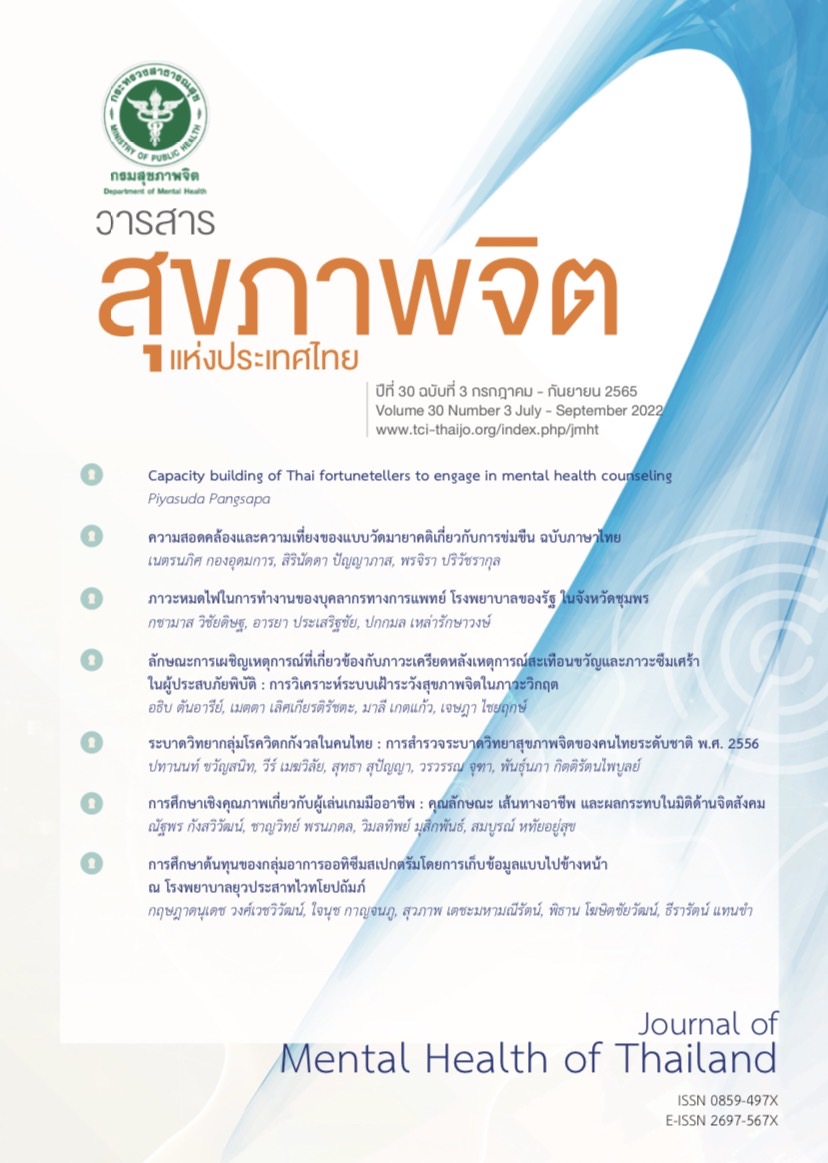
ลักษณะการเผชิญเหตุการณ์ที่เกี่ยวข้องกับภาวะเครียดหลังเหตุการณ์สะเทือนขวัญและภาวะซึมเศร้าในผู้ประสบภัยพิบัติ : การวิเคราะห์ระบบเฝ้าระวังสุขภาพจิตในภาวะวิกฤต
คำสำคัญ:
ความเครียดหลังเหตุการณ์สะเทือนขวัญ, ภาวะซึมเศร้า, เหตุการณ์วิกฤตบทคัดย่อ
วัตถุประสงค์ : เพื่อประมาณความชุกของปัญหาสุขภาพจิตและความสัมพันธ์กับลักษณะการเผชิญเหตุการณ์ของผู้ได้รับผลกระทบจากเหตุการณ์วิกฤตในประเทศไทย
วิธีการ : ใช้ข้อมูลจากระบบเฝ้าระวังสุขภาพจิตในภาวะวิกฤต (crisis mental health surveillance system; CMS) ระหว่างปี พ.ศ. 2560 - 2563 ในประชาชนที่อาศัยอยู่ภายในพื้นที่เกิดเหตุการณ์วิกฤต อายุ 18 ปีขึ้นไป สำรวจลักษณะพื้นฐานก่อนเกิดเหตุการณ์ ลักษณะการเผชิญเหตุการณ์ และคัดกรองภาวะเครียดหลังเหตุการณ์สะเทือนขวัญและภาวะซึมเศร้าช่วง 2 สัปดาห์ถึง 3 เดือนหลังเกิดเหตุการณ์ วิเคราะห์ข้อมูลด้วย chi-square test และการวิเคราะห์ถดถอยโลจิสติก เพื่อหาปัจจัยที่เกี่ยวข้องกับผลกระทบทางจิตเวช
ผล : กลุ่มตัวอย่าง 1,489 คน ร้อยละ 80.1 ประสบภัยพิบัติจากการกระทำของมนุษย์ ร้อยละ 13.3 ประสบภัยธรรมชาติ ความชุกของภาวะเครียดหลังเหตุการณ์สะเทือนขวัญและภาวะซึมเศร้าเท่ากับร้อยละ 2.4 (95% CI = 2.8 - 4.7) และ 3.8 (95% CI = 1.6 - 3.2) ตามลำดับ ลักษณะพื้นฐานที่มีความสัมพันธ์กับปัญหาสุขภาพจิต ได้แก่ อายุ สถานภาพสมรส และศาสนา เมื่อควบคุมลักษณะพื้นฐานที่สำคัญและประเภทของเหตุการณ์วิกฤตพบว่า การได้รับบาดเจ็บ สูญเสียญาติ ผู้สูงอายุติดบ้านหรือติดเตียง และผู้ที่มีความเครียด กังวล ท้อแท้ สิ้นหวัง หลังเกิดเหตุการณ์ เพิ่มโอกาสเกิดภาวะเครียดหลังเหตุการณ์สะเทือนขวัญอย่างมีนัยสำคัญ ในขณะที่การได้รับบาดเจ็บ อยู่ในเหตุการณ์ มีญาติเสียชีวิต มีญาติบาดเจ็บ และรับรู้เหตุการณ์ เพิ่มโอกาสเกิดภาวะซึมเศร้าอย่างมีนัยสำคัญ
สรุป : ฐานข้อมูล CMS สามารถใช้คัดแยกผู้ที่ต้องการความช่วยเหลือทางจิตใจอย่างเร่งด่วนหลังประสบเหตุการณ์วิกฤต โดยเฉพาะผู้ที่ได้รับบาดเจ็บ ญาติผู้บาดเจ็บหรือเสียชีวิต ผู้สูงอายุติดบ้านหรือติดเตียง และผู้ที่มีความเครียด กังวล ท้อแท้ สิ้นหวัง หลังเกิดเหตุการณ์
Downloads
เอกสารอ้างอิง
Norris FH, Elrod CL. Psychosocial consequences of disaster: a review of past research. In: Norris FH, Galea S, Friedman MJ, Watson PJ, editor. Methods for disaster mental health research. New York: The Guilford Press; 2006. p. 20-42.
Karl A, Schaefer M, Malta LS, Dörfel D, Rohleder N, Werner A. A meta-analysis of structural brain abnormalities in PTSD. Neurosci Biobehav Rev. 2006;30(7):1004-31. doi:10.1016/j.neubiorev.2006.03.004.
Koenen KC, Ratanatharathorn A, Ng L, McLaughlin KA, Bromet EJ, Stein DJ, et al. Posttraumatic stress disorder in the world mental health surveys. Psychol Med. 2017;47(13):2260-74. doi:10.1017/S0033291717000708.
Tang B, Liu X, Liu Y, Xue C, Zhang L. A meta-analysis of risk factors for depression in adults and children after natural disasters. BMC Public Health. 2014;14:623. doi:10.1186/1471-2458-14-623.
Tracy M, Norris FH, Galea S. Differences in the determinants of posttraumatic stress disorder and depression after a mass traumatic event. Depression and Anxiety. 2011;28(8):666-75. doi:10.1002/da.20838.
Rytwinski NK, Scur MD, Feeny NC, Youngstrom EA. The co‐occurrence of major depressive disorder among individuals with posttraumatic stress disorder: A meta‐analysis. J Trauma Stress. 2013;26(3):299-309. doi:10.1002/jts.21814.
Palgi Y, Ben-Ezra M, Langer S, Essar N. The effect of prolonged exposure to war stress on the comorbidity of PTSD and depression among hospital personnel. Psychiatry Res. 2009;168(3):262-4. doi:10.1016/j.psychres.2008.06.003.
Gill JM, Page GG, Sharps P, Campbell JC. Experiences of traumatic events and associations with PTSD and depression development in urban health care-seeking women. J Urban Health. 2008;85(5):693-706. doi:10.1007/s11524-008-9290-y.
นพพร ตันติรังสี, กันตวรรณ มากวิจิต, วิชัย ลิขสิทธิ์ดํารงกุล, อัญชลี บุญรัตนา, เมตตา เลิศเกียรติรชตะ. ปัจจัยที่มีความสัมพันธ์กับโรคเครียดหลังเหตุการณ์สะเทือนขวัญ : การสำรวจระบาดวิทยาสุขภาพจิตของคนไทยระดับชาติ ปี พ.ศ. 2556 [Factors related with post-traumatic stress disorder: Thai national mental health survey 2013]. วารสารสุขภาพจิตแห่งประเทศไทย. 2560;25(2):122-35.
Hobfoll SE, Canetti‐Nisim D, Johnson RJ, Palmieri PA, Varley JD, Galea S. The association of exposure, risk, and resiliency factors with PTSD among Jews and Arabs exposed to repeated acts of terrorism in Israel. J Trauma Stress. 2008;21(1):9-21. doi:10.1002/jts.20307.
Cisler JM, Begle AM, Amstadter AB, Resnick HS, Danielson CK, Saunders BE, et al. Exposure to interpersonal violence and risk for PTSD, depression, delinquency, and binge drinking among adolescents: Data from the NSA‐R. J Trauma Stress. 2012;25(1):33-40. doi:10.1002/jts.21672.
Fan F, Zhang Y, Yang Y, Mo L, Liu X. Symptoms of posttraumatic stress disorder, depression, and anxiety among adolescents following the 2008 Wenchuan earthquake in China. J Trauma Stress. 2011;24(1):44-53. doi:10.1002/jts.20599.
สำนักยุทธศาสตร์สุขภาพจิต กรมสุขภาพจิต. ร่างรายงานการทบทวนสถานการณ์และแนวโน้มการดำเนินงานด้านสุขภาพจิตประกอบการจัดทำแผนยุทธศาสตร์กรมสุขภาพจิต ในช่วงแผนฯ 12 (พ.ศ.2560 - 2564) [Draft report reviewing the situation and trend of mental health operations for the preparation of the department of mental health strategic plan during the plan 12 (2017 - 2021)]. นนทบุรี: สำนัก; 2559.
เสาวลักษณ์ สุวรรณไมตรี, นพพร ตันติรังสี, พัชรินทร์ ศิริวิสุทธิรัตน์. คู่มือการปฏิบัติงานทีมช่วยเหลือเยียวยาจิตใจผู้ประสบภาวะวิกฤต [Mental Health Crisis Assessment and Treatment Team: MCATT]. นนทบุรี: กรมสุขภาพจิต กระทรวงสาธารณสุข; 2561.
ภควัต วิวัฒนวรเศรษฐ, จารุรินทร ปตานุพงศ์. ความชุกและปจจัยที่สัมพันธกับโรคเครียดทางจิตหลังประสบภัยระเบิด [Prevalence and association factors in posttraumatic stress disorder following a bombing]. วารสารสมาคมจิตแพทยแหงประเทศไทย. 2558;60(3):209-20.
van Griensven F, Chakkraband ML, Thienkrua W, Pengjuntr W, Lopes Cardozo B, Tantipiwatanaskul P, et al. Mental health problems among adults in tsunami-affected areas in southern Thailand. JAMA. 2006;296(5):537-48. doi:10.1001/jama.296.5.537.
พิทักษ์พล บุณยมาลิก, สุพัฒนา สุขสว่าง, ศิริลักษณ์ สว่างวงศ์สิน. ปัญหาสุขภาพจิตของผู้ประสบอุทกภัยจังหวัดอุตรดิตถ์ ปี 2549: การติดตามดูแลระยะยาว 1 ปี [A one-year cohort study in mental health problems of the flooding victims in Uttaradit, 2005]. วารสารสมาคมจิตแพทย์แห่งประเทศไทย. 2555;57(2):165-74.
นพพร ตันติรังสี. การพัฒนาแบบคัดกรองความเสี่ยงต่อการเกิดโรคเครียดหลังเหตุการณ์สะเทือนขวัญ [Development of post-traumatic stress disorder (PTSD) screening test]. สงขลา: โรงพยาบาลจิตเวชสงขลาราชนครินทร์; 2559.
พิทักษ์พล บุณยมาลิก. การพัฒนาแบบประเมินผลกระทบทางจิตใจหลังเกิดเหตุการณ์วิกฤต-10 [The Establishment of the Psychological Impact Scale for Crisis Events-10 (PISCES-10)]. วารสารโรงพยาบาลศรีธัญญา. 2557;15(1):8-21.
ธรณินทร์ กองสุข, สุวรรณา อรุณพงค์ไพศาล, ศุภชัย จันทร์ทอง, เบญจมาศ พฤกษ์กานนท์, สุพัตรา สุขาวห, จินตนา ลี้จงเพิ่มพูน. ความเที่ยงตรงตามเกณฑ์การวินิจฉัยโรคซึมเศร้าของแบบประเมินอาการซึมเศร้า 9 คำถาม ฉบับปรับปรุงภาษากลาง [Criterion-related validity of the 9 questions depression rating scale revised for Thai central dialect]. วารสารสมาคมจิตแพทย์แห่งประเทศไทย. 2561;63(4):321-34.
พันธุ์นภา กิตติรัตนไพบูลย์, นพพร ตันติรังสี, วรวรรณ จุฑา, อธิบ ตันอารีย์, ปทานนท์ ขวัญสนิท, สาวิตรี อัษณางค์กรชัย. ความชุกของโรคจิตเวชและปัญหาสุขภาพจิต : การสำรวจระบาดวิทยาสุขภาพจิตของคนไทยระดับชาติ ปี พ.ศ. 2556 [Prevalence of mental disorders and mental health problems: results from Thai mental health survey 2013]. วารสารสุขภาพจิตแห่งประเทศไทย. 2560;25(1):1-19.
Brewin CR, Andrews B, Valentine JD. Meta-analysis of risk factors for posttraumatic stress disorder in trauma-exposed adults. J Consult Clin Psychol. 2000;68(5):748-66. doi:10.1037//0022-006x.68.5.748.
Lee J. Pathways from education to depression. J Cross Cult Gerontol. 2011;26(2):121-35. doi:10.1007/s10823-011-9142-1.
Yan XY, Huang S, Huang C-Q, Wu W-H, Qin Y. Marital status and risk for late life depression: a meta-analysis of the published literature. J Int Med Res. 2011;39(4):1142-54. doi:10.1177/147323001103900402.
Richa S, Herdane M, Dwaf A, Bou Khalil R, Haddad F, El Khoury R, et al. Trauma exposure and PTSD prevalence among Yazidi, Christian and Muslim asylum seekers and refugees displaced to Iraqi Kurdistan. PLoS One. 2020;15(6):e0233681. doi:10.1371/journal.pone.0233681.
Heim E, Karatzias T, Maercker A. Cultural concepts of distress and complex PTSD: Future directions for research and treatment. Clin Psychol Rev. 2022;93:102143. doi:10.1016/j.cpr.2022.102143.
Kessler RC, Aguilar-Gaxiola S, Alonso J, Benjet C, Bromet EJ, Cardoso G, et al. Trauma and PTSD in the WHO world mental health surveys. Eur J Psychotraumatol. 2017;8(sup5):1353383. doi:10.1080/20008198.2017.1353383.
McDermott BM, Cobham VE. Family functioning in the aftermath of a natural disaster. BMC Psychiatry. 2012;12:55. doi:10.1186/1471-244X-12-55.
Pan X, Liu W, Deng G, Liu T, Yan J, Tang Y, et al. Symptoms of posttraumatic stress disorder, depression, and anxiety among junior high school students in worst-hit areas 3 years after the Wenchuan earthquake in China. Asia Pac J Public Health. 2015;27(2):NP1985-94. doi:10.1177/1010539513488625.
Smid GE, Mooren TT, Van Der Mast RC, Gersons BP, Kleber RJ. Delayed posttraumatic stress disorder: systematic review, meta-analysis, and meta-regression analysis of prospective studies. J Clin Psychiatry. 2009;70(11):1572-82. doi:10.4088/JCP.08r04484.
Bryant RA, O’Donnell ML, Creamer M, McFarlane AC, Silove D. A multisite analysis Bryant RA, O’Donnell ML, Creamer M, McFarlane AC, Silove D. A multisite analysis of the fluctuating course of posttraumatic stress disorder. JAMA psychiatry. 2013;70(8):839-46. doi:10.1001/jamapsychiatry.2013.1137.
Najarian LM, Goenjian AK, Pelcovitz D, Mandel F, Najarian B. The effect of relocation after a natural disaster. J Trauma Stress. 2001;14(3):511-26. doi:10.1023/A:1011108622795.
Kendler KS, Karkowski LM, Prescott CA. Causal relationship between stressful life events and the onset of major depression. Am J Psychiatry. 1999;156(6):837-41. doi:10.1176/ajp.156.6.837.
Campbell DG, Felker BL, Liu CF, Yano EM, Kirchner JE, Chan D, et al. Prevalence of depression-PTSD comorbidity: Implications for clinical practice guidelines and primary care-based interventions. J Gen Intern Med. 2007;22(6):711-8. doi:10.1007/s11606-006-0101-4.
Thaipisuttikul P, Ittasakul P, Waleeprakhon P, Wisajun P, Jullagate S. Psychiatric comorbidities in patients with major depressive disorder. Neuropsychiatr Dis Treat. 2014;10:2097-103. doi:10.2147/NDT.S72026.
พันธุ์นภา กิตติรัตนไพบูลย์, ธรณินทร์ กองสุข, วชิระ เพ็งจันทร์, จินตนา ลี้จงเพิ่มพูน, วรวรรณ จุฑา, เกษราภรณ์ เคนบุปผา. ระบาดวิทยาโรคจิตเวชร่วมในคนไทย : การศึกษาระดับชาติ 2551 [Epidemiology of psychiatric comorbidity in Thailand: a national study 2008]. วารสารสุขภาพจิตแห่งประเทศไทย. 2556;21(1):1-14.
Feeny NC, Zoellner LA, Fitzgibbons LA, Foa EB. Exploring the roles of emotional numbing, depression, and dissociation in PTSD. J Trauma Stress. 2000;13(3):489-98. doi:10.1023/A:1007789409330.
Sledjeski EM, Speisman B, Dierker LC. Does number of lifetime traumas explain the relationship between PTSD and chronic medical conditions? Answers from the National Comorbidity Survey-Replication (NCS-R). J Behav Med. 2008;31(4):341-9. doi:10.1007/s10865-008-9158-3.
ดาวน์โหลด
เผยแพร่แล้ว
รูปแบบการอ้างอิง
ฉบับ
ประเภทบทความ
สัญญาอนุญาต
ลิขสิทธิ์ (c) 2022 วารสารสุขภาพจิตแห่งประเทศไทย

อนุญาตภายใต้เงื่อนไข Creative Commons Attribution-NonCommercial-NoDerivatives 4.0 International License.
- ผู้อ่านสามารถนำข้อความ ข้อมูล จากวารสารไปใช้ไปใช้ประโยชน์ทางวิชาการได้ เช่น เพื่อการสอน เพื่อการอ้างอิง แต่การนำไปใช้เพื่อวัตถุประสงค์อื่น เช่น เพื่อการค้า จะต้องได้รับอนุญาตเป็นลายลักษณ์อักษรจากกรมสุขภาพจิตก่อน
- ความคิดเห็น ข้อมูล และบทสรุปต่าง ๆ ที่ลงตีพิมพ์ในวารสารสุขภาพจิตแห่งประเทศไทยเป็นของผู้เขียนบทความและมิได้แสดงว่ากองบรรณาธิการหรือกรมสุขภาพจิตเห็นพ้องด้วย