
การพัฒนา Line Official Account “Narakids Respiratory Info” สำหรับผู้ดูแลผู้ป่วยเด็กโรคติดเชื้อทางเดินหายใจ โรงพยาบาลนราธิวาสราชนครินทร์
คำสำคัญ:
ผู้ดูแล , โรคติดเชื้อทางเดินหายใจในเด็ก , พฤติกรรมการดูแล , ภาระผู้ดูแลบทคัดย่อ
การวิจัยและพัฒนานี้เพื่อศึกษาสภาพการณ์ ความต้องการของผู้ดูแล พัฒนา และประเมินประสิทธิผลของ Line Official Account “Nara-kids Respiratory Info” ดำเนินการ 3 ระยะ ได้แก่ ระยะที่ 1 ศึกษาสภาพการณ์ ความต้องการของผู้ดูแล จำนวน 10 คน ระยะที่ 2 พัฒนา Line Official Account ระยะที่ 3 ศึกษาประสิทธิผลของ Nara-kids Respiratory Info ระเบียบวิธีวิจัยแบบกึ่งทดลองชนิดกลุ่มเดียววัดก่อนและหลัง กลุ่มตัวอย่าง ได้แก่ ผู้ดูแลผู้ป่วยเด็กโรคติดเชื้อทางเดินหายใจจำนวน 30 คน เครื่องมือวิจัยประกอบด้วย Line Official Account “Nara-kids Respiratory Info” แบบทดสอบความรู้ แบบประเมินพฤติกรรมการดูแล แบบประเมินภาระของผู้ดูแล และแบบประเมินความพึงพอใจ ตรวจสอบความตรงเชิงเนื้อหาโดยผู้ทรงคุณวุฒิ 3 ท่าน ได้ค่าดัชนีความสอดคล้อง .67 - 1.00 แบบทดสอบความรู้ได้ค่า KR-20 เท่ากับ .73 แบบประเมินพฤติกรรมการดูแลและแบบประเมินภาระของผู้ดูแลได้ค่าสัมประสิทธิ์แอลฟาของครอนบาค เท่ากับ .71 - .75 การวิเคราะห์ข้อมูลใช้สถิติพรรณนาและสถิติ Paired T-Test ผลการวิจัยพบว่า
1. สถานการณ์ผู้ป่วยเด็กที่ติดเชื้อทางเดินหายใจอายุ 1 เดือน ถึง 5 ปี พ.ศ. 2565 - 2567 มีแนวโน้มเพิ่มขึ้น ผู้ดูแลขาดความรู้เรื่องการป้องกันการแพร่เชื้อ การใช้ยา และการสังเกตอาการที่ควรพาไปพบแพทย์
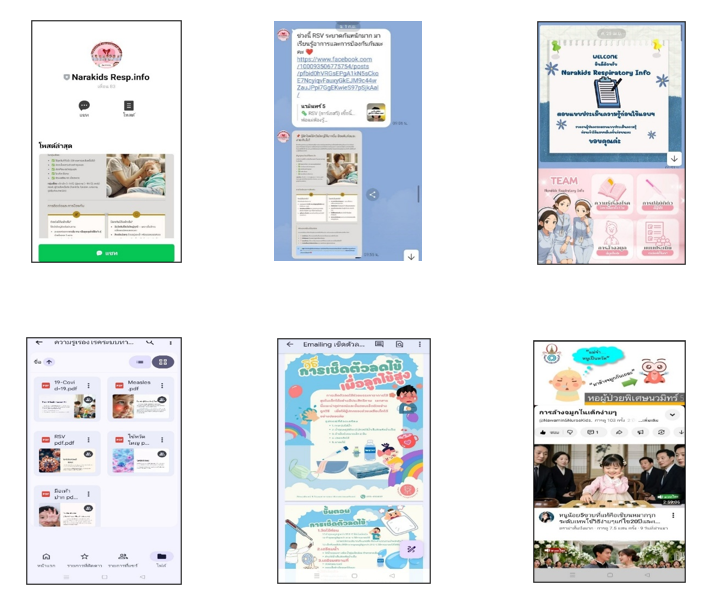
2. Line Official Account “Narakids Respiratory Info” เป็นนวัตกรรมดิจิทัลบนแพลตฟอร์มแอปพลิเคชันไลน์ ประกอบด้วยความรู้เกี่ยวกับโรคติดเชื้อทางเดินหายใจ การดูแลเมื่อเด็กมีไข้ การล้างจมูกอย่างถูกวิธี
3. หลังการใช้ Line Official Account “Nara-kids Respiratory Info” ผู้ดูแลมีคะแนนความรู้เพิ่มขึ้นเฉลี่ย 2.50 คะแนน และคะแนนพฤติกรรมการดูแลเพิ่มขึ้นเฉลี่ย 3.07 คะแนน ในขณะที่คะแนนภาระของผู้ดูแลลดลงเฉลี่ย 1.57 คะแนน และผู้ดูแลมีความพึงพอใจต่อการใช้งาน ระดับมากที่สุด (M = 4.63, SD = 0.52)
ผลการวิจัยชี้ให้เห็นว่า Line Official Account “Nara-kids Respiratory Info” เป็นนวัตกรรมดิจิทัลที่มีประสิทธิผลในการให้ความรู้ ส่งเสริมพฤติกรรมการดูแลได้อย่างมีประสิทธิภาพ
เอกสารอ้างอิง
Areemit, R., Saengnipanthkul, S., Sutra, S., Lumbiganon, P., Pornprasitsakul, P., Paopongsawan, P., et al. (2023). Effectiveness of a mobile app (KhunLook) versus the maternal and child health handbook on Thai parents’ health literacy, accuracy of health assessments, and convenience of use: Randomized controlled trial. Journal of Medical Internet Research, 25, e43196. https://doi.org/10.2196/43196
Bandura, A. (1997). Self-Efficacy: The Exercise of Control. New York, NY: W. H. Freeman.
Brown, T. (2009). Change by Design: How Design Thinking Transforms Organizations and Inspires Innovation. New York, NY: Harper Business.
Cohen, J. (1988). Statistical Power Analysis for the Behavioral Sciences (2nd ed.). Hillsdale, NJ:Lawrence Erlbaum Associates.
Crabtree, B. F., & Miller, W. L. (1992). Doing Qualitative Research. Newbury Park, CA: Sage Publications.
Faul, F., Erdfelder, E., Lang, A. G., & Buchner, A. (2007). G*Power 3: A flexible statistical power analysis program for the social, behavioral, and biomedical sciences. Behavior Research Methods, 39(2), 175–191. https://doi.org/10.3758/BF03193146
Hartweg, D. L., & Metcalfe, S. A. (2022). Orem’s self-care deficit nursing theory: Relevance and need for refinement. Nursing Science Quarterly, 35(1), 70–76. https://doi.org/10.1177/08943184211051369
Jeennamsai, H., Sawasdipanich, N., & Deerojanawong, J. (2023). Factors related to caregiver burden of children with chronic respiratory failure with tracheostomy at home. Journal of Thailand Nursing and Midwifery Council, 38(4), 291–308. https://doi.org/10.60099/jtnmc.v38i04.264593
Katiya, S., & Jaiboon, S. (2024). Effect of a perceived self-efficacy enhancing program on knowledge and caring behaviors among caregivers of children with lower respiratory tract infections. Vajira Nursing Journal, 26(1), 26–41. https://he02.tci-thaijo.org/index.php/vnj/article/view/268862
Kreps, G. L., & Thornton, B. C. (1992). Health Communication: Theory & Practice (2nd ed.). Prospect Heights, IL: Waveland Press.
Mayae, H., Binuma, K., Nobnun, J., Soison, S., Mankaket, A., & Phomprateep, S. (2025). The effects of using the Line Official Account “Malnutrition” on the knowledge, satisfaction, and experiences of parents of toddlers in Narathiwat Municipality. The Southern College Network Journal of Nursing and Public Health, 12(3), e280128. https://he01.tci-thaijo.org/index.php/scnet/article/view/280128
Medical Records and Health Information Division, Naradhiwas Rajanagarindra Hospital. (2024). Statistical report of pediatric respiratory infectious diseases, fiscal years 2022–2024. Narathiwat: Naradhiwas Rajanagarindra Hospital.
National Statistical Office. (2023). Summary of Key Findings: The 2023 Household Survey on the Use of Information and Communication Technology. Bangkok, Thailand: National Statistical Office.
Niyomyart, A., Chow, S. K. Y., Bualoy, W., Butsing, N., Tao, X., & Zhu, X. (2023). Antibiotic knowledge, antibiotic resistance knowledge, and antibiotic use: A cross-sectional study among community members of Bangkok in Thailand. Antibiotics, 12(8), 1312. https://doi.org/10.3390/antibiotics12081312
Norjan, W., Pumiapiradee, W., & Nawsuwan, K. (2022). The effects of a teaching program on knowledge among pediatric caregivers and the recurrence rate of pneumonia in a pediatric clinic, Narathiwat Ratchanakarin Hospital. Journal of Nursing and Public Health Research, 2(2), 1–11. https://he02.tci-thaijo.org/index.php/jnphr/article/view/257302
Orem, D. E. (1991). Nursing: Concepts of practice (4th ed.). St. Louis, MO: Mosby-Year Book. Pender, N. J. (2015). Health Promotion in Nursing Practice (7th ed.). Boston, MA: Pearson.
Plattner, H., Meinel, C., & Leifer, L. (Eds.). (2011). Design Thinking: Understand–Improve–Apply. Berlin, Germany: Springer.
Reinhard, S. C., Given, B., Petlick, N. H., & Bemis, A. (2008). Supporting family caregivers in providing care. In R. G. Hughes (Ed.), Patient safety and quality: An evidence-based handbook for nurses. (pp. 341–404). Rockville, MD: Agency for Healthcare Research and Quality.
Sakamoto, M., Ishikawa, H., & Suzuki, A. (2024). Evaluation of parents’ use of a child health care information app and their health literacy: Cross-sectional study. JMIR Pediatrics and Parenting, 7, e48478. https://doi.org/10.2196/48478
Schiavo, R. (2014). Health Communication: From Theory to Practice (2nd ed.). San Francisco, CA:Jossey-Bass.
Sitthikarnkha, P., Uppala, R., Niamsanit, S., Sutra, S., Thepsuthammarat, K., Techasatian, L., et al. (2022). Epidemiology of acute lower respiratory tract infection hospitalizations in Thai children: A 5-year national data analysis. Influenza and Other Respiratory Viruses, 16(1), 142–150. https://doi.org/10.1111/irv.12911
Temsesgen, D., Wordofa, B., Tesfaye, T., & Etafa, W. (2023). Delay in seeking healthcare for pneumonia and associated factors among mothers/caregivers of children aged 2–59 months in public health facilities in Nekemte town, Ethiopia. BMC Pediatrics, 23, 17. https://doi.org/10.1186/s12887-022-03825-x
United Nations Children's Fund. (2020). Childhood Pneumonia: Everything You Need to Know. United Nations Children’s Fund (UNICEF). Retrieved July 10, 2025 from https://www.unicef.org/stories/childhood-pneumonia-explained
United Nations Children's Fund. (2021). The State of the World's Children 2021: On My Mind-Promoting, Protecting and Caring for Children's Mental Health. United Nations Children's Fund. Retrieved July 10, 2025 from https://www.unicef.org/reports/state-worlds-children-2021
United Nations Children's Fund. (2023). New National Statistics Office and UNICEF Study Reveals Children in Thailand's Southern Provinces Lag in Immunization, Nutrition and Learning. Retrieved July 10, 2025 from https://www.unicef.org/thailand/press-releases/new-national-statistics-office-and-unicef-study-reveals-children-thailands-southern
World Health Organization. (2021). Pneumonia in Children: Key Facts. World Health Organization (WHO). Retrieved July 10, 2025 from https://www.who.int/news-room/fact-sheets/detail/pneumonia
World Health Organization. (2022). Patient Satisfaction and Digital Health Communication Report 2022. World Health Organization (WHO). Retrieved July 10, 2025 from https://www.who.int
Zarit, S. H., Reever, K. E., & Bach-Peterson, J. (1980). Relatives of the impaired elderly: Correlates of feelings of burden. The Gerontologist, 20(6), 649–655. https://doi.org/10.1093/geront/20.6.649
ดาวน์โหลด
เผยแพร่แล้ว
ฉบับ
ประเภทบทความ
สัญญาอนุญาต
ลิขสิทธิ์ (c) 2026 วารสารการพยาบาลและการศึกษา

อนุญาตภายใต้เงื่อนไข Creative Commons Attribution-NonCommercial-NoDerivatives 4.0 International License.


