
The Effects of Implementing a Nursing Practice Guideline for Pressure Ulcer Prevention on Skin Integrity and Incidence of Pressure Ulcers in Medical Intensive Care Unit 2, Nakornping Hospital
Keywords:
Pressure Ulcer, Nursing Practice Guideline, Critically Ill Medical Patients, Pressure Ulcer Prevention, Skin IntegrityAbstract
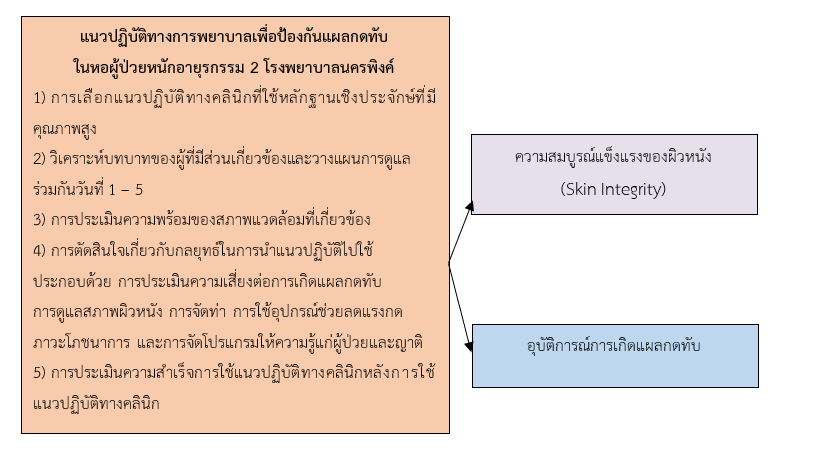
This two-group post-test design quasi-experimental study aimed to compare skin integrity and the incidence of pressure ulcers subsequently to implementing new nursing practice guidelines for pressure ulcer prevention. The sample consisted of 68 critically ill medical patients, admitted to the Medical Intensive Care Unit of Nakornping Hospital between February and May 2025. Participants were equally divided into a control and experimental group (n = 34). Research instruments included: 1) a personal and health information questionnaire, 2) a skin integrity assessment form (reliability = .87), 3) a pressure ulcer incidence record form (inter-rater reliability
= .92), and (4) the new nursing practice guidelines for pressure ulcer prevention. All instruments demonstrated content validity (CVI = 1.00). The experimental group received care based on the guidelines from the Ontario Nurses’ Association framework, consisting of six components: 1) risk assessment every 48 hours, 2) skin care, 3) repositioning every two hours, 4) use of pressure-relieving devices, 5) nutritional management, and 6) patient/family education. These interventions were implemented continuously for 5 days. Data were analyzed using descriptive statistics, Mann-Whitney U test, chi-square test, and Fisher’s exact test. The results showed as follows.
1.After the intervention, abnormal skin conditions were observed in 38.24% of the control group and 20.59% of the experimental group, with no statistically significant difference (p = 0.113).
2.The incidence of pressure ulcers was lower in the experimental group compared to the control group (17.64% vs. 32.35%). Relative Risk = 1.83 (95% CI: 0.77–4.39), Absolute Risk Reduction = 0.147 (95% CI: –0.06–0.35), Number Needed to Harm = 7, and Odds Ratio = 2.23 (95% CI: 0.72–6.96).
The developed nursing practice guidelines demonstrated a promising potential in reducing the incidence of pressure ulcers and maintaining skin integrity among critically ill medical patients. Although the differences were not statistically significant, the 14.71% reduction in pressure ulcer incidence represents an significant clinical outcome.
References
Alderden, J., Brooks, K. R., Kennerly, S. M., Yap, T. L., Dworak, E., & Cox, J. (2025). Risk factors for pressure injuries in critical care patients: An updated systematic review. International Journal of Nursing Studies, 169, 105127. https://doi.org/10.1016/j.ijnurstu.2025.105127
Alderden, J., Shibily, F., & Cowan, L. (2020). Best practice in pressure injury prevention among critical care patients. Critical Care Nursing Clinics of North America, 32(4), 489-500. https://doi.org/10.1016/j.cnc.2020.08.001
Alshahrani, B., Middleton, R., Rolls, K., & Sim, J. (2024). Pressure injury prevalence in critical care settings: An observational pre-post intervention study. Nursing Open, 11(2), e2110. https://doi.org/10.1002/nop2.2110
Amico K. R. (2009). Percent total attrition: a poor metric for study rigor in hosted intervention designs. American Journal of Public Health, 99(9), 1567–1575. https://doi.org/10.2105/AJPH.2008.134767
Beeckman, D., Serraes, B., Anrys, C., Van Tiggelen, H., Van Hecke, A., & Verhaeghe, S. (2019). A multicentre prospective randomised controlled clinical trial comparing the effectiveness and cost of a static air mattress and alternating air pressure mattress to prevent pressure ulcers in nursing home residents. International journal of nursing studies, 97, 105–113. https://doi.org/10.1016/j.ijnurstu.2019.05.015
Chen, B., Yang, Y., Cai, F., Zhu, C., Lin, S., Huang, P., et al. (2023). Nutritional status as a predictor of the incidence of pressure injury in adults: A systematic review and meta-analysis. Journal of Tissue Viability, 32(3), 339–348. https://doi.org/10.1016/j.jtv.2023.04.005
Cohen, J. (1998). Statistical Power Analysis for the Behavioral Sciences (2nd ed.). Lawrence Erlbaum Associates.
Cox, J., Edsberg, L. E., Koloms, K., & VanGilder, C. A. (2022). Pressure injuries in critical care patients in US hospitals: Results of the international pressure ulcer prevalence survey. Journal of Wound, Ostomy and Continence Nursing, 49(1), 21-28. https://doi.org/10.1097/WON.0000000000000850
Gefen, A., Brienza, D. M., Cuddigan, J., Haesler, E., & Kottner, J. (2022). Our contemporary understanding of the aetiology of pressure ulcers/pressure injuries. International Wound Journal, 19(3), 692–704. https://doi.org/10.1111/iwj.13667
Kandula U. R. (2025). Impact of multifaceted interventions on pressure injury prevention: a systematic review. BMC Nursing, 24(1), 11. https://doi.org/10.1186/s12912-024-02558-9
Nguvulu, F. N. (2025). Incidence and risk factors of pressure ulcer among critically ill patients at Kenyatta National Hospital- Main Critical Care Unit. Medtigo Journal of Anesthesia and Pain Medicine, 1(1), e3067111. https://doi.org/10.63096/medtigo3067111
Pakkeraka W., Wiboonchuy N., Somkit W., Innok J., & Prapaspong S. (2023). Factors associated with pressure ulcer development in neurosurgical critical care patients. Mahasarakham Hospital Journal, 19(2), 140-153. (in Thai)
Registered Nurses' Association of Ontario. (2002). Toolkit: Implementation of Clinical Practice Guidelines. Retrieved January 20, 2025 from https://rnao.ca/bpg/guidelines/toolkit-implementation-clinical-practice-guidelines
Roussou, E., Fasoi, G., Stavropoulou, A., Kelesi, M., Vasilopoulos, G., Gerogianni, G., et al. (2023). Quality of life of patients with pressure ulcers: a systematic review. Medicine and Pharmacy Reports, 96(2), 123–130. https://doi.org/10.15386/mpr-2531
Sutthasan M., & Panyathorn K. (2019). Effectiveness of pressure ulcer prevention guidelines implementation in critically ill patients, Kaengkrachan Hospital, Udon Thani Province. Journal of Nursing and Health Care, 37(4), 80-89. (in Thai)
Thaipradeep S. (2013). Skin Erythema Assessment Tool. [Master's thesis, Prince of Songkla University]. PSU Knowledge Bank. http://kb.psu.ac.th/psukb/handle/2010/8913 (in Thai)
Tian, S., & Bian, W. (2025). Advanced biomaterials in pressure ulcer prevention and care: from basic research to clinical practice. Frontiers in Bioengineering and Biotechnology, 13, 1535588. https://doi.org/10.3389/fbioe.2025.1535588
Wei, M., Wu, L., Chen, Y., Fu, Q., Chen, W., & Yang, D. (2020). Predictive validity of the Braden scale for pressure ulcer risk in critical care: A meta-analysis. Nursing in Critical Care, 25(3), 165–170. https://doi.org/10.1111/nicc.12500
Xu, Y. B., Chen, Z. Q., Su, X. H., & Cao, Y. (2024). Influences of evidence-based nursing intervention on pressure ulcers in intensive care units: A meta-analysis. International Wound Journal, 21(4), e14834. https://doi.org/10.1111/iwj.14834
Yonjoho N., Daratip P., & Chuangnark P. (2018). Development of nursing practice guidelines for pressure ulcer prevention in medical ward 5, Ramathibodi Hospital. Ramathibodi Medical Journal, 11(3), 1-12. (in Thai)
Zaidi, S. R. H., & Sharma, S. (2024). Pressure Ulcer. In StatPearls [Internet]. StatPearls Publishing. Retrieved January 20, 2025 from https://www.ncbi.nlm.nih.gov/books/NBK553107/
Downloads
Published
Issue
Section
License
Copyright (c) 2026 Journal of Nursing and Education

This work is licensed under a Creative Commons Attribution-NonCommercial-NoDerivatives 4.0 International License.



