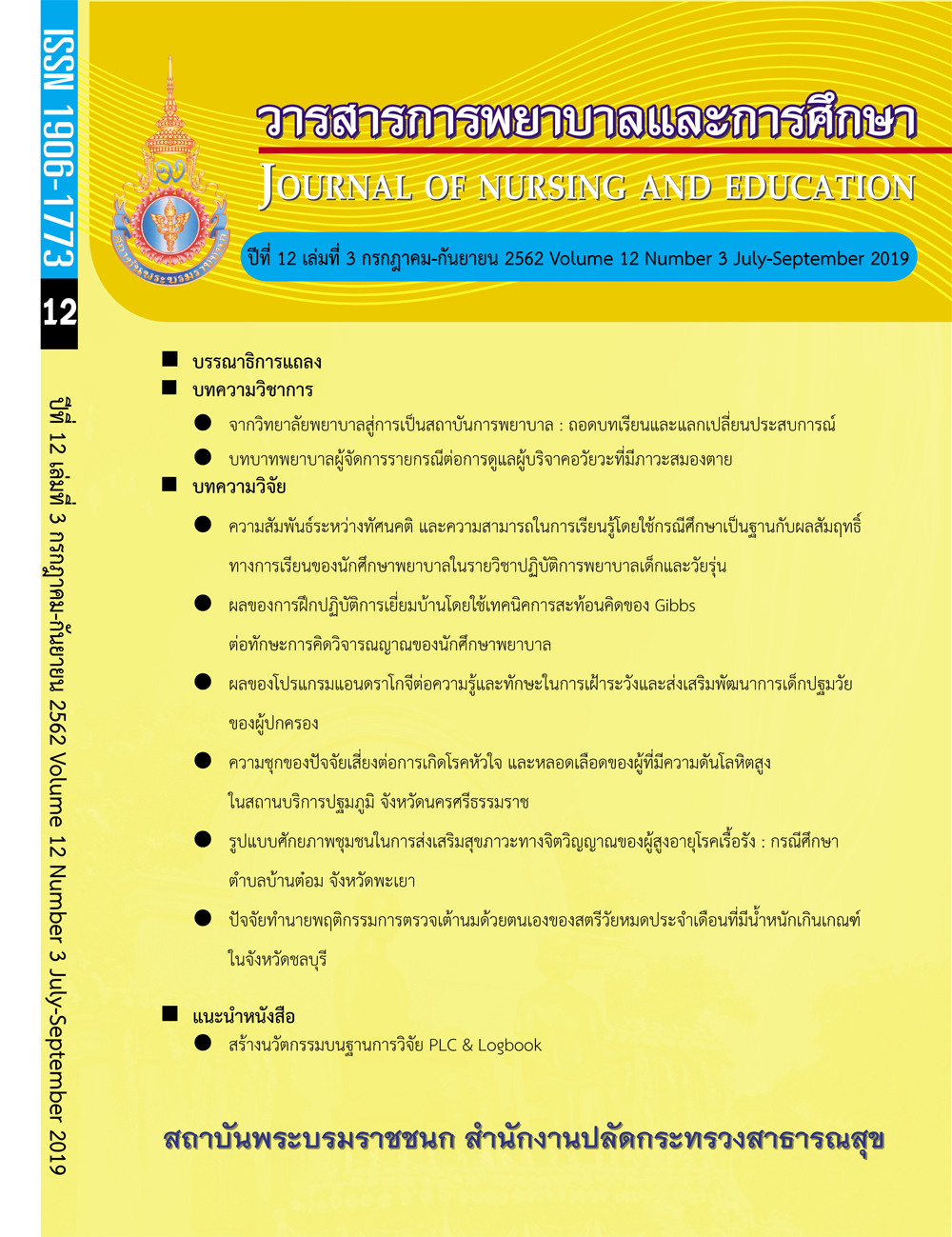
The Effects of Home visit practice by using Gibbs's Reflection Techniques on Critical Thinking of Nursing Students
ผลของการฝึกปฏิบัติการเยี่ยมบ้านโดยใช้เทคนิคการสะท้อนคิดของ Gibbs ต่อทักษะการคิดวิจารณญาณของนักศึกษาพยาบาล
Keywords:
Reflection, Critical Thinking, Nursing Students, Family and Community NursingAbstract
ABSTRACT
The purpose of this quasi-experimental study was to examine the effects of home visit practice by using Gibbs's Reflection Techniques on critical thinking among nursing students. Participants included 130 third-year undergraduate nursing students of a college of nursing who was practicing home visit in the “Family and community health nursing practicum I” course. The intervention included Gibbs's Reflection Techniques and data collected by critical thinking test. This test was used for collecting data before the intervention and 1 month after the intervention. The reliability (KR 20) of the critical thinking test was 0.74. Descriptive statistics, the Wilcoxon Signed Ranks Test, and the Kruskal-Wallis Test were used to analyze data.
The results showed the mean scores of critical thinking of the nursing students after using Gibbs's Reflection Techniques increased from 50.16 ± 5.59 for the pretest to 50.40 ± 5.44 for posttest. The evaluation of argument and the recognition of assumption subscale scores after the intervention were higher than those of before the intervention. The overall critical thinking scores after the intervention was not significantly higher than those of before the intervention (p > .05). However, the critical thinking scores of nursing students after using Gibbs's Reflection Techniques were significantly different (p <0.001) between groups of each teacher. Findings support that teachers who utilize reflection techniques must have a skill of raising proper questions to encourage students to have complex thinking, analyze, synthesize, and effective conclusions. Then students will have critical thinking.
References
1. Ministry of Education. Thailand Qualifications Framework for Bachelor of nursing
science curriculum in 2017. 2018 [cited 2019/3/19]. Available from:
http://www.mua.go.th/users/tqf-hed/news/data6/%E0%B8%9B%E0%B8%A3%E0%
B8%B0%E0%B8%81%E0%B8%B2%E0%B8%A8-%E0%B8%A8%E0%B8%98-NQF-2560-
%E0%B8%9E%E0%B8%A2%E0%B8%B2%E0%B8%9A%E0%B8%B2%E0%B8%A5%
E0%B8%A8%E0%B8%B2%E0%B8%AA%E0%B8%95%E0%B8%A3%E0%B9%8C-
%E0%B8%9B-%E0%B8%95%E0%B8%A3%E0%B8%B5.PDF. (in Thai)
2. Facione PA.. Critical Thinking What It Is and Why It Counts. 2015. [cited 2018/3/19].
Available from: http://go.roguecc.edu/sites/go.roguecc.edu/files/
dept/nursing/PDF/Nursing/Critical%20Thinking-What%20it%20is%20and%20Why%
20it%20Counts--to%20be%20linked%20to%20HSRT%20info.pdf.
3. Phaktoop, M. & Khuinak, U. Critical Thinking in Nursing. J Nurs Educ. 2018; 11(2): 1-12.
(in Thai)
4. Cottrell, S. Critical Thinking Skills: Developing Effective Analysis and Argument [online].
2nd Revised edition. United Kingdom: Palgrave MacMillan. 2016. [cited 2019/4/1].
Available from: https://www.bookboxpdf.com/critical-thinking-skills-by-stella-cottrell-
pdf/
5. Panettieri, R.C. Can Critical-Thinking Skills Be Taught? Radiol Technol. 2015; 86(6): 686-
688.
6. Horton-Deutsh, S. & Sherwood, G.D. Reflective Practice: Transforming Education and
Improving Outcomes. 2nd Edition. USA: Dustin Sillivan; 2017.
7. Sherwood, G.D. & Horton-Deutsh, S. Reflective Organizations On the Front Lines of
QSEN & Reflective Implementation. USA: Dustin Sillivan; 2015.
8. Zhang, C., Fan, H., Xia, J., Guo, H., Jiang, X. & Yan, Y. The Effects of Reflective Training
on the Disposition of Critical Thinking for Nursing Students in China: A Controlled Trial.
Asian Nurs Res. 2017; 11(3): 194-200.
9. Khorphon, S., Pankeaw, J., Sorobol, T., Choopun, K., Chomchan, S. & Boonlue, N.
Promoting of Critical Thinking Skills in Nursing Students Through Reflective Thinking.
Nurs J (Manila). 2019; (46): 87-101. (in Thai)
10. Schon, A. D. The Reflective Practitioner. Aldershot: Ashgate Publishing Ltd; 1991.
11. Magnussen L, Ishida D & Itano J. The impact of the use of inquiry-based learning as a
teaching methodology on the development of critical thinking. J Nurs Educ. 2000;
39(8): 360-364.
12. Chaiya S. Effects of clinical teaching by using portfolio on critical thinking ability and
self directed learning readiness of nursing students. [Thesis], Faculty of Nursing.
Chulalongkorn University. 1998. 1-146. (in Thai)
13. Thongsen, A., Teeraputon, D. & Hingkanont, P. Development of Learning Model
Through Online Social Networks using Reflective Process to Enhance Creative
Problem Solving Ability in Nursing. J Nurs Health Sci. 2018; (12): 133-147. (in Thai)
14. Wichainate, K. Reflective Thinking: Teaching Students to Develop Critical Thinking in
Nursing Practice. J Police Nurse. 2014; 6(2): 188-199. (in Thai)
15. Kittiboonthawal, P., Cheanchum, J., Srithanya S. & Umereweneza, S. Reflection:
Transformation from valuable experiences. J Health Sci Res. 2018; 12(1): 102-110. (in
Thai)
16. Naber, J & Markley, L. A guide to nursing students’written reflections for students and
educators. Nurse Educ Pract. 2017; 25: 1-4.
17. Sinthuchai, S., Dejpituksirikul, S. & Yoksuriyan, P. Reflective Practice in Nursing
Education. Jounal R Thai Army Nurses. 2018; 19(2): 15-23. (in Thai)