
ผลของการใช้แนวปฏิบัติทางการพยาบาลเพื่อป้องกันแผลกดทับต่อความสมบูรณ์แข็งแรง ของผิวหนังและอุบัติการณ์การเกิดแผลกดทับ ในหอผู้ป่วยหนักอายุรกรรม 2 โรงพยาบาลนครพิงค์
คำสำคัญ:
แผลกดทับ, แนวปฏิบัติทางการพยาบาล, ผู้ป่วยวิกฤตอายุรกรรม, การป้องกันแผลกดทับ, ความสมบูรณ์ของผิวหนังบทคัดย่อ
การวิจัยกึ่งทดลองแบบ 2 กลุ่มวัดผลภายหลังการทดลอง มีวัตถุประสงค์เพื่อเปรียบเทียบสัดส่วนความสมบูรณ์แข็งแรงของผิวหนังและอุบัติการณ์การเกิดแผลกดทับภายหลังการใช้แนวปฏิบัติทางการพยาบาลเพื่อป้องกันแผลกดทับระหว่างกลุ่มทดลองและกลุ่มควบคุม กลุ่มตัวอย่างเป็นผู้ป่วยวิกฤตอายุรกรรมที่เข้ารับการรักษา ณ หอผู้ป่วยหนักอายุรกรรม 2 โรงพยาบาลนครพิงค์ ระหว่างเดือนกุมภาพันธ์ ถึงเดือนพฤษภาคม พ.ศ. 2568 จำนวน 68 คน แบ่งเป็นกลุ่มควบคุม 34 คน และกลุ่มทดลอง 34 คน เครื่องมือที่ใช้ประกอบด้วย 1) แบบสอบถามข้อมูลส่วนบุคคลและภาวะสุขภาพ 2) แบบบันทึกความสมบูรณ์แข็งแรงของผิวหนัง (ค่าความเชื่อมั่นเท่ากับ .87) 3) แบบบันทึกอุบัติการณ์
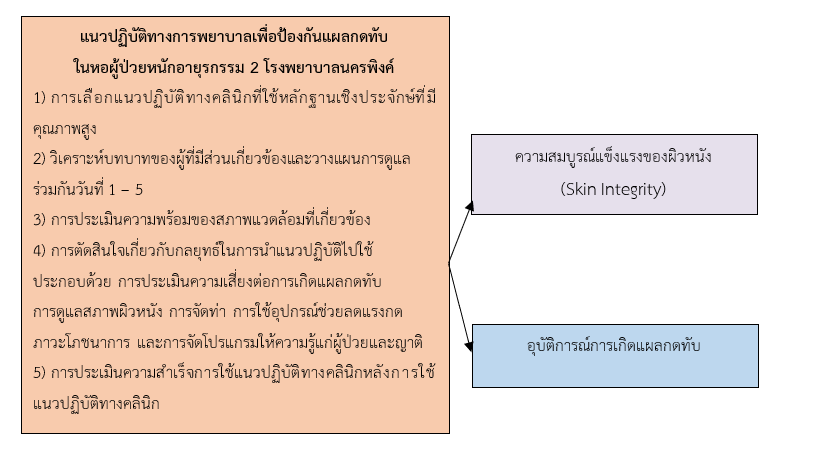
การเกิดแผลกดทับ (ค่าความเที่ยงแบบสังเกตร่วมเท่ากับ .92) และ 4) แนวปฏิบัติทางการพยาบาลเพื่อป้องกันแผลกดทับ โดยเครื่องมือทั้งหมดมีค่าความตรงเชิงเนื้อหาเท่ากับ 1.00 กลุ่มทดลองได้รับการดูแลตามแนวปฏิบัติที่พัฒนาขึ้นจากกรอบแนวคิดของสมาคมพยาบาลออนทาริโอ ประกอบด้วย 6 องค์ประกอบ การประเมินความเสี่ยงทุก 48 ชั่วโมง การดูแลสภาพผิวหนัง การจัดท่าทุก 2 ชั่วโมง การใช้อุปกรณ์ช่วยลดแรงกด การดูแลภาวะโภชนาการ และการให้ความรู้แก่ผู้ป่วยและญาติ โดยดำเนินกิจกรรมอย่างต่อเนื่อง 5 วัน วิเคราะห์ข้อมูลโดยใช้สถิติเชิงพรรณนา สถิติ Mann-Whitney U test สถิติ Chi-Square Test และ Fisher's Exact Test ผลการวิจัยพบว่า
1. ภายหลังการทดลอง กลุ่มควบคุมมีผิวหนังผิดปกติร้อยละ 24 ขณะที่กลุ่มทดลองมีผิวหนังผิดปกติร้อยละ 20.59 ไม่แตกต่างกันอย่างมีนัยสำคัญทางสถิติ (p-value = .113)
2. อุบัติการณ์การเกิดแผลกดทับ กลุ่มทดลองมีอุบัติการณ์ต่ำกว่ากลุ่มควบคุม (ร้อยละ 17.64 และ 32.35)
3.มี Relative Risk = 1.83 (95% CI: 0.77 - 39) Absolute Risk Reduction = .147 (95% CI: -0.06 - 0.35) Number Needed to Harm = 7 และ Odds Ratio = 2.23 (95% CI: 0.72 - 6.96)
แนวปฏิบัติทางการพยาบาลเพื่อป้องกันแผลกดทับที่พัฒนาขึ้นแสดงแนวโน้มในการลดอุบัติการณ์การเกิดแผลกดทับและช่วยรักษาความสมบูรณ์ของผิวหนังในผู้ป่วยวิกฤตอายุรกรรม แม้ว่าผลจะยังไม่แตกต่างอย่างมีนัยสำคัญทางสถิติ แต่การลดลงของอุบัติการณ์แผลกดทับร้อยละ 14.71 ถือเป็นผลลัพธ์ทางคลินิกที่สำคัญ
เอกสารอ้างอิง
Alderden, J., Brooks, K. R., Kennerly, S. M., Yap, T. L., Dworak, E., & Cox, J. (2025). Risk factors for pressure injuries in critical care patients: An updated systematic review. International Journal of Nursing Studies, 169, 105127. https://doi.org/10.1016/j.ijnurstu.2025.105127
Alderden, J., Shibily, F., & Cowan, L. (2020). Best practice in pressure injury prevention among critical care patients. Critical Care Nursing Clinics of North America, 32(4), 489-500. https://doi.org/10.1016/j.cnc.2020.08.001
Alshahrani, B., Middleton, R., Rolls, K., & Sim, J. (2024). Pressure injury prevalence in critical care settings: An observational pre-post intervention study. Nursing Open, 11(2), e2110. https://doi.org/10.1002/nop2.2110
Amico K. R. (2009). Percent total attrition: a poor metric for study rigor in hosted intervention designs. American Journal of Public Health, 99(9), 1567–1575. https://doi.org/10.2105/AJPH.2008.134767
Beeckman, D., Serraes, B., Anrys, C., Van Tiggelen, H., Van Hecke, A., & Verhaeghe, S. (2019). A multicentre prospective randomised controlled clinical trial comparing the effectiveness and cost of a static air mattress and alternating air pressure mattress to prevent pressure ulcers in nursing home residents. International journal of nursing studies, 97, 105–113. https://doi.org/10.1016/j.ijnurstu.2019.05.015
Chen, B., Yang, Y., Cai, F., Zhu, C., Lin, S., Huang, P., et al. (2023). Nutritional status as a predictor of the incidence of pressure injury in adults: A systematic review and meta-analysis. Journal of Tissue Viability, 32(3), 339–348. https://doi.org/10.1016/j.jtv.2023.04.005
Cohen, J. (1998). Statistical Power Analysis for the Behavioral Sciences (2nd ed.). Lawrence Erlbaum Associates.
Cox, J., Edsberg, L. E., Koloms, K., & VanGilder, C. A. (2022). Pressure injuries in critical care patients in US hospitals: Results of the international pressure ulcer prevalence survey. Journal of Wound, Ostomy and Continence Nursing, 49(1), 21-28. https://doi.org/10.1097/WON.0000000000000850
Gefen, A., Brienza, D. M., Cuddigan, J., Haesler, E., & Kottner, J. (2022). Our contemporary understanding of the aetiology of pressure ulcers/pressure injuries. International Wound Journal, 19(3), 692–704. https://doi.org/10.1111/iwj.13667
Kandula U. R. (2025). Impact of multifaceted interventions on pressure injury prevention: a systematic review. BMC Nursing, 24(1), 11. https://doi.org/10.1186/s12912-024-02558-9
Nguvulu, F. N. (2025). Incidence and risk factors of pressure ulcer among critically ill patients at Kenyatta National Hospital- Main Critical Care Unit. Medtigo Journal of Anesthesia and Pain Medicine, 1(1), e3067111. https://doi.org/10.63096/medtigo3067111
Pakkeraka W., Wiboonchuy N., Somkit W., Innok J., & Prapaspong S. (2023). Factors associated with pressure ulcer development in neurosurgical critical care patients. Mahasarakham Hospital Journal, 19(2), 140-153. (in Thai)
Registered Nurses' Association of Ontario. (2002). Toolkit: Implementation of Clinical Practice Guidelines. Retrieved January 20, 2025 from https://rnao.ca/bpg/guidelines/toolkit-implementation-clinical-practice-guidelines
Roussou, E., Fasoi, G., Stavropoulou, A., Kelesi, M., Vasilopoulos, G., Gerogianni, G., et al. (2023). Quality of life of patients with pressure ulcers: a systematic review. Medicine and Pharmacy Reports, 96(2), 123–130. https://doi.org/10.15386/mpr-2531
Sutthasan M., & Panyathorn K. (2019). Effectiveness of pressure ulcer prevention guidelines implementation in critically ill patients, Kaengkrachan Hospital, Udon Thani Province. Journal of Nursing and Health Care, 37(4), 80-89. (in Thai)
Thaipradeep S. (2013). Skin Erythema Assessment Tool. [Master's thesis, Prince of Songkla University]. PSU Knowledge Bank. http://kb.psu.ac.th/psukb/handle/2010/8913 (in Thai)
Tian, S., & Bian, W. (2025). Advanced biomaterials in pressure ulcer prevention and care: from basic research to clinical practice. Frontiers in Bioengineering and Biotechnology, 13, 1535588. https://doi.org/10.3389/fbioe.2025.1535588
Wei, M., Wu, L., Chen, Y., Fu, Q., Chen, W., & Yang, D. (2020). Predictive validity of the Braden scale for pressure ulcer risk in critical care: A meta-analysis. Nursing in Critical Care, 25(3), 165–170. https://doi.org/10.1111/nicc.12500
Xu, Y. B., Chen, Z. Q., Su, X. H., & Cao, Y. (2024). Influences of evidence-based nursing intervention on pressure ulcers in intensive care units: A meta-analysis. International Wound Journal, 21(4), e14834. https://doi.org/10.1111/iwj.14834
Yonjoho N., Daratip P., & Chuangnark P. (2018). Development of nursing practice guidelines for pressure ulcer prevention in medical ward 5, Ramathibodi Hospital. Ramathibodi Medical Journal, 11(3), 1-12. (in Thai)
Zaidi, S. R. H., & Sharma, S. (2024). Pressure Ulcer. In StatPearls [Internet]. StatPearls Publishing. Retrieved January 20, 2025 from https://www.ncbi.nlm.nih.gov/books/NBK553107/
ดาวน์โหลด
เผยแพร่แล้ว
ฉบับ
ประเภทบทความ
สัญญาอนุญาต
ลิขสิทธิ์ (c) 2026 วารสารการพยาบาลและการศึกษา

อนุญาตภายใต้เงื่อนไข Creative Commons Attribution-NonCommercial-NoDerivatives 4.0 International License.


