การใช้ปัญญาประดิษฐ์สำหรับการวิจัยการทบทวนอย่างเป็นระบบและการวิเคราะห์อภิมาน ด้านการบริหารทางการพยาบาล
คำสำคัญ:
ปัญญาประดิษฐ์, การทบทวนวรรณกรรมอย่างเป็นระบบ, การบริหารทางการพยาบาล, เครื่องมือซอฟต์แวร์ , PRISMA 2020บทคัดย่อ
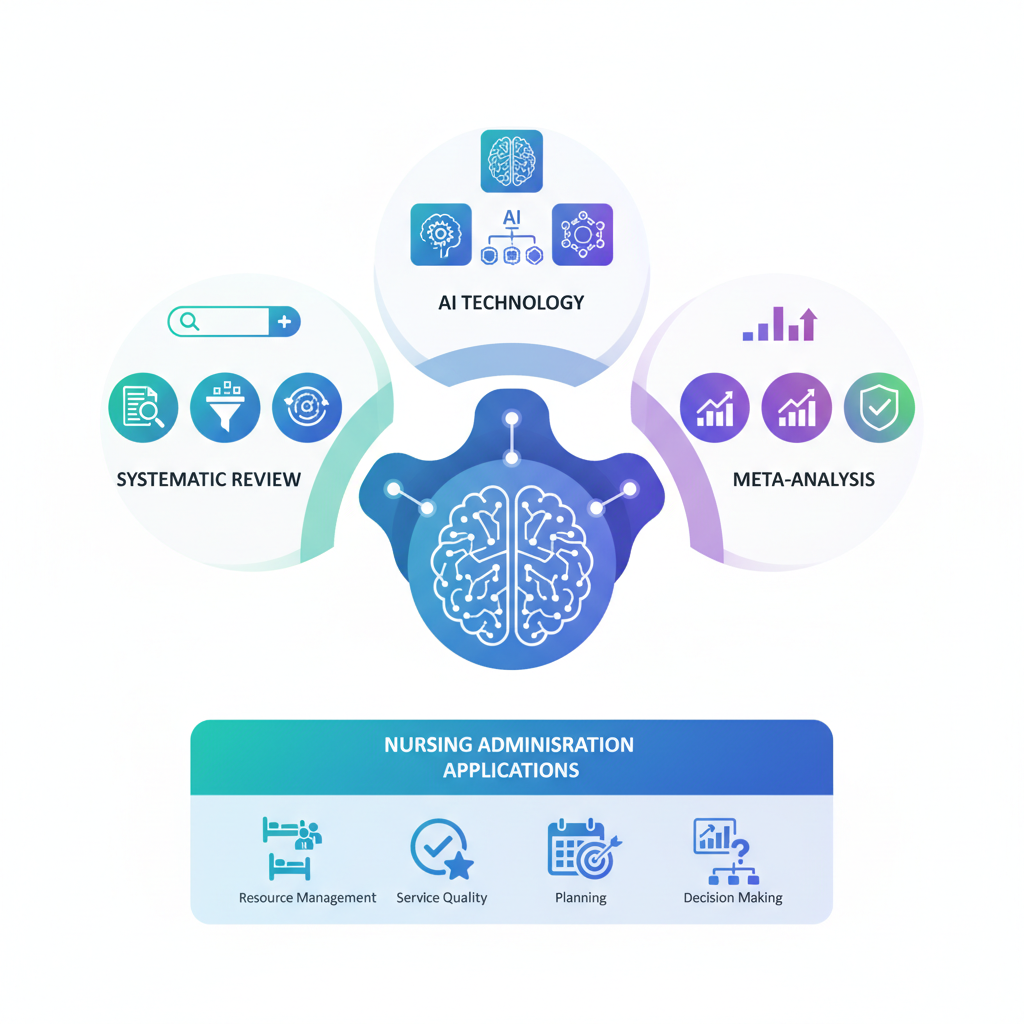
การวิจัยการทบทวนอย่างเป็นระบบและการวิเคราะห์อภิมาน (Systematic Review: SR and Meta-Analysis :MA) ถือเป็นเครื่องมือสำคัญในการสังเคราะห์หลักฐานเชิงประจักษ์สำหรับการบริหารทางการพยาบาล บทความนี้นำเสนอภาพรวมของการประยุกต์ใช้ปัญญาประดิษฐ์ (Artificial Intelligence: AI) เพื่อเสริมสมรรถภาพการดำเนินการวิจัยการทบทวนอย่างเป็นระบบ (Systematic Review: SR) ใน 6 ขั้นตอนหลัก ได้แก่ การจัดการรายการอ้างอิง (Reference Management) การคัดกรองและคัดเลือกงานวิจัย (Screening and Selection) การสกัดข้อมูล (Data Extraction) การวิเคราะห์อภิมาน (Meta-Analysis) การประเมินความเสี่ยงต่อความลำเอียง (Risk of Bias Assessment) และมาตรฐานการรายงาน (Reporting Standards) เครื่องมือซอฟต์แวร์ที่นำเสนอ ได้แก่ Zotero, Rayyan, REDCap, R (metafor), RoB 2, JBI Critical Appraisal Tools และ PRISMA 2020 ผลการทบทวนพบว่าปัญญาประดิษฐ์ (AI) สามารถลดภาระการทำงานของนักวิจัยได้อย่างมีนัยสำคัญ เพิ่มความแม่นยำในการคัดกรอง และส่งเสริมมาตรฐานการรายงานผลการวิจัยระดับสากล บทความนี้มุ่งสนับสนุนนักวิจัยและนักศึกษาระดับบัณฑิตศึกษาสาขาบริหารการพยาบาลในการเลือกใช้เครื่องมือที่เหมาะสมและมีประสิทธิภาพสูงสุด
เอกสารอ้างอิง
เพชรน้อย สิงห์ช่างชัย. (2568). การวิจัยทบทวนอย่างเป็นระบบและวิเคราะห์อภิมานด้วยแนวปฏิบัติของ PRISMA 2020 สำหรับการบริหารทางการพยาบาล. วารสารเครือข่ายวิทยาลัยพยาบาลและการสาธารณสุขภาคใต้, 12(2), e278816. https://he01.tci-thaijo.org/index.php/scnet/article/view/278816
Balduzzi, S., Rücker, G., & Schwarzer, G. (2019). How to perform a meta-analysis with R: A practical tutorial. Evidence-Based Mental Health, 22(4), 153-160. https://doi.org/10.1136/ebmental-2019-300117
Booth, A., Sutton, A., & Papaioannou, D. (2021). Systematic Approaches to a Successful Literature review (3rd ed.). London, England: SAGE Publications.
Borenstein, M., Hedges, L. V., Higgins, J. P. T., & Rothstein, H. R. (2021). Introduction to Meta-Analysis (2nd ed.). Hoboken, NJ: Wiley.
Chang, C., Jen, H., & Su, W. (2023). Trends in artificial intelligence in nursing: Impacts on nursing management. Journal of Nursing Management, 31(4), 112-121. https://doi.org/10.1111/jonm.13858
Critical Appraisal Skills Programme. (2018). CASP checklists. Retrieved April 17, 2026, from https://casp-uk.net/casp-tools-checklists/
Harris, P. A., Taylor, R., Minor, B. L., Elliott, V., Fernandez, M., O'Neal, L., et al. (2019). The REDCap consortium: Building an international community of software platform partners. Journal of Biomedical Informatics, 95, Article 103208. https://doi.org/10.1016/j.jbi.2019.103208
Martinez-Ortigosa, A., Martinez-Granados, A., Gil-Hernandez, E., Rodriguez-Arrastia, M., Ropero-Padilla, C., & Roman, P. (2023). Applications of artificial intelligence in nursing care: A systematic review. Journal of Nursing Management, 2023, Article 3219127. https://doi.org/10.1155/2023/3219127
Moola, S., Munn, Z., Tufanaru, C., Aromataris, E., & Sears, K. (2020). Chapter 7: Systematic reviews of etiology and risk. In E. Aromataris & Z. Munn (Eds.), JBI manual for evidence synthesis. Adelaide, Australia: JBI. doi:10.46658/JBIMES-20-08
Ouzzani, M., Hammady, H., Fedorowicz, Z., & Elmagarmid, A. (2016). Rayyan: A web and mobile app for systematic reviews. Systematic Reviews, 5(1), Article 210. https://doi.org/10.1186/s13643-016-0384-4
Page, M. J., McKenzie, J. E., Bossuyt, P. M., Boutron, I., Hoffmann, T. C., Mulrow, C. D., et al. (2021). The PRISMA 2020 statement: An updated guideline for reporting systematic reviews. BMJ, 372, Article n71. https://doi.org/10.1136/bmj.n71
Rethlefsen, M. L., Kirtley, S., Waffenschmidt, S., Ayala, A. P., Moher, D., Page, M. J., et al. (2021). PRISMA-S: An extension to the PRISMA statement for reporting literature searches in systematic reviews. Systematic Reviews, 10(1), Article 39. https://doi.org/10.1186/s13643-021-01621-7
Ruksakulpiwat, S., Phianhasin, L., Benjasirisan, C., Chiaranai, C., Smith, O., & Aldossari, H. A. (2025). Artificial intelligence in nursing research: A systematic review of applications, benefits, and challenges. International Nursing Review. Advance online publication. https://doi.org/10.1111/inr.70080
Sheikh, H., Prins, C., & Schrijvers, E. (2023). Artificial intelligence: Definition and background. In H. Sheikh, C. Prins, & E. Schrijvers (Eds.), Mission AI: The New System Technology (pp. 15-41). Springer. https://doi.org/10.1007/978-3-031-21448-6_2
Sterne, J. A. C., Savovic, J., Page, M. J., Elbers, R. G., Blencowe, N. S., Boutron, I., et al. (2019). RoB 2: A revised tool for assessing risk of bias in randomised trials. BMJ, 366, Article l4898. https://doi.org/10.1136/bmj.l4898
Viechtbauer, W. (2010). Conducting meta-analyses in R with the meta for package. Journal of Statistical Software, 36(3), 1-48. https://doi.org/10.18637/jss.v036.i03
Wei, Y., Pan, J., Liu, X., Hong, R., Nong, H., & Zhang, L. (2025). The integration of AI in nursing: Addressing current applications, challenges, and future directions. Frontiers in Medicine, 12, Article 1552372. https://doi.org/10.3389/fmed.2025.1552372
Wells, G. A., Shea, B., O'Connell, D., Peterson, J., Welch, V., Losos, M., et al. (2000). The Newcastle- Ottawa Scale (NOS) for assessing the quality of nonrandomised studies in meta-analyses. Ottawa Hospital Research Institute. Retrieved April 17, 2026, from http://www.ohri.ca/programs/clinical_epidemiology/oxford.asp
ดาวน์โหลด
เผยแพร่แล้ว
ฉบับ
ประเภทบทความ
สัญญาอนุญาต
ลิขสิทธิ์ (c) 2026 วารสารเครือข่ายวิทยาลัยพยาบาลและการสาธารณสุขภาคใต้

อนุญาตภายใต้เงื่อนไข Creative Commons Attribution-NonCommercial-NoDerivatives 4.0 International License.
1. บทความหรือข้อคิดเห็นใด ๆ ที่ปรากฏในวารสารเครือข่าย วิทยาลัยพยาบาลและการสาธารณสุขภาคใต้ ที่เป็นวรรณกรรมของผู้เขียน บรรณาธิการหรือเครือข่ายวิทยาลัยพยาบาลและวิทยาลัยการสาธารณสุขภาคใต้ ไม่จำเป็นต้องเห็นด้วย
2. บทความที่ได้รับการตีพิมพ์ถือเป็นลิขสิทธิ์ของ วารสารเครือข่ายวิทยาลัยพยาบาลและการสาธารณสุขภาคใต้