ผลของโปรแกรมการบำบัดแบบออนไลน์เพื่อเสริมสร้างแรงจูงใจต่อพฤติกรรมการดื่มสุราในผู้ที่มีความผิดปกติจากการใช้สุรา
คำสำคัญ:
โปรแกรมการบำบัดแบบออนไลน์ , การเสริมสร้างแรงจูงใจ, พฤติกรรมการดื่ม , ความผิดปกติจากการดื่มสุราบทคัดย่อ
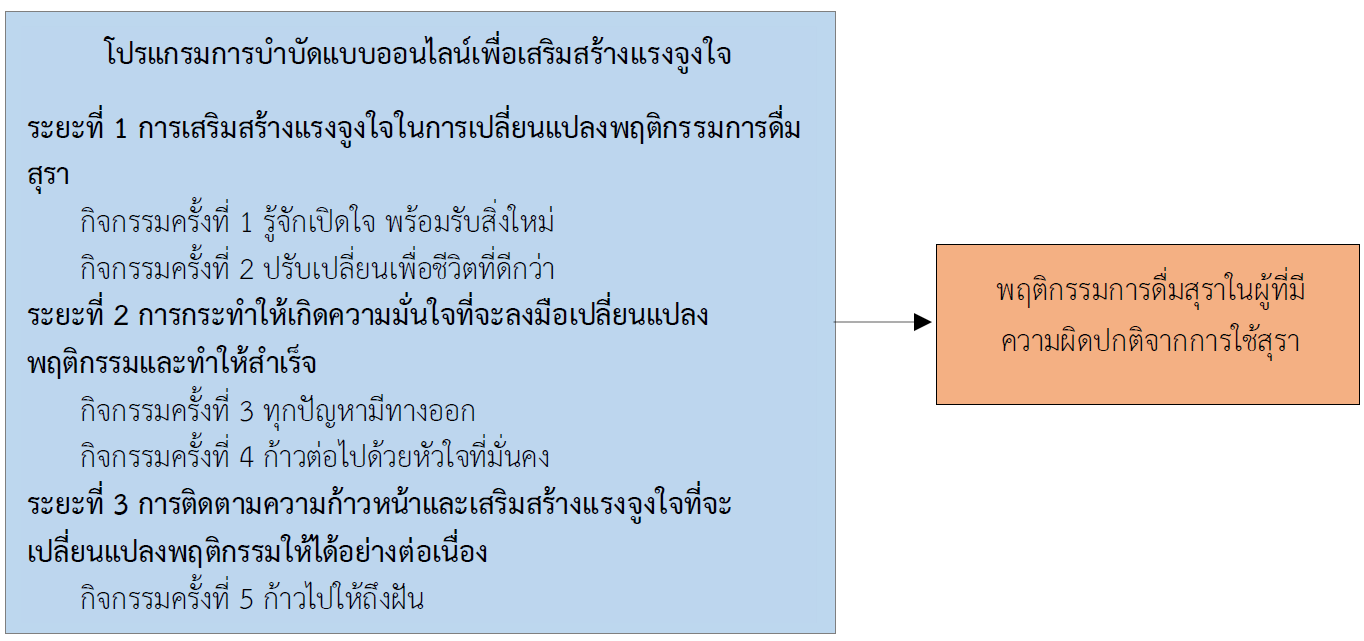
การวิจัยกึ่งทดลองแบบสอบกลุ่มวัดซ้ำ มีวัตถุประสงค์เพื่อศึกษาผลของโปรแกรมการบำบัดแบบออนไลน์เพื่อเสริมสร้างแรงจูงใจต่อพฤติกรรมการดื่มสุราในผู้ที่มีความผิดปกติจากการใช้สุรากลุ่มตัวอย่างเป็นผู้ป่วยที่ได้รับการวินิจฉัยว่ามีความผิดปกติจากการใช้สุราที่จำหน่ายกลับบ้านจากการเข้ารับการบำบัดสุราในโรงพยาบาลโนนสะอาด จำนวน 36 คน สุ่มเข้าเป็นกลุ่มควบคุมและกลุ่มทดลอง เครื่องมือที่ใช้ในการวิจัย ได้แก่ 1) แบบประเมินอาการถอนพิษสุรา 2) แบบสอบถามข้อมูลส่วนบุคคล 3) แบบประเมินพฤติกรรมการดื่มสุรา และ 4) โปรแกรมการบำบัดแบบออนไลน์เพื่อเสริมสร้างแรงจูงใจต่อพฤติกรรมการดื่มสุราในผู้ที่มีความผิดปกติจากการใช้สุรา มีการดำเนินกิจกรรมบำบัดออนไลน์ทั้งหมด 5 ครั้ง ครั้งละ 30 - 45 นาที สัปดาห์ละ 1 ครั้ง ติดต่อกัน 5 สัปดาห์ และติดตามผลหลังการบำบัด 1 เดือน วิเคราะห์ข้อมูลโดยใช้สถิติเชิงพรรณนา สถิติทดสอบค่าทีชนิดสองกลุ่มที่เป็นอิสระต่อกัน และสถิติการวิเคราะห์ความแปรปรวนทางเดียวแบบวัดซ้ำ ผลการศึกษาพบว่า
1. ค่าเฉลี่ยร้อยละจำนวนวันที่ไม่ดื่มในกลุ่มทดลองที่ได้รับโปรแกรมการบำบัดแบบออนไลน์เพื่อเสริมสร้างแรงจูงใจในระยะหลังการทดลองสิ้นสุดทันที และระยะติดตามผล 1 เดือน สูงกว่ากลุ่มควบคุมที่ได้รับการพยาบาลตามปกติ อย่างมีนัยสำคัญทางสถิติที่ระดับ .001 แต่ค่าเฉลี่ยร้อยละจำนวนวันที่ดื่มหนักไม่แตกต่างกัน
2. กลุ่มทดลองที่ได้รับโปรแกรมการบำบัดแบบออนไลน์เพื่อเสริมสร้างแรงจูงใจมีค่าเฉลี่ยร้อยละจำนวนวันที่ดื่มหนักในระยะหลังการทดลองสิ้นสุดทันที และระยะติดตามผล 1 เดือน ต่ำกว่าระยะก่อนการทดลองอย่างมีนัยสำคัญทางสถิติที่ระดับ .01 และค่าเฉลี่ยร้อยละจำนวนวันที่ไม่ดื่มในระยะหลังการทดลองสิ้นสุดทันที และระยะติดตามผล 1 เดือน สูงกว่าระยะก่อนการทดลองอย่างมีนัยสำคัญทางสถิติที่ระดับ .001
ผลการศึกษาครั้งนี้แสดงให้เห็นว่า โปรแกรมบำบัดออนไลน์เพื่อเสริมสร้างแรงจูงใจมีประสิทธิภาพในการลดพฤติกรรมการดื่ม และสามารถใช้เป็นข้อมูลเชิงประจักษ์ในการพัฒนาแนวทางการบำบัดและการวิจัยต่อยอด เพื่อสร้างรูปแบบการดูแลที่ตอบสนองต่อความต้องการของผู้ป่วยและสอดคล้องกับบริบททางสังคมปัจจุบัน
เอกสารอ้างอิง
ธันยพร บัวเหลือง. (2561). ผลของโปรแกรมเสริมสร้างแรงจูงใจต่อความตั้งใจในการหยุดดื่มและพฤติกรรมการดื่มสุราของผู้ดื่มชายแบบเสี่ยง (วิทยานิพนธ์ปริญญามหาบัณฑิต สาขาการพยาบาลจิตเวชและสุขภาพจิต). มหาวิทยาลัยบูรพา. สืบค้นเมื่อ 20 พฤศจิกายน 2567 จากhttps://buuir.buu.ac.th/xmlui/handle/1234567890/7859
นรากร สารีแหล้, กันตวิชญ์ จูเปรมปรี, และกัลยา มั่นล้วน. (2561). ตราบาปของผู้ป่วยติดสุรากับการเลือกปฏิบัติและสิทธิมนุษยชนในวิถีของชุมชน. ศรีนครินทร์เวชสาร, 33(6), 589-594.
นุษณี เอี่ยมสะอาด. (2558). ผลของโปรแกรมการสร้างแรงจูงใจต่อพฤติกรรมการดื่มสุราของผู้ติดสุรา. (วิทยานิพนธ์ปริญญามหาบัณฑิต สาขาการพยาบาลจิตเวชและสุขภาพจิต). มหาวิทยาลัยธรรมศาสตร์.
บุบผา บุญญามณี และอรวรรณ หนูแก้ว. (2567). การพัฒนาและผลของโปรแกรมการเสริมสร้างพลังอำนาจต่อพฤติกรรมการกำกับตนเองเพื่อการเลิกยาเสพติดของผู้ป่วยยาเสพติดแอมเฟตามีนในระยะฟื้นฟูสมรรถภาพ. วารสารเครือข่ายวิทยาลัยพยาบาลและการสาธารณสุขภาคใต้, 11(2), e267558.
พิชัย แสงชาญชัย, ดรุณี ภู่ขาว, สังวร สมบัติใหม่, ณัฐนาฎ สระอุบล, สายรัตน์ นกน้อย และเพ็ญพักตร์ อุทิศ. (2553). การให้คำปรึกษาและการบำบัดเพื่อเสริมสร้างแรงจูงใจในผู้ป่วยที่มีปัญหาการดื่มสุรา (พิมพ์ครั้งที่ 1). กรุงเทพ: วนิดาการพิมพ์.
สถาบันบำบัดรักษาและฟื้นฟูผู้ติดยาเสพติดแห่งชาติบรมราชชนนี (สบยช.). (2565). สถิติผู้ป่วยสุราทั้งหมด ประจำปีงบประมาณ 2561-2565. สืบค้นเมื่อ 31 พฤษภาคม 2567 จาก http://www.pmnidat.go.th/thai/index.php?option=com_content&task=view&id=3872&Itemid
สำนักงานคณะกรรมการควบคุมเครื่องดื่มแอลกอฮอล์. (2563). รายงานผลการดำเนินงานควบคุมเครื่องดื่มแอลกอฮอล์. สืบค้นเมื่อ 31 พฤษภาคม 2564 จาก https://ddc.moph.go.th/uploads/files/1438820200823062406.pdf
สำนักงานสถิติแห่งชาติ. (2564). การสำรวจพฤติกรรมด้านสุขภาพของประชากร พ.ศ. 2564. สืบค้นเมื่อ 31 พฤษภาคม 2567 จาก http://www.nso.go.th/sites/2014/DocLib13/ด้านสังคม/สาขาสุขภาพ/สำรวจพฤติกรรมด้านสุขภาพของประชากร/2564/report_2501_64.pdf=53
สุกัญญา สมะดอเล๊าะ. (2565). ปริมาณการดื่มสุราส่งผลกระทบต่อสุขภาพ สังคม เศรษฐกิจและสิ่งแวดล้อมอย่างไร?. ศูนย์วิจัยปัญหาสุรา. สืบค้นเมื่อ 31 พฤษภาคม 2567 จาก https://cas.or.th/?p=9634
อรุณ จิรวัฒน์กุล. (2558). สถิติทาวิทยาศาสตร์สุขภาพเพื่อการวิจัย (พิมพ์ครั้งที่ 1). กรุงเทพฯ: วิทยพัฒน์.
American Psychiatric Association. (2022). Diagnostic and Statistical Manual of Mental Disorders (5th ed., text rev.). doi.org/10.1176/appi.books.9780890425787
Cohen, J. (1988). Statistical Power Analysis for The Behavioral Sciences (2nd ed.). Hillsdale, NJ: Lawrence Erlbaum Associates.
Faul, F., Erdfelder, E., Lang, A.-G., & Buchner, A. (2007). G*Power 3: A flexible statistical power analysis program for the social, behavioral, and biomedical sciences. Behavior Research Methods, 39(2), 175–191.
Kumar, S., Srivastava, M., Srivastava, M., Yadav, J. S., & Prakash, S. (2021). Effect of motivational enhancement therapy (MET) on the self-efficacy of individuals of alcohol dependence. Journal of Family Medicine and Primary Care, 10(1), 367–372.
Miller, W. R., & Rollnick, S. (1991). Motivational Interviewing: Preparing People to Change Addictive Behavior. New York, NY: Guilford Press.
Norman, P., Cameron, D., Epton, T., Webb, T. L., Harris, P. R., Millings, A., et al. (2018). A randomized controlled trial of a brief online intervention to reduce alcohol consumption in new university students: Combining self-affirmation, theory of planned behaviour messages, and implementation intentions. Journal of Health Psychology, 23, 108–127.
Olgac, T., Zielinska, E. K., Saunt, J. V., Painter, S., Ding, X., Hussey, D. L., et al. (2024). Motivational Interviewing and Motivational Enhancement Therapy for The Treatment of Alcohol Use Disorders. The Begun Center, Case Western Reserve University.
Perula-Jimenez, C., Romero-Rodriguez, E., Fernandez-Garcia, J. A., Parras-Rejano, J. M., Carmona-Casado, A. B., Rich-Ruiz, M., et al. (2024). Effectiveness of a motivational interviewing-based intervention in decreasing risky alcohol use in primary care patients in Spain: A controlled clinical trial. Healthcare, 12(19), 1970. doi.org/10.3390/healthcare12191970
Priyamvada, R., Ranjan, R., Chaudhury, S., & Patil, J. (2024). Effect of motivational enhancement therapy on the self-efficacy and locus of control of patients with alcohol dependence. Industrial Psychiatry Journal. doi.org/10.4103/ipj.ipj_150_24
Prochaska, J. O., & DiClemente, C. C. (1982). Transtheoretical therapy: Toward a more integrative model of change. Psychotherapy: Theory, Research & Practice, 19(3), 390–395.
Schwinn, T. M., Schinke, S. P., Hopkins, J., Keller, B., & Liu, X. (2018). An online drug abuse prevention program for adolescent girls: Posttest and 1-year outcomes. Journal of Youth and Adolescence, 47(3), 490–500. doi.org/10.1007/s10964-017-0715-9
Sullivan, J. T., Sykora, K., Schneiderman, J., Naranjo, C. A., & Sellers, E. M. (1989). Assessment of alcohol withdrawal: The revised Clinical Institute Withdrawal Instrument for Alcohol Scale (CIWA-Ar). British Journal of Addiction, 84(11), 1353–1357.
Vangrunderbeek, A., Raveel, A., Mathei, C., Claeys, H., Aertgeerts, B., & Bekkering, B. (2022). Effectiveness of guided and unguided online alcohol help: A real-life study. Internet Interventions, 28, 100523.
World Health Organization. (2019). For Health System Strengthening. Geneva: World Health Organization.
World Health Organization. (2019). WHO Guideline: Recommendations on Digital Interventions for Health System Strengthening. Geneva: World Health Organization.
ดาวน์โหลด
เผยแพร่แล้ว
ฉบับ
ประเภทบทความ
สัญญาอนุญาต
ลิขสิทธิ์ (c) 2025 วารสารเครือข่ายวิทยาลัยพยาบาลและการสาธารณสุขภาคใต้

อนุญาตภายใต้เงื่อนไข Creative Commons Attribution-NonCommercial-NoDerivatives 4.0 International License.
1. บทความหรือข้อคิดเห็นใด ๆ ที่ปรากฏในวารสารเครือข่าย วิทยาลัยพยาบาลและการสาธารณสุขภาคใต้ ที่เป็นวรรณกรรมของผู้เขียน บรรณาธิการหรือเครือข่ายวิทยาลัยพยาบาลและวิทยาลัยการสาธารณสุขภาคใต้ ไม่จำเป็นต้องเห็นด้วย
2. บทความที่ได้รับการตีพิมพ์ถือเป็นลิขสิทธิ์ของ วารสารเครือข่ายวิทยาลัยพยาบาลและการสาธารณสุขภาคใต้