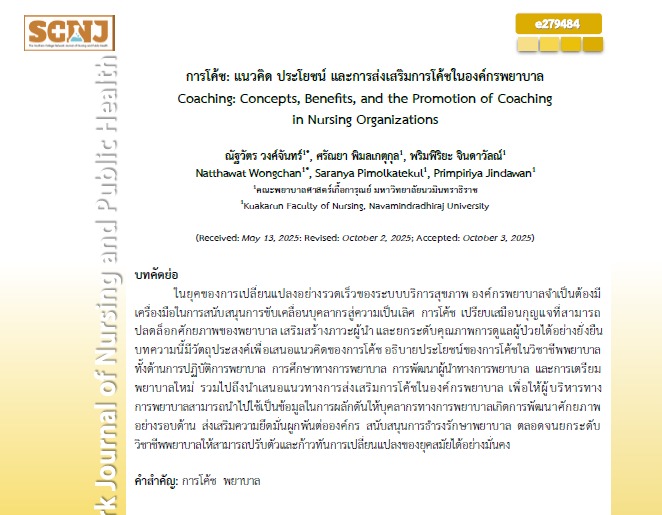
การโค้ช: แนวคิด ประโยชน์ และการส่งเสริมการโค้ชในองค์กรพยาบาล
คำสำคัญ:
การโค้ช, พยาบาลบทคัดย่อ
ในยุคของการเปลี่ยนแปลงอย่างรวดเร็วของระบบบริการสุขภาพ องค์กรพยาบาลจำเป็นต้องมีเครื่องมือในการสนับสนุนการขับเคลื่อนบุคลากรสู่ความเป็นเลิศ การโค้ช เปรียบเสมือนกุญแจที่สามารถปลดล็อกศักยภาพของพยาบาล เสริมสร้างภาวะผู้นำ และยกระดับคุณภาพการดูแลผู้ป่วยได้อย่างยั่งยืน บทความนี้มีวัตถุประสงค์เพื่อเสนอแนวคิดของการโค้ช อธิบายประโยชน์ของการโค้ชในวิชาชีพพยาบาลทั้งด้านการปฏิบัติการพยาบาล การศึกษาทางการพยาบาล การพัฒนาผู้นำทางการพยาบาล และการเตรียมพยาบาลใหม่ รวมไปถึงนำเสนอแนวทางการส่งเสริมการโค้ชในองค์กรพยาบาล เพื่อให้ผู้บริหารทาง
การพยาบาลสามารถนำไปใช้เป็นข้อมูลในการผลักดันให้บุคลากรทางการพยาบาลเกิดการพัฒนาศักยภาพอย่างรอบด้าน ส่งเสริมความยึดมั่นผูกพันต่อองค์กร สนับสนุนการธำรงรักษาพยาบาล ตลอดจนยกระดับวิชาชีพพยาบาลให้สามารถปรับตัวและก้าวทันการเปลี่ยนแปลงของยุคสมัยได้อย่างมั่นคง
เอกสารอ้างอิง
ชญาณิน สลีมิน, ปรีนาภา ชูรัตน์, อริยา คูหา, และฐปรัตน์ รักษ์ภาณุสิทธิ์. (2567). ผลของการโค้ชจิตวิทยาเชิงบวกต่อศักยภาพการดูแลใจตนและทุนจิตวิทยาเชิงบวก ของนักศึกษาพยาบาล มหาวิทยาลัยสงขลานครินทร์ วิทยาเขตหาดใหญ่. วารสารพฤติกรรมศาสตร์, 30(1), 88–108.
ธัญพร ชื่นกลิ่น, และวัชรา เล่าเรียนดี. (2555). การพัฒนารูปแบบการโค้ช เพื่อพัฒนาสมรรถนะการจัดการเรียนรู้ของอาจารย์พยาบาล ที่ส่งเสริมทักษะการคิดอย่างมีวิจารณญาณของนักศึกษาพยาบาล ในสังกัดสถาบันพระบรมราชชนก กระทรวงสาธารณสุข. วารสารศิลปากรศึกษาศาสตร์วิจัย, 4(1), 112–129.
พรทิพย์ รัตนบุรี, เปรมฤทัย น้อยหมื่นไวย, และเรณุการ์ ทองคำรอด. (2566). ผลของโปรแกรมการโค้ชแบบโกรว์ของผู้บริหารทางการพยาบาลระดับต้น ต่อสมรรถนะการปฏิบัติราชการของพยาบาลวิชาชีพจบใหม่ โรงพยาบาลทุ่งสง. วารสารการพยาบาลและการศึกษา, 16(3), 76–91.
พัชรินทร์ สุนันต๊ะ, พัชราภรณ์ อารีย์, และเพชรน้อย สิงห์ช่างชัย. (2564). ผลของโปรแกรมการโค้ชแบบเพียร์ต่อความสามารถในการปฏิบัติงาน ของพยาบาลวิชาชีพในโรงพยาบาลเอกชน. วารสารการพยาบาลและสุขภาพ, 15(3), 98–111.
ไพเราะ พ่อนุ้ย, ปรัชญานันท์ เที่ยงจรรยา, และศศิธร ลายเมฆ. (2565). การพัฒนารูปแบบการสอนงานพยาบาลใหม่ตามแนวทางพีพีซีอีเพื่อเสริมความรอบรู้ด้านยาสำหรับผู้ป่วยสูงอายุ. วารสารสุขภาพและการศึกษาพยาบาล, 28(2), e257978.
เพชรฎา แอชตัน, นิตรา ชาญชัยเดชาชัย, พิชญดา โลลุพิมาน, และสุภาพร หงษ์ทอง. (2565). ผลของการพัฒนาโปรแกรมการเรียนรู้แบบโค้ชเพื่อส่งเสริมความสามารถพยาบาล ห้องผ่าตัดในการพยาบาลผู้ป่วยผ่าตัดทำทางเบี่ยงหลอดเลือดหัวใจ โรงพยาบาลนครปฐม. วารสารกองการพยาบาล, 49(3), 44–57.
รุ่งอรุณ เกศวหงส์, และมนตรี แสงภัทราชัย. (2565). โค้ชชิ่ง: นวัตกรรมเพื่อพัฒนาภาวะผู้นำทางการพยาบาล. วารสารการปฏิบัติการพยาบาลและการผดุงครรภ์ไทย, 9(1), 122–128.
รุ่งอรุณ บุตรศรี, สมพันธ์ หิญชีระนันทน์, และปราณี มีหาญพงษ์. (2563). ผลของการนิเทศตามโมเดลการโค้ชแบบโกรว์ของผู้บริหารการพยาบาลระดับต้นต่อความสามารถในการปฏิบัติงานของพยาบาลวิชาชีพ. วารสารมหาวิทยาลัยคริสเตียน, 26(2), 84–96.
สุทินา วงศ์ฉายา, และจิญ แก้วกล้า. (2566). ผลของการโค้ชต่อการปฏิบัติตามแนวทางการจัดการความเจ็บปวดและผลลัพธ์ทางคลินิกของผู้ป่วยหลังรับการผ่าตัดทางออร์โธปิดิกส์. วารสารการแพทย์และวิทยาศาสตร์ทางคลินิก โรงพยาบาลแพร่, 31(2), 34–47.
Ali, M., Islam, T., Ali, F. H., Raza, B., & Kabir, G. (2021). Enhancing nurses well-being through managerial coaching: a mediating model. International Journal of Human Rights in Healthcare, 14(2), 143–157. doi.org/10.1108/IJHRH-10-2020-0088
Barr, J. A., & Tsai, L. P. (2021). Health coaching provided by registered nurses described: A systematic review and narrative synthesis. BMC Nursing, 20(1), 1–18. doi.org/10.1186/s12912-021-00594-3
Bell, F. (2024). The Importance of Mentoring and Coaching in Nursing. Retrieved April 20, 2025 from https://www.myamericannurse.com/the-importance-of-mentoring-and-coaching-in-nursing/
Cable, S., & Graham, E. (2018). “Leading better care”: An evaluation of an accelerated coaching intervention for clinical nursing leadership development. Journal of Nursing Management, 26(5), 605–612. doi.org/10.1111/jonm.12590
Clutterbuck, C. & Turner, T. (2017). A Brief History of Coaching and Mentoring. In A. Blackman, D. Kon, & D. Clutterbuck (Eds.), Coaching and Mentoring in the Asia Pacific (pp. 3–22). Routledge.
Douglas, N. F., & MacPherson, M. K. (2021). Positive changes in certified nursing Assistants' communication behaviors with people with dementia: Feasibility of a coaching strategy. American Journal of Speech-Language Pathology, 30(1), 239–252. doi.org/10.1044/ 2020_ajslp-20-00065
Faithfull-Byrne, A., Thompson, L., Schafer, K. W., Elks, M., Jaspers, J., Welch, A., et al. (2017). Clinical coaches in nursing and midwifery practice: Facilitating point of care workplace learning and development. Collegian, 24(4), 403–410. doi.org/10.1016/j.colegn.2016.06.001
Fisher, J., Ainsworth, A., Thomson, R., Matthan, J., Nadarajah, Vishna Devi V., et al. (2025). A guide to peer coaching for health professions educators. The Clinical Teacher, 22(2). 1–8. doi.org/10.1111/tct.70051
Hu, S., Chen, W., Hu, H., Huang, W., Chen, J., & Hu, J. (2022). Coaching to develop leadership for healthcare managers: a mixed-method systematic review protocol. Systematic Reviews, 11(1), 1–7. doi.org/10.1186/s13643-022-01946-z
Huggins, D. (2016). Enhancing nursing students’ education by coaching mentors. Nursing Management (Harrow, London, England: 1994), 23(1), 30–32. doi.org/10.7748/ nm.23.1.30.s28
International Coaching Federation [ICF]. (2021). ICF Core Competencies: The Foundation of Transformative Coaching. Retrieved April 10, 2025, from https://coachingfederation.org/ core-competencies
International Coaching Federation [ICF]. (2025). ICF Coaching Culture Research. Retrieved April 30, 2025 from https://coachingfederation.org/resources/research/building-a-coaching-culture/
Kerns, C., & Wedgeworth, M. (2025). Coaching and evaluating new graduate nurses. American Nurse Journal, 20(02), 06–13. doi.org/10.51256/ANJ022506
Lee, E. A., Hendricks, S., LaMothe, J., Draucker, C. B., & Wright, L. (2020). Coaching strategies used to support interprofessional teams in 3 primary care centers. Clinical Nurse Specialist CNS, 34(6), 263–269. doi.org/10.1097/NUR.0000000000000557
Lee, S. Y., Han, K. S., & Jung, M. (2024). Coaching in nursing: A concept analysis. Journal of Korean Academy of Psychiatric and Mental Health Nursing, 33(4), 365–372. doi.org/10.12934/jkpmhn.2024.33.4.365
Livesay, K., Petersen, S., Walter, R., Zhao, L., Butler-Henderson, K., & Abdolkhani, R. (2023). Sociotechnical challenges of digital health in nursing practice during the COVID-19 pandemic: National study. JMIR nursing, 6, e46819. doi.org/10.2196/46819
Mbokota, G., & Myres, K. (2024). Coach competencies to facilitate transformative learning: A multiple case study involving public-sector executives in South Africa. Human Resource Development International, 1–31. doi.org/10.1080/13678868.2
Merino-Godoy, M.-d.-L.-Á., Teixeira da Costa, E., Salas, M. G., Lara, A. P., Bernal, N. C., Domínguez, B. M., et al. (2024). Challenges in clinical training for nursing students during COVID-19: examining Its effects on nurses’ job satisfaction. Journal of Nursing Management, 2024, 7865540. doi.org/10.1155/2024/7865540
Patterson, B. J., Brewington, J., Krouse, A., & Hall, M. (2022). Building academic leadership capacity through coaching. Nursing Education Perspectives, 43(4), 222–227. doi.org/10.1097/01.NEP. 0000000000000981
Rahayu, C. D., Hartiti, T., & Rofi’i, M. (2016). A review of the quality improvement in discharge planning through coaching in nursing. Nurse Media Journal of Nursing, 6(1), 19–29. doi.org/10.14710/nmjn.v6i1.11817
Richardson, C., Wicking, K., Biedermann, N., & Langtree, T. (2023). Coaching in nursing: An integrative literature review. Nursing Open, 10(10), 6635–6649. doi.org/10.1002/nop2.1925
Sarroeira, C., Cunha, F., & Simões, J. (2020). Coaching & nursing: A qualitative analysis of literature. Journal of UIIPS- Research Unit of the Polytechnic Institute of Santarém, 8, 42–56. doi.org/10.25746/ruiips.v8.i1.19877
Sherrer, M., & Rezania, D. (2020). A scoping review on the use and effectiveness of leadership coaching in succession planning. Coaching: An International Journal of Theory, Research and Practice, 13(2), 209–219. doi.org/10.1080/17521882.2020.1758178
Srivali Teal, J., Vaughn, S., & Fortes, K. (2023). The nurse coach’s role in supporting student well-being. Teaching and Learning in Nursing, 18(4), 508–511. doi.org/10.1016/ j.teln.2023.06.016
Taie, E. S. (2018). Peer coaching as an innovative approach to accelerate development for Helwan intern nurse. Journal of Nursing & Healthcare, 3(2). 1–6. doi.org/10.33140/ JNH/03/02/00003
Thompson, L., Lin, F., Faithfull-Byrne, A., Gonzalez, J., Naumann, A., Geisler, K., et al. (2021). Clinical coaches and patient safety - Just in time: A descriptive exploratory study. Nurse Education in Practice, 54. 1–6. doi.org/10.1016/j.nepr.2021.103134
Whitmore, J. (2017). Coaching for Performance. Principles and Practice of Coaching and Leadership (5th ed.). London: Nicholas Brealey Publishing.
World Health Organization [WHO]. (2016). Global Strategic Directions for Strengthening Nursing and Midwifery. Geneva: author.
Yusuf, F. R., Kumar, A., Goodson-Celerin, W., Lund, T., Davis, J., Kutash, M., et al. (2018). Impact of coaching on the nurse-physician dynamic. Advances in Critical Care, 29(3), 259–267. doi.org/10.4037/aacna cc2018624
ดาวน์โหลด
เผยแพร่แล้ว
ฉบับ
ประเภทบทความ
สัญญาอนุญาต
ลิขสิทธิ์ (c) 2025 วารสารเครือข่ายวิทยาลัยพยาบาลและการสาธารณสุขภาคใต้

อนุญาตภายใต้เงื่อนไข Creative Commons Attribution-NonCommercial-NoDerivatives 4.0 International License.
1. บทความหรือข้อคิดเห็นใด ๆ ที่ปรากฏในวารสารเครือข่าย วิทยาลัยพยาบาลและการสาธารณสุขภาคใต้ ที่เป็นวรรณกรรมของผู้เขียน บรรณาธิการหรือเครือข่ายวิทยาลัยพยาบาลและวิทยาลัยการสาธารณสุขภาคใต้ ไม่จำเป็นต้องเห็นด้วย
2. บทความที่ได้รับการตีพิมพ์ถือเป็นลิขสิทธิ์ของ วารสารเครือข่ายวิทยาลัยพยาบาลและการสาธารณสุขภาคใต้