ภาวะผู้นำแบบใฝ่บริการของผู้บริหารวิทยาลัยพยาบาล สังกัดคณะพยาบาลศาสตร์ สถาบันพระบรมราชชนก กระทรวงสาธารณสุข
คำสำคัญ:
ภาวะผู้นำแบบใฝ่บริการ , ผู้บริหารวิทยาลัยพยาบาล , สถาบันพระบรมราชชนกบทคัดย่อ
การวิจัยแบบผสมวิธีนี้มีวัตถุประสงค์ 1) เพื่อศึกษาองค์ประกอบภาวะผู้นําแบบใฝ่บริการของผู้บริหารวิทยาลัยพยาบาลสังกัดคณะพยาบาลศาสตร์ สถาบันพระบรมราชชนก กระทรวงสาธารณสุข 2) เพื่อยืนยันองค์ประกอบภาวะผู้นําแบบใฝ่บริการของผู้บริหารวิทยาลัยพยาบาล สังกัดคณะพยาบาลศาสตร์ สถาบันพระบรมราชชนก กระทรวงสาธารณสุข กลุ่มตัวอย่างของการวิจัย คือ วิทยาลัยพยาบาล สังกัดคณะพยาบาลศาสตร์ สถาบันพระบรมราชชนก กระทรวงสาธารณสุข จำนวน 28 วิทยาลัย กำหนดผู้ให้ข้อมูลวิทยาลัยละ 16 คน รวมผู้ให้ข้อมูลทั้งสิ้น 448 คน เครื่องมือที่ใช้ในการวิจัย ได้แก่ แบบสัมภาษณ์แบบกึ่งโครงสร้าง แบบสอบความคิดเห็นและแบบสอบถามเพื่อยืนยันองค์ประกอบ สถิติที่ใช้ในการวิเคราะห์ข้อมูล ได้แก่ ความถี่ ค่าร้อยละ ค่ามัชฌิมเลขคณิต ส่วนเบี่ยงเบนมาตรฐาน การวิเคราะห์องค์ประกอบเชิงสํารวจ ผลการวิจัยพบว่า
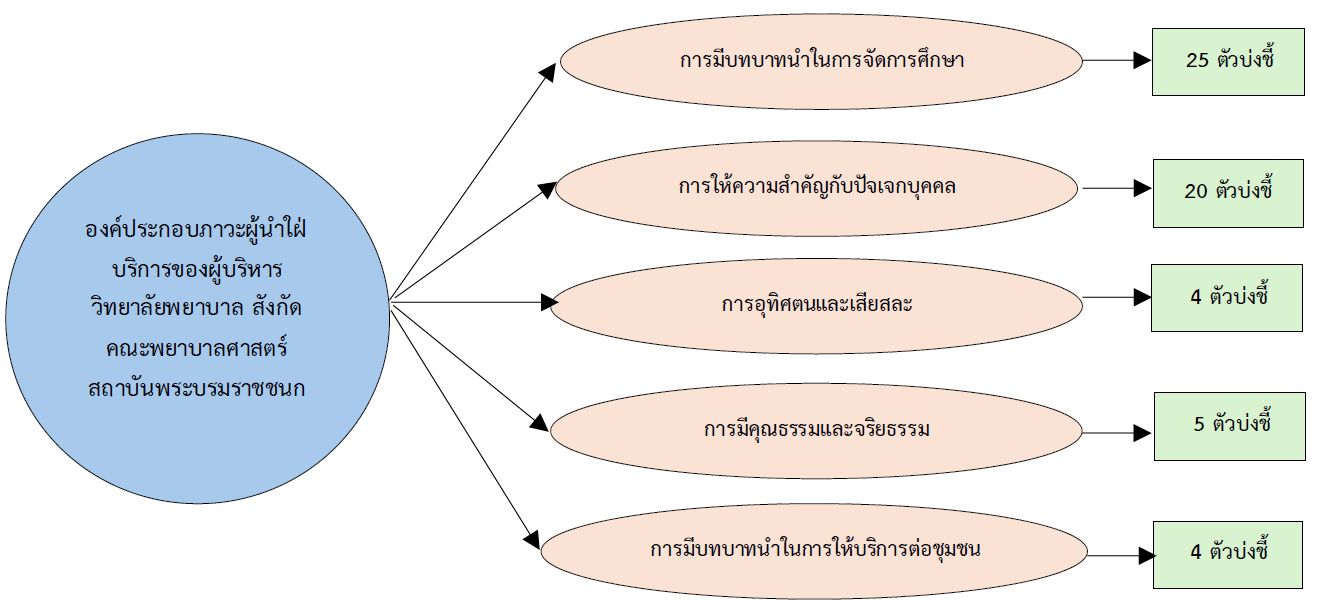
1. องค์ประกอบภาวะผู้นําแบบใฝ่บริการของผู้บริหารวิทยาลัยพยาบาลสังกัดคณะพยาบาลศาสตร์ สถาบันพระบรมราชชนก กระทรวงสาธารณสุข ประกอบด้วย 5 องค์ประกอบ คือ 1) การมีบทบาทนำในการจัดการศึกษาพยาบาล 2) การให้ความสำคัญกับปัจเจกบุคคล 3) การอุทิศตนและเสียสละ 4) การมีคุณธรรมและจริยธรรม และ 5) การมีบทบาทนำในการให้บริการต่อชุมชน โดยทั้ง 5 องค์ประกอบ 58 ตัวบ่งชี้ สามารถร่วมกันอธิบายความแปรปรวนของตัวบ่งชี้ได้ร้อยละ 65.52 โดยมีค่าไอเกน เท่ากับ 27.00, 23.93, 9.12, 5.99 และ 5.53 ตามลำดับ
2. ผลการยืนยันองค์ประกอบภาวะผู้นําแบบใฝ่บริการของผู้บริหารวิทยาลัยพยาบาลสังกัดคณะพยาบาลศาสตร์ สถาบันพระบรมราชชนก กระทรวงสาธารณสุข พบว่า ผู้เชี่ยวชาญทั้ง 5 คน มีความเห็นสอดคล้องกัน โดยมีความเห็นว่าภาวะผู้นําแบบใฝ่บริการของผู้บริหารวิทยาลัยพยาบาลสังกัดคณะพยาบาลศาสตร์ สถาบันพระบรมราชชนก กระทรวงสาธารณสุข ทั้ง 5 องค์ประกอบ มีความถูกต้อง จำนวน 5 คน คิดเป็นร้อยละ 100 มีความเหมาะสม จำนวน 5 คน คิดเป็นร้อยละ 100 มีความเป็นไปได้ จำนวน 5 คน คิดเป็นร้อยละ 100 และมีความเป็นประโยชน์ จำนวน 5 คนคิดเป็นร้อยละ 100
ดังนั้นสามารถนำองค์ประกอบและตัวบ่งชี้ภาวะผู้นําแบบใฝ่บริการของผู้บริหารวิทยาลัยพยาบาลสังกัดคณะพยาบาลศาสตร์ สถาบันพระบรมราชชนก กระทรวงสาธารณสุข ไปประยุกต์ใช้ในการส่งเสริมภาวะผู้นำแบบใฝ่บริการของผู้บริหาร เพื่อส่งผลต่อประสิทธิผลขององค์กร
เอกสารอ้างอิง
ชูศรี มโนการ, รัศมิ์ลภัส ใจยะสิทธิ์ และศศิญา บัวผุด. (2563). องค์ประกอบเชิงยืนยันประสิทธิผลทีมของอาจารย์พยาบาลสังกัดกระทรวงสาธารณสุข. วารสารทหารบก, 21(3), 179-190.
ธนพร วรรณกูล, ศักดา สถาพรวจนา และนรลักขณ์ เอื้อกิจ. (2559). การพัฒนาตัวบ่งชี้คุณลักษณะภาวะผู้นำแบบผู้บริการของผู้บริหารสถาบันการศึกษาพยาบาล. วารสารเวอริเดียนส์, 9(1), 598-610.
เนติยา แจ่มทิม, จารุวรรณ สนองญาติ และลักขณา ศิรถิกุล. (2564). คุณลักษณะของผู้บริหารที่พึงประสงค์ วิทยาลัยพยาบาลในสังกัดคณะพยาบาลศาสตร์ สถาบันพระบรมราชชนก. วารสารวิทยาลัยพยาบาลบรมราชชนนี สุพรรณบุรี, 4(1), 95-103.
ปุณยนุช พิมใจใส, อนุชา มาเรียน, มัณฑนา เทวาโภคิณกุล และพรทิพย์ กวินสุพร. (2563). ภาวะผู้นำใฝ่บริการ: มุมมองผู้บริหารการพยาบาล. วารสารพยาบาลทหารบก, 21(1), 9-17.
มาลีวัล เลิศสาครศิริ, มาลินี ปั้นดี และวิลาวัณย์ เพ็งพานิช. (2563). การเสริมสร้างความพึงพอใจในงานและการคงอยู่ในองค์กรของพยาบาลวิชาชีพสำเร็จใหม่. วารสารวิทยาลัยพยาบาลพระปกเกล้า จันทบุรี, 31(2), 201-212.
วรางคณา จันทร์คง. (2567). แนวทางการพัฒนาภาวะผู้นำใฝ่บริการด้านสุขภาพของอาสาสมัครสาธารณสุขประจำหมู่บ้าน จังหวัดสุพรรณบุรี. วารสารเครือข่ายวิทยาลัยพยาบาลและการสาธารณสุขภาคใต้, 11(1), 1-10.
วิวัฒน์ โรจนพิทยากร. (2562). สถาบันพระบรมราชชนก:สถาบันอุดมศึกษาแห่งใหม่ของไทย. วารสารวิชาการสาธารณสุข, 28(ฉบับพิเศษ), 1-2.
ศิริพร สิงหเนตร, จรวยพร ใจสิทธิ และวิชยา เห็นแก้ว. (2560). ภาวะผู้นำการพยาบาลในศตวรรษที่ 21. วารสารนเรศวรพะเยาว์, 10(1), 17-22.
สถาบันพระบรมราชชนก. (2561). ยกสถานะ ‘สถาบันพระบรมราชชนก’ เป็นอุดมศึกษาเฉพาะทางผลิตบุคลากรตามความต้องการ สธ. สืบค้นเมื่อ 4 กันยายน 2567 จาก https://www.hfocus.org/content/2018/04/15680.
คณะพยาบาลศาสตร์, สถาบันพระบรมราชชนก. (2562). ประวัติคณะพยาบาลศาสตร์ สถาบันพระบรมราชชนก. สืบค้นเมื่อ 2 ธันวาคม 2567 จาก fon.pi.ac.th/รู้จักองค์กร/.
สมจิตร เจริญกร. (2561). ภาวะผู้นำทางวิชาการของผู้บริหารสถานศึกษาในองค์กร. วารสารรอยขอนแก่นอคาเดมี 3(2), 1-16.
สัมฤทธิ์ กางเพ็ง. (2557). ภาวะผู้นำแบบบริการ : แนวคิด ทฤษฎี และงานวิจัย. มหาสารคาม: อภิชาติการพิมพ์.
สำนักงานคณะกรรมการการอุดมศึกษา. (2566). แผนพัฒนาอุดมศึกษาระยะยาว. สืบค้นเมื่อ 2 กุมภาพันธ์ 2567 จาก https://www.ubu.ac.th/web/files_up/ 03f20170 409 16420783.pdf.
สุพัตรา วัชรเกตุ. (2557). ภาวะผู้นำแบบผู้รับใช้ : บัญญัติ 10 ประการของผู้นำทางการพยาบาล. วารสารพยาบาลทหารบก, 15(3), 44-48.
สุระพรรณ พนมฤทธิ์ และเพ็ญพรรณ พิทักษ์สงคราม. (2564). การพัฒนาภาวะผู้นำแบบใฝ่บริการ: ทิศทางการบริหารจัดการในองค์การพยาบาล. วารสารพยาบาลกระทรวงสาธารณสุข, 31(3), 202-210.
สุไฮดาร์ แวเตะ และชวลิต เกิดทิพย์. (2568). องค์ประกอบและตัวบ่งชี้ของภาวะผู้นําการปรับเปลี่ยนในภาวะพลิกผันสำหรับนักศึกษาหลักสูตรพยาบาลศาสตรบัณฑิต. วารสารเครือข่ายวิทยาลัยพยาบาลและการสาธารณสุขภาคใต้, 12(2), 1-13.
อุทัยวรรณ พงษ์บริบูรณ์ และทวีวัฒน์ ปิตยานนท์. (2558). องค์ประกอบภาวะผู้นำแบบให้บริการของผู้บริหารสถาบัน การศึกษาพยาบาลเอกชนที่ส่งผลต่อประสิทธิภาพและประสิทธิผลในการบริหารการศึกษาพยาบาล. วารสารทหารบก, 7(2), 64-76.
Comrey, A. L., & Lee, H. B. (1992). A First Course in Factor Analysis. Hillsdale, NJ: Erlbaum.
Comrey, A. L., & Lee, H. B. (1998). A First Course in Factor Analysis. (2nd ed.). Hillsdale, NJ: Erlbaum.
Daswati, Buntuang, C. D. P., Hattab, S., & , Kornelius, Y. (2021). Effect of servant leadership on the performance of a regional general hospital. Problems and Perspectives in Management, 19(2), 506-518.
Greenleaf, K. R. (2002). Servant Leadership: A Journey into the Nature of Legitimate power and Greatness. New Jersey:Paulist Press 5-8.
Hair, J. F., Gabriel, M. L., Siva, D. D., & Sergio, S. B. (2019). Development and validation of attitudes measurement scales:fundamental and practical aspects. Rausp Management Journal, 54(4), 490-507.
Kaiser, H. F. (1983). Using Multivariate Statistics. New York: Haper & Row 411.
Krejcie, V. R., & Morgan, W. E. (1970). Determining sample size for research activities. Educational and Psychological Measurement, 30(3), 607-610.
Miles, M. B., & Huberman, A. M. (1994). Qualitative Data Analysis. (2nd ed.). Thousand Oaks, CA: Sage.
Purwanti, Y. R., Sriatmi, A., & , Dwiantoro, L. (2023). The impact of servant leadership in nursing practice at the hospital: A literature review. Journal of Holistic Nursing Science, 10(2), 82-88.
Robinson, M., & Magnusen, J. M. (2023). Developing servant leadership through experience and practice: A case study in service learning. Behavioral Science, 14(2), 1-15.
Zada, S., Khan, J., Saeed, I. Jun, Y. Z., Munoz, V. A., & , Barraza, C. N. (2022). Servant leadership behavior at the workplace and knowledge hoarding: A moderation mediation examination. Frontiers in Psychology, 13(4), 1-12.
ดาวน์โหลด
เผยแพร่แล้ว
ฉบับ
ประเภทบทความ
สัญญาอนุญาต
ลิขสิทธิ์ (c) 2025 วารสารเครือข่ายวิทยาลัยพยาบาลและการสาธารณสุขภาคใต้

อนุญาตภายใต้เงื่อนไข Creative Commons Attribution-NonCommercial-NoDerivatives 4.0 International License.
1. บทความหรือข้อคิดเห็นใด ๆ ที่ปรากฏในวารสารเครือข่าย วิทยาลัยพยาบาลและการสาธารณสุขภาคใต้ ที่เป็นวรรณกรรมของผู้เขียน บรรณาธิการหรือเครือข่ายวิทยาลัยพยาบาลและวิทยาลัยการสาธารณสุขภาคใต้ ไม่จำเป็นต้องเห็นด้วย
2. บทความที่ได้รับการตีพิมพ์ถือเป็นลิขสิทธิ์ของ วารสารเครือข่ายวิทยาลัยพยาบาลและการสาธารณสุขภาคใต้