ความชุกและปัจจัยที่มีผลต่อภาวะการรู้คิดบกพร่องของผู้สูงอายุและก่อนสูงอายุในชุมชนแห่งหนึ่ง จังหวัดพิษณุโลก
คำสำคัญ:
ภาวะการรู้คิดบกพร่อง, ผู้สูงอายุ, ก่อนสูงอายุบทคัดย่อ
การวิจัยภาคตัดขวางเชิงวิเคราะห์ครั้งนี้ มีวัตถุประสงค์เพื่อศึกษาความชุกและปัจจัยที่มีผลต่อภาวะการรู้คิดบกพร่องของผู้สูงอายุและก่อนสูงอายุในชุมชนแห่งหนึ่ง จังหวัดพิษณุโลก กลุ่มตัวอย่างคือ ประชากรผู้สูงอายุและก่อนสูงอายุ จำนวน 248 คน คัดเลือกโดยวิธีการสุ่มตัวอย่างแบบชั้นภูมิ เครื่องมือที่ใช้ในการเก็บข้อมูล คือ แบบสอบถามประกอบด้วย 3 ส่วน คือ ข้อมูลส่วนบุคคล ซึ่งประกอบด้วย เพศ อายุ ระดับการศึกษา อาชีพ การมีโรคประจำตัว ดัชนีมวลกาย พฤติกรรมการสูบบุหรี่ และแบบคัดกรองภาวะการรู้คิด วิเคราะห์ข้อมูลโดยใช้สถิติเชิงพรรณนา และสถิติถดถอยพหุคูณโลจิสติก ผลการวิจัยพบว่า
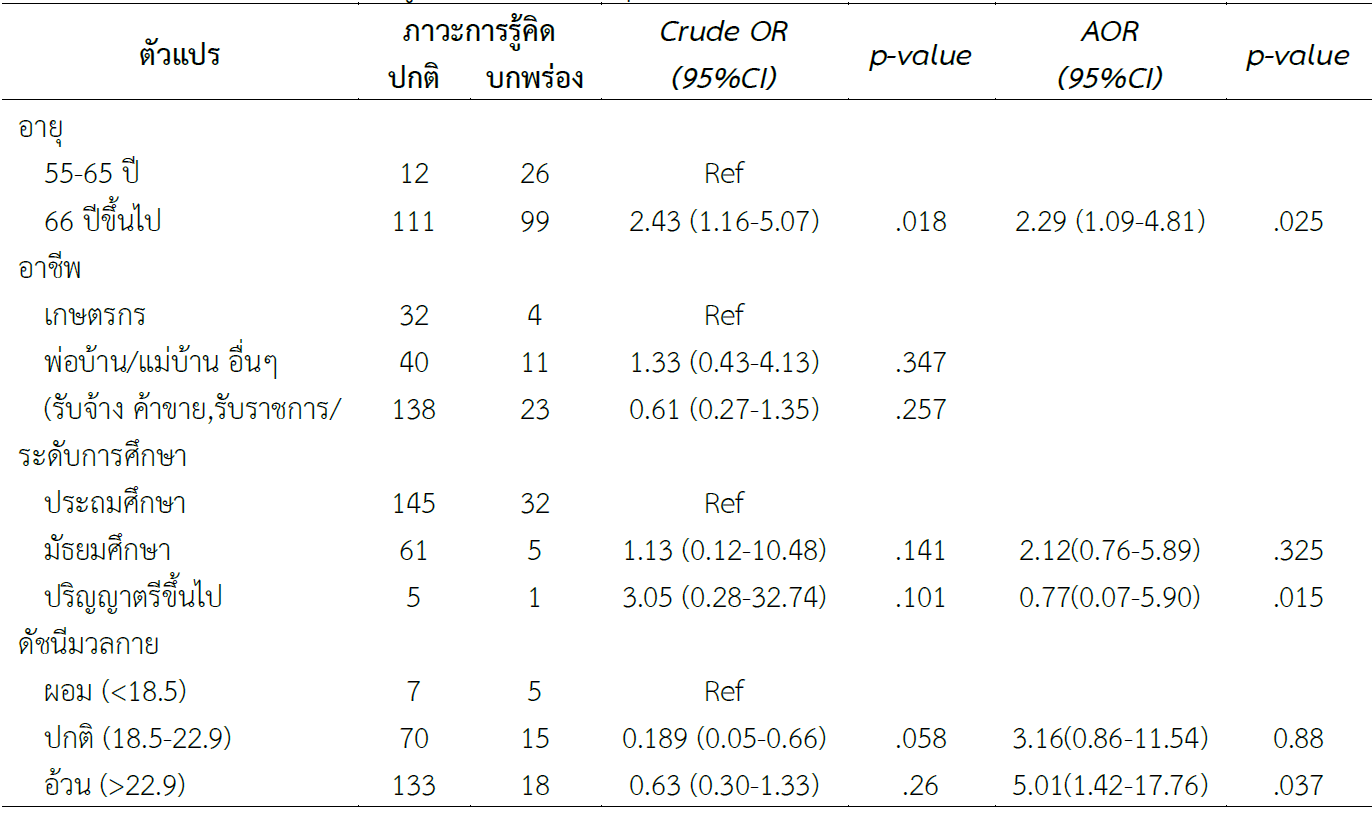
ความชุกภาวะการรู้คิดบกพร่องเท่ากับร้อยละ 15.32 ปัจจัยที่มีผลต่อภาวะการู้คิดบกพร่อง ประกอบด้วย อายุ 66 ปีขึ้นไป (ORadj = 2.29, 95%CI: 1.09-4.81) ดัชนีมวลกายระดับอ้วน (ORadj = 5.01, 95%CI: 1.42-17.76) และพฤติกรรมการสูบบุหรี่ (ORadj = 2.56, 95%CI: 1.01-6.50) มีผลต่อภาวการณ์รู้คิดบกพร่องของผู้สูงอายุและก่อนสูงอายุ ในชุมชนแห่งหนึ่ง จังหวัดพิษณุโลก อย่างมีนัยสำคัญทางสถิติที่ระดับ .05
ดังนั้นทีมสุขภาพควรจัดหากิจกรรมในการรักษาระดับดัชนีมวลกายให้อยู่ในเกณฑ์ปกติ รณรงค์การลดสูบบุหรี่ และกิจกรรมการป้องกันภาวะการรู้คิดบกพร่องในช่วงก่อนสูงอายุ เชิงรุกในชุมชนเพื่อป้องกันการนำไปสู่การเกิดภาวะสมองเสื่อม ตลอดจนสร้างความตระหนักในทีมสุขภาพ ชุมชน ครอบครัว ในการร่วมมือคัดกรองและตระหนักถึงผลกระทบของการนำไปสู่โรคสมองเสื่อมต่อไป
เอกสารอ้างอิง
Alzheimer’ Disease International. (2025). Dementia Statistics. Retrieved January 10, 2025 from https://www.alzint.org/about/dementia-facts-figures/dementia-statistics/
Anantdilokrit, P., (2023). Mild cognitive impairment or mild neurocognitive disorder. Regional Health Promotion Center 9 Journal, 17(1), 381-393. (in Thai)
Bonkhunthod, P., & Munluan, K. (2022). Mild Cognitive Impairment: Before getting sick with dementia. APHEIT Journal of Nursing and Health, 4(1), 1-15. (in Thai)
Chaowanasilpa, N., (2020). Teaching Materials Courese: Geriatric Nursing. Retrieved January 10, 2025 from https://pws.npru.ac.th/nongnutch/system/sys_article/20240424120650_ b12f5935f18ba1cacae4001677f9801b.pdf
Chirdchoothum, S., Bosittipichet, T., Korwatthanamongkol, K., & Leesri, T. (2024). Factors related to mild cognitive impairment of ageing people in Phra Nakhon Si Ayutthaya Province. Regional Health Promotion Center 9 Journal, 18(3), 801-814. (in Thai)
Faul, F., Erdfelder, E., Lang, A. G., & Buchner, A. (2007). G*Power 3: A flexible statistical power analysis program for the social, behavioral, and biomedical sciences. Behavior Research Methods, 39(2), 175-191.
Griffiths, J., Thaikruea, L., Wongpakaran, N., & Munkhetvit, P. (2020). Prevalence of mild cognitive impairment in rural Thai older people, associated risk factors and their cognitive characteristics. Dement Geriatr Cogn Dis Extra, 10(1), 38-45. doi:10.1159/000506279.
Harnsomskul, R., & Jayathavaj, V. (2024). Forecasting the number of inpatients with dementia and Alzheimer's disease in Thailand. Academic Journal of Community Public Health, 10(4), 74-85. (in Thai)
Jhomkhum, W., Kachiangrai, W., Phromvichai, P., Praserttitipong, K., Phongphanngam, S., & Duangsanjun. (2024). Factors associated with mild cognitive impairment among older adults in Mueang District, Phayao Province. Regional Health Promotion Center 9 Journal, 18(3), 935-945. (in Thai)
Kuder, G., & Richardson, M. (1937). The Theory of Estimation of Test Reliability. Psychometrika.
Leecharoen, P., Pothiban, L., Trapsinsaree, D., Rongsawat, O., & Nontaput, P. (2021). Stress and coping in older persons with dementia. The Southern College Network Journal of Nursing and Public Health, 8(2), 288-302. (in Thai)
Loef, M., & Walach, H. (2013). Midlife obesity and dementia: meta-analysis and adjusted forecast of dementia prevalence in the United States and China. Obesity (Silver Spring, Md.), 21(1), E51–E55. doi.org/10.1002/oby.20083
Mani, N., Chenu, R., & Dunthara, L. (2024). Risk factors affecting dementia among older adults in Bana health promoting hospital, Mueang district, Pattani province. Journal of Education and Research in Public Health, 2(1), 64-78. (in Thai)
Morys, F., Potvin, O., Zeighami, Y., Vogel, J., Lamontagne-Caron, R., Duchesne, S., & et al. (2022). Obesity-associated neurodegeneration pattern mimics alzheimer's disease in an observational cohort study. Journal of Alzheimer's disease, 91(3), 1059–1071. doi.org/10.3233/JAD-220535
Ott, A., Slooter, A. J., Hofman, A., Van Harskamp, F., Witteman, J. C., Van Broeckhoven, C., et al. (1998). Smoking and risk of dementia and Alzheimer’s disease in a population-based cohort study: The Rotterdam Study. The Lancet, 351(9119), 1840–1843. doi.org/10.1016/S0140-6736(97)09203-6
Prungwittaya, N. (2025). The risk of developing dementia is higher in women than in men. Retrieved January 10, 2025 from https://cimjournal.com/medical-news/higher-dementia-risk-women/
Rattanawat, W., Nakawiro, D., Visajan, P. (2018). Prevalence of Mild Cognitive Impairment (MCI) in Pre-Retirement Period of Hospital Staff. J Psychiatr Assoc Thailand, 63(1), 55-64. (in Thai)
Roongruang, A., & Satayavongthip, B. (2023). Prevalence and factors associated with risks for dementia among elderly in Sungnoen subdistruct municipality, Nakhon Ratchasima Province. Regional Health Promotion Center 9 Journal, 17(1). 272-287. (in Thai)
Saengkum, P. (2024). Prevalence and factors associated with dementia among elderly people at Muang Phai Community Health Center, Banphai Hospital Network, Khon Kaen Province. Journal of Environmental Medical and Health, 9(4), 408–479. (in Thai)
Sukchan, P., Niyomdecha, K., & Srichaisuwan, D. (2019). Factors related to dementia among elderly persons in Thailand: A systematic review, Princess of Naradhiwas university journal, 14(1), 276-292. (in Thai)
Thajang, S., Saowaphan, J., Upamana, C., Khomhanpol, P., & Padchasee, P. (2021). Personal factors associated among risk factors for dementia in the elderly of Ban Chan sub-district, Mueang district, Udon Thani province. Udonthani Hospital Medical Journal, 29(2), 193-203. (in Thai)
Thumsing, P., Janpol, k., & Phuhongsai, P., (2023). Mental status and factors associated with mental status among the older persons in elderly school: Health region 7. Research and Development Health System Journal, 16(3). 268-279. (in Thai)
Tiparat, W., Meng-aied, S., Suwanweala, S., & Chuaykaew, B. (2019). Factors Predicting Dementia Preventive Behavior among Older Adults-at-Risk. The Journal of Faculty of Nursing Burapha University, 27(1), 100-108. (in Thai)
U.S. Food and Drug Administration. (2023). FDA Converts Novel Alzheimer’s Disease Treatment to Traditional Approval. Retrieved January 3, 2024 from: https://www.fda.gov/news- events/press-announcements/fda-converts-novel-alzheimers-disease-treatment-traditional-approval
Wang, Y., Song, M., Yu, L., Wang, L., An, C., Xun, S., et al. (2015). Mild cognitive impairment: Vascular risk factors in community elderly in four cities of Hebei Province, China. PLoS One, 0(5), e0124566. doi.org/10.1371/journal.pone.0124566
Wongsaree, C., & Puenthong, S. (2018). Dementia syndrome in the elderly: Nursing care and caring for relatives caregiver. Journal of Health Sciences and Wellness, 22(43-44), 166-179. (in Thai)
World Health Organization. Dementia Syndrome. Retrieved January 3, 2024 from https://www.who.int/news-room/fact-sheets/detail/dementia
ดาวน์โหลด
เผยแพร่แล้ว
ฉบับ
ประเภทบทความ
สัญญาอนุญาต
ลิขสิทธิ์ (c) 2025 วารสารเครือข่ายวิทยาลัยพยาบาลและการสาธารณสุขภาคใต้

อนุญาตภายใต้เงื่อนไข Creative Commons Attribution-NonCommercial-NoDerivatives 4.0 International License.
1. บทความหรือข้อคิดเห็นใด ๆ ที่ปรากฏในวารสารเครือข่าย วิทยาลัยพยาบาลและการสาธารณสุขภาคใต้ ที่เป็นวรรณกรรมของผู้เขียน บรรณาธิการหรือเครือข่ายวิทยาลัยพยาบาลและวิทยาลัยการสาธารณสุขภาคใต้ ไม่จำเป็นต้องเห็นด้วย
2. บทความที่ได้รับการตีพิมพ์ถือเป็นลิขสิทธิ์ของ วารสารเครือข่ายวิทยาลัยพยาบาลและการสาธารณสุขภาคใต้