การพัฒนานวัตกรรมเครื่องนวดเต้านมด้วยพลังสั่น เพื่อลดอาการคัดตึงเต้านม และเพิ่มการไหลของน้ำนมในมารดาหลังคลอด
คำสำคัญ:
นวัตกรรมเครื่องนวดเต้านมด้วยพลังสั่น , อาการคัดตึงเต้านม , การไหลของน้ำนมบทคัดย่อ
การวิจัยและพัฒนานี้เพื่อศึกษาสภาพปัญหาอาการคัดตึงเต้านมและแนวทางแก้ปัญหาพัฒนาและประเมินประสิทธิผลนวัตกรรมเครื่องนวดเต้านมด้วยพลังสั่น ดำเนินการ 3 ขั้นตอน คือ ขั้นตอนที่ 1 ศึกษาสภาพปัญหาอาการคัดตึงเต้านมและแนวทางแก้ปัญหาโดยการทบทวนวรรณกรรมและสัมภาษณ์มารดาหลังคลอด และพยาบาลวิชาชีพแผนกหลังคลอด โรงพยาบาลชัยนาทนเรนทร จำนวน 9 คน ขั้นตอนที่ 2 พัฒนานวัตกรรมเครื่องนวดเต้านมด้วยพลังสั่น ด้วยการะบวนการ PDCA และขั้นตอนที่ 3 ประเมินประสิทธิผลของนวัตกรรมเครื่องนวดเต้านมด้วยพลังสั่น โดยแบบแผนการทดลองขั้นต้นแบบกลุ่มเดียวทดสอบก่อนและหลัง กลุ่มตัวอย่างคือ มารดาหลังคลอด แผนกหลังคลอด โรงพยาบาลชัยนาทนเรนทร สุ่มแบบเจาะจงจำนวน 24 คน รวบรวมข้อมูลโดยแบบประเมินประสิทธิผลของนวัตกรรม ประกอบด้วยแบบวัดอาการคัดตึงเต้านมแบบประเมินการไหลของน้ำนม และแบบประเมินความพึงพอใจการใช้นวัตกรรม ผลการวิจัยพบว่า
1. สภาพปัญหาอาการคัดตึงเต้านมและแนวทางการแก้ปัญหาพบว่า ปัญหาเกิดจากมารดาหลังคลอด ไม่ปฏิบัติตามแนวทางการแก้ปัญหาที่ได้รับอย่างต่อเนื่อง มารดามีเหตุผลว่าการปฏิบัติและการเตรียมอุปกรณ์การประคบเต้านมมีความยุ่งยาก ทำให้พยาบาลต้องการพัฒนาแนวทางการแก้ปัญหาเต้านมคัดตึงในมารดาหลังคลอด
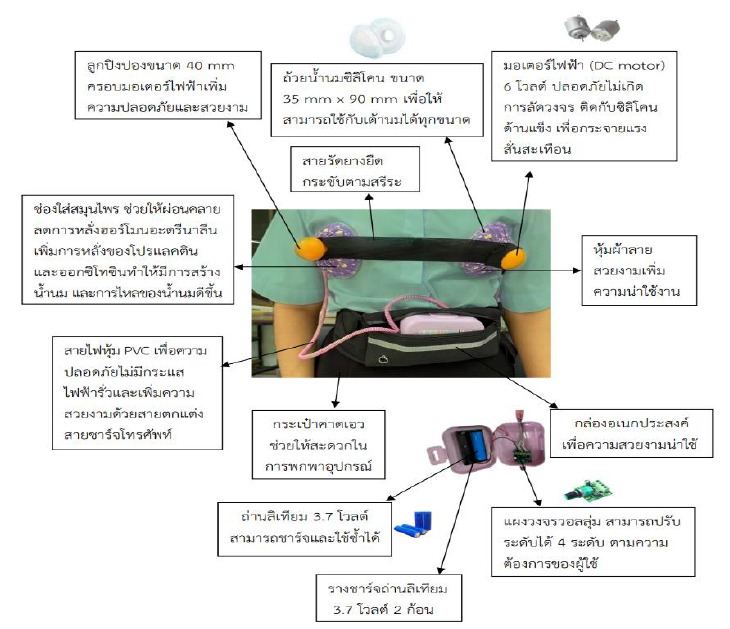
2. นวัตกรรมเครื่องนวดเต้านมด้วยพลังสั่นประกอบด้วย แนวคิดกระบวนการสร้างนวัตกรรม กลไกการสร้างและการไหลของน้ำนม และกระบวนการกระตุ้นการไหลเวียนของน้ำนมด้วยการสั่นสะเทือนจากมอเตอร์พลังไฟฟ้า ผลการพัฒนานวัตกรรมเครื่องนวดเต้านมด้วยพลังสั่นประกอบด้วย 3 ส่วน คือ 1) คุณลักษณะของนวัตกรรม 2) ขั้นตอนการทำงานของนวัตกรรม 3) จุดเด่นของนวัตกรรม
3. ภายหลังใช้นวัตกรรมกลุ่มตัวอย่างมีคะแนนเฉลี่ยอาการคัดตึงเต้านมลดลงอย่างมีนัยสำคัญทางสถิติที่ระดับ .001 (t = -11.63, p-value < .001) และคะแนนเฉลี่ยการไหลของน้ำนมสูงกว่าก่อนใช้นวัตกรรมอย่างมีนัยสำคัญทางสถิติที่ระดับ .001 (t = 11.07, p-value < .001) 3) คะแนนเฉลี่ยความพึงพอใจหลังใช้นวัตกรรมโดยรวมอยู่ในระดับมากที่สุด (M = 4.69, SD = .53)
พยาบาลแผนกหลังคลอดควรนำนวัตกรรมไปดูแลมารดาหลังคลอดควบคู่กับการดูแลแบบปกติ เพื่อลดอาการคัดตึงเต้านม เพิ่มการไหลของน้ำนม
เอกสารอ้างอิง
Deming, W. E. (1986). Out of the crisis. Cambridge, MA: Center for Advanced Engineering Study, Massachusetts Institute of Technology.
Department of Health, Ministry of Public Health. (2020). Percentage of newborns Breastfeeding within a 6 Months’ Period among. Retrieved June 8, 2024 from https://hdcservice. moph.go.th/hdc/reports/ report.php? source= pformated/format1.php&cat_id= 1ed90bc32310b503b7ca9b32af425ae5&id= 4164a7c49fcb2b8c3ccca67dcdf28bd0#. (in Thai)
Erlingsson, C., & Brysiewicz, P. (2017). A hands-on guide to doing content analysis. African Journal of Emergency Medicine, 7(3), 93-99.
Khotsang, K., Sangin, S. & Chuahorm, U. (2016). The effects of lactational program on milk secretion time, Onset of lactation and breastfeeding self-efficacy in mothersafter cesarean section. The Journal of Faculty of Nursing Burapha University, 24(1), 13-26. (in Thai)
Lahukarn, B., Rattaya, M., Nunart, T., & Masae, M. (2019). Self-breast massage: Concept and management methods of milk ejection in postpartum mothers. Journal of Sakon Nakhon Hospital, 22(3), 106-114. (in Thai)
Masae, M., Kala, S. & Chatchawet, W. (2019). Effect of self-breast massage program on milk ejection of first-time mothers. Princess of Naradhiwas University Journal, 11(3), 1-14. (in Thai)
Nasution, S. S., Erniyati, E., & Aizar, E. (2018). The effectiveness of DC motor vibrilatory stimulus (DMV) among postpartum women on giving breast milk. Open Access Macedonian Journal of Medical Sciences, 6(12), 2306–2309.
Nuampa. S., Tangsuksan, P., Jitima, V., & Nguycharoen, G. (2020). Breast massage for breastfeeding promotion and problem solving: Evidence-based nursing practice. Nursing Science Journal of Thailand, 38(3), 4-21. (in Thai)
Panngam, N., Theerasopon, P., & Ungpansattawong, S. (2016). The effects of warm moist polymer gel pack compression on the onset milk production in primiparous mothers. Journal of Phrapokklao Nursing College, Chanthaburi, 27(1), 28-38. (in Thai)
Pingwong, K., Kantaruksa, K., & Chaloumsuk, N. (2020). Effectiveness of breast massage on breast engorgement among lactating mothers: A systematic review. Nursing Journal, 47(2), 143-155. (in Thai)
Plandee, P. (2022). The effectiveness of physical therapy prevention and treatment programs on breast engorgement in primigravida. Thai Journal of Physical Therapy, 45(1), 13-24. (in Thai)
Postpartum department, Jainad Narendra Hospital. (2023). Postpartum Registration. Chainat: Jainad Narendra hospital. (in Thai)
Sokan-Adeaga, M., Sokan-Adeaga, A., & Sokan-Adeaga E. (2019). A systematic review on exclusive breastfeeding practice in Sub-Saharan Africa: facilitators and barriers. Acta Scientific Medical Sciences, 3(7), 53-65.
Srithupthai, K., Hongsuwan, N, Phoomchaichot, A., & Phromdi, P., (2015). Herbal formulas developed to reduce maternal postpartum breast engorgement. Sakon Nakhon Rajabhat University Journal of Science and Technology, 7(2), 32-39. (in Thai)
Udomtanateera, K. (2018). The Process of Innovation. Retrieved December 2, 2023 from https://www.iok2u.com/article/innovation/innovation-004a-process.
Witt, A. M., Bolman, M., Kredit, S., and Vanic, A. (2016). Therapeutic breast massage in lactation for the management of engorgement, plugged ducts, and mastitis. Journal Of Human Lactation: Official Journal of International Lactation Consultant Association, 32(1), 123–131.
ดาวน์โหลด
เผยแพร่แล้ว
ฉบับ
ประเภทบทความ
สัญญาอนุญาต
ลิขสิทธิ์ (c) 2024 วารสารเครือข่ายวิทยาลัยพยาบาลและการสาธารณสุขภาคใต้

อนุญาตภายใต้เงื่อนไข Creative Commons Attribution-NonCommercial-NoDerivatives 4.0 International License.
1. บทความหรือข้อคิดเห็นใด ๆ ที่ปรากฏในวารสารเครือข่าย วิทยาลัยพยาบาลและการสาธารณสุขภาคใต้ ที่เป็นวรรณกรรมของผู้เขียน บรรณาธิการหรือเครือข่ายวิทยาลัยพยาบาลและวิทยาลัยการสาธารณสุขภาคใต้ ไม่จำเป็นต้องเห็นด้วย
2. บทความที่ได้รับการตีพิมพ์ถือเป็นลิขสิทธิ์ของ วารสารเครือข่ายวิทยาลัยพยาบาลและการสาธารณสุขภาคใต้