ผลของการพยาบาลระบบสนับสนุนและให้ความรู้ต่อความสามารถในการดูแลตนเอง และคุณภาพชีวิตของผู้ป่วยมะเร็งเต้านมที่ได้รับเคมีบำบัด
คำสำคัญ:
มะเร็งเต้านม , ความสามารถในการดูแลตนเอง , คุณภาพชีวิตบทคัดย่อ
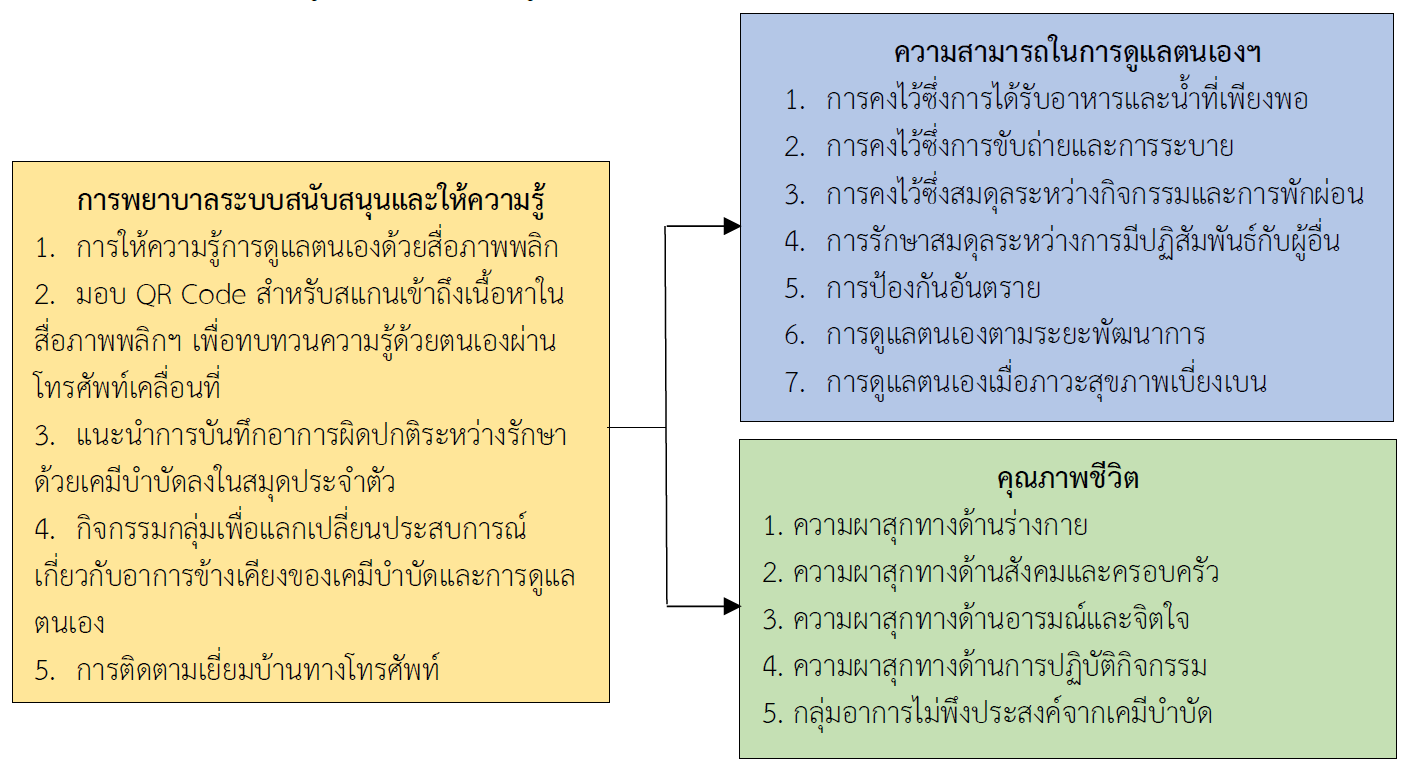
การวิจัยกึ่งทดลองแบบสองกลุ่มและมีการทดสอบก่อนกับหลังการทดลอง เพื่อเปรียบเทียบความสามารถในการดูแลตนเองและคุณภาพชีวิตของผู้ป่วยมะเร็งเต้านมที่ได้รับเคมีบำบัด ณ หน่วยเคมีบำบัด โรงพยาบาลแพร่ กลุ่มตัวอย่างจำนวน 30 คน จากการคัดเลือกอย่างเจาะจงตามคุณสมบัติที่กำหนด แบ่งเป็นกลุ่มทดลองและกลุ่มควบคุมกลุ่มละ 15 คน กลุ่มทดลองได้รับการพยาบาลระบบสนับสนุนและให้ความรู้ที่พัฒนาขึ้นจากทฤษฎีการพยาบาลของโอเร็ม กลุ่มควบคุมได้รับการพยาบาลตามปกติ รวบรวมข้อมูลก่อนและหลังการทดลองโดยใช้แบบสอบถามความสามารถในการดูแลตนเองและคุณภาพชีวิต วิเคราะห์ข้อมูล โดยใช้สถิติ Wilcoxon Signed Rank test และ สถิติ Independent t-test ผลวิจัยพบว่า
1. ค่าคะแนนเฉลี่ยความสามารถในการดูแลตนเองและคุณภาพชีวิตของผู้ป่วยมะเร็งเต้านมที่ได้รับยาเคมีบำบัด หลังได้รับการพยาบาลระบบสนับสนุนและให้ความรู้ สูงกว่าก่อนการได้รับ การพยาบาลระบบสนับสนุนและให้ความรู้อย่างมีนัยสำคัญทางสถิติที่ระดับ .001
2. ค่าคะแนนเฉลี่ยความสามารถในการดูแลตนเอง และคุณภาพชีวิตของผู้ป่วยมะเร็งเต้านมที่ได้รับเคมีบำบัดทั้งภาพรวมและรายด้าน ก่อนและหลังการได้รับการพยาบาลแบบปกติ ไม่แตกต่างกัน ส่วนค่าคะแนนเฉลี่ยคุณภาพชีวิตรายด้าน ความผาสุกทางด้านอารมณ์และจิตใจ และความผาสุกทางด้านการปฏิบัติกิจกรรม หลังได้รับการพยาบาลแบบปกติ สูงกว่าก่อนได้รับการพยาบาลแบบปกติอย่างมีนัยสำคัญทางสถิติที่ .01
3. ผลต่างคะแนนเฉลี่ยระหว่างก่อนและหลังของความสามารถในการดูแลตนเอง และคุณภาพชีวิตของผู้ป่วยมะเร็งเต้านมที่ได้รับเคมีบำบัดของกลุ่มที่ได้รับการพยาบาลระบบสนับสนุนและให้ความรู้สูงกว่ากลุ่มที่ได้รับการพยาบาลแบบปกติอย่างมีนัยสำคัญทางสถิติ ที่ระดับ .001
ควรนำการพยาบาลระบบสนับสนุนและให้ความรู้ ใช้เป็นแนวทางในการให้การพยาบาลผู้ป่วยมะเร็งเต้านมที่ได้รับเคมีบำบัดทุกราย โดยเฉพาะผู้ป่วยที่เข้ารับการรักษาด้วยเคมีบำบัดครั้งแรกเพื่อช่วยส่งเสริมให้สามารถดูแลตนเองได้ถูกต้องและมีคุณภาพชีวิตที่ดี
เอกสารอ้างอิง
Ai, Z. P., Gao, X. L., Li, J. F., Zhou, J. R & Wu, Y. F. (2017). Changing trends and influencing factors of the quality of life of chemotherapy patients with breast cancer. Chinese Nursing Research, 4(1), 18-23. doi.org/10.1016/j.cnre.2017.03.006
Arends, J., Bachmann, P., Baracos, V., Barthelemy, N., Bertz, H., Bozzetti, F., et al. (2017). ESPEN guidelines on nutrition in cancer patients. Clinical Nutrition, 36(1), 11-48. doi:10.1016/ j.clnu.2016.07.015.
Browall, M., Brandberg, Y., Nasic, S., Rydberg, P., Bergh, J., Rydén, A., et al. (2017). A prospective exploration of symptom burden clusters in women with breast cancer during chemotherapy treatment. Support Care Cancer, 25(6), 1017-2017. doi: 10.1007/s00520-016-3527-1
Cancer Research UK. (2023). Chemotherapy for Breast Cancer. Retrieved 12, 2023 from https://www.cancerresearchuk.org/about-cancer/breast-cancer/treatment/chemotherapy.
Chansiri, K., Puthawatana, P. & Kuwathanasamrit, K. (2016). The relationship between basic conditioning factors, self-care behaviors, and quality of life among patients after coronary stent implantation. Vajira Nursing Journal, 18(1), 12-23. (in Thai)
Cicco, P.D., Catani, M.V., Gasperi, V., Sibilano, M., Quaglietta, M. & Savini,I. (2019). Nutrition and breast cancer: a literature review on prevention, treatment and recurrence. Nutrients, 11(7), 1- 28. doi:10.3390/nu11071514.
Faul, F., Erdfelder, E., Lang, A. G. & Buchner, A. (2007). G*Power 3: A flexible statistical power analysis program for the social, behavioral, and biomedical sciences. Behavior Research Methods, 39(2), 175-191.
Jansook, N., Rodprom, P. & Jansook, C. (2014). The development of self-help group program on quality of life among colorectal cancer patients undergoing chemotherapy. KU Journal of Public Health Research, 7(3), 45-50. (in Thai)
Jindakul, P., Namvongprom, A. & Pakdevong, N. (2018). Effectiveness of the educative-supportive program on self care ability, perceived intensity of side effects of chemotherapy and anxiety among patients with early breast cancer undergoing adjuvant chemotherapy. Thai Caner Journal, 38(3), 105-116. (in Thai)
Kaewubon, J. (2563). The Effective of Program Providing Information to Quality of Life among the breast cancer patients receiving breast surgery. Academic Journal of Mahasarakham Provincial Public Health Office, 4(7), 13-26. (in Thai)
Lertpanich,P., Namvongprom, A. & Pakdevong, N. (2017). Symptom experiences and quality of life of patients with advanced cancer receiving chemotherapy. APHIT Journal, 6(1), 45-55. (in Thai)
Lewandowska, A., Rudzki, G., Lewandowski, T., Próchnicki, M., Rudzki, S., Laskowska, B., & Brudniak, J. (2020). Quality of Life of Cancer Patients Treated with Chemotherapy. International Journal of Environmental Research and Public Health, 17(19), 6938. doi.org/10.3390/ijerph17196938
Lortamma, P., Tangkawanich,T., Janepaniss, U. & Prachamban, P. (2015). The Effect of Supportive and Educative Nursing Program on Self Care Agency and Quality of life in Patients Breast Cancer Post Operation with Chemotherapy. Journal of Public Health, 45(1), 13-27. (in Thai)
Mollaoglu, M. & Erdogan, G. (2020). Effect on Symptom Control of Structured Information Given to Patients Receiving Chemotherapy. Retrieved June 1, 2023 from https://www.ncbi.nlm.nih. gov/pubmed/24095215. (in Thai)
National Cancer Institute. (2015). Side Effects of Cancer Treatment. Retrieved June 1, 2023 from https://www.cancer.gov/about-cancer/treatment/side-effects.
Orem, D.E. (2001). Nursing Concepts of Practice (6th ed.). St. Luois:LuNeois Mosby.
Prisutkul, A., Sukuntapan, M., Arundon, T., Dechapunkul, A. & Prupetchkaew, N. (2013). Symptom Experiences, Symptom Management and Outcomes in Patients Undergoing Chemotherapy. Thai Cancer Journal, 33(3), 98-110. (in Thai)
Supasilapa, U. (2019). Quality of Life in Breast Cancer Patients Receiving Chemotherapy in Suratthani Cancer Hospital. Region 11 Medical Journal, 33(3), 462-468. (in Thai)
Suriyan, S., Issaret, w. & Chaimongkol, N. (2015). Factors influencing quality of life of breast cancer patients receiving chemotherapy: A causal model. Journal of Nursing and Health Care, 33(4), 131-140. (in Thai)
ดาวน์โหลด
เผยแพร่แล้ว
ฉบับ
ประเภทบทความ
สัญญาอนุญาต
ลิขสิทธิ์ (c) 2023 วารสารเครือข่ายวิทยาลัยพยาบาลและการสาธารณสุขภาคใต้

อนุญาตภายใต้เงื่อนไข Creative Commons Attribution-NonCommercial-NoDerivatives 4.0 International License.
1. บทความหรือข้อคิดเห็นใด ๆ ที่ปรากฏในวารสารเครือข่าย วิทยาลัยพยาบาลและการสาธารณสุขภาคใต้ ที่เป็นวรรณกรรมของผู้เขียน บรรณาธิการหรือเครือข่ายวิทยาลัยพยาบาลและวิทยาลัยการสาธารณสุขภาคใต้ ไม่จำเป็นต้องเห็นด้วย
2. บทความที่ได้รับการตีพิมพ์ถือเป็นลิขสิทธิ์ของ วารสารเครือข่ายวิทยาลัยพยาบาลและการสาธารณสุขภาคใต้