การพัฒนาโปรแกรมการดูแลผู้ป่วยเด็กโรคหัวใจพิการแต่กำเนิดต่อเนื่องที่บ้าน ต่อปัจจัยจูงใจและปัจจัยค้ำจุน และความพึงพอใจของพยาบาล ในหน่วยบริการสุขภาพระดับปฐมภูมิ
คำสำคัญ:
ปัจจัยจูงใจและปัจจัยค้ำจุน, ความพึงพอใจ, โปรแกรมการดูแลผู้ป่วยเด็กโรคหัวใจพิการแต่กำเนิดต่อเนื่องที่บ้านบทคัดย่อ
การวิจัยและพัฒนานี้ มีวัตถุประสงค์เพื่อพัฒนาโปรแกรมการดูแลผู้ป่วยเด็กโรคหัวใจพิการแต่กำเนิด (Congenital Heart Disease: CHD) ต่อเนื่องที่บ้าน และศึกษาผลของโปรแกรมต่อปัจจัยจูงใจและปัจจัยค้ำจุน และความพึงพอใจของพยาบาล การวิจัยแบ่งเป็น 3 ระยะ ได้แก่ ระยะที่ 1 ศึกษาสภาพปัญหาของพยาบาลในหน่วยบริการสุขภาพระดับปฐมภูมิเกี่ยวกับการดูแลผู้ป่วยเด็ก CHD โดยใช้การสนทนากลุ่ม (Focus Group) ระยะที่ 2 พัฒนาโปรแกรมด้วยการวิเคราะห์ข้อมูลและทบทวนวรรณกรรมที่เกี่ยวข้อง หลังจากนั้นนำไปทดลองใช้ ระยะที่ 3 เปรียบเทียบปัจจัยจูงใจและปัจจัยค้ำจุน และความพึงพอใจของพยาบาล ด้วยวิจัยแบบกึ่งทดลอง (One Group Pre-Posttest Design) กลุ่มตัวอย่างมีจำนวน 30 คน คัดเลือกโดยการสุ่มแบบหลายขั้นตอน เครื่องมือที่ใช้ดำเนินการวิจัย คือ โปรแกรมการดูแลผู้ป่วยเด็ก CHD ต่อเนื่องที่บ้าน เก็บรวบรวมข้อมูลโดยแบบสอบถามปัจจัยจูงใจและปัจจัยค้ำจุน และความพึงพอใจต่อโปรแกรมการดูแลผู้ป่วยเด็ก CHD ต่อเนื่องที่บ้าน วิเคราะห์ข้อมูลโดยสถิติพรรณนา และการทดสอบค่าที ชนิดเปรียบเทียบก่อนหลัง (Paired t-test) ผลการวิจัยพบว่า
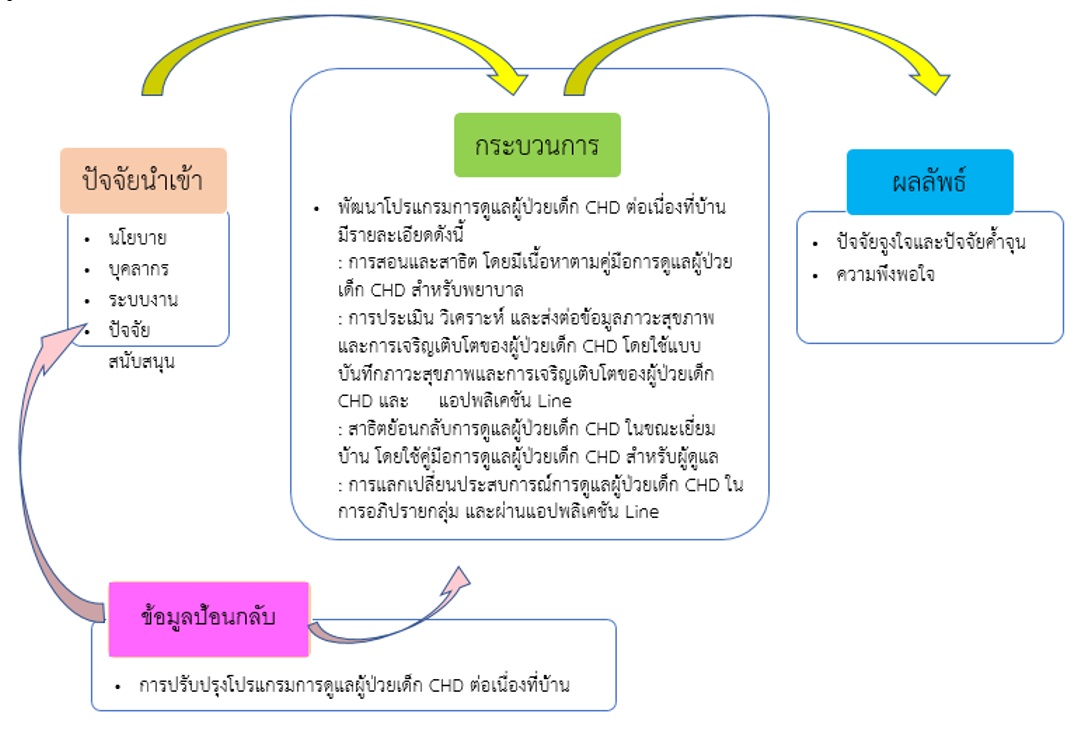
1.โปรแกรมการดูแลผู้ป่วยเด็ก CHD ต่อเนื่องที่บ้าน ประกอบด้วยกิจกรรมการสอนและสาธิต โดยมีสื่อการสอน คือ คู่มือการดูแลผู้ป่วยเด็ก CHD สำหรับพยาบาล กิจกรรมการประเมิน วิเคราะห์ และส่งต่อข้อมูลภาวะสุขภาพและการเจริญเติบโตของผู้ป่วยเด็ก CHD โดยใช้แบบบันทึกภาวะสุขภาพและการเจริญเติบโตของผู้ป่วยเด็ก CHD และแอปพลิเคชัน Line กิจกรรมการสาธิตย้อนกลับการดูแลผู้ป่วยเด็ก CHD ในขณะเยี่ยมบ้าน โดยใช้สื่อการสอน คือ คู่มือการดูแลผู้ป่วยเด็ก CHD สำหรับผู้ดูแล และกิจกรรมการแลกเปลี่ยนประสบการณ์การดูแลผู้ป่วยเด็ก CHD ในการอภิปรายกลุ่ม และผ่านแอปพลิเคชัน Line
2. ค่าเฉลี่ยปัจจัยจูงใจและปัจจัยค้ำจุน หลังได้รับโปรแกรมสูงกว่าก่อนได้รับโปรแกรมอย่างมีนัยสำคัญทางสถิติ (t=3.98, p<.001) และค่าเฉลี่ยความพึงพอใจหลังได้รับโปรแกรมสูงกว่าก่อนได้รับโปรแกรมอย่างมีนัยสำคัญทางสถิติ (t=4.29, p<.001) เช่นกัน
การเตรียมความพร้อมในการดูแลผู้ป่วยเด็ก CHD แก่พยาบาลในหน่วยบริการสุขภาพระดับปฐมภูมิ ด้วยกิจกรรมการสอน สาธิต สาธิตย้อนกลับขณะเยี่ยมบ้าน และการแลกเปลี่ยนประสบการณ์ ส่งเสริมให้พยาบาลมีความรู้ และมีทักษะในการดูแลผู้ป่วยเด็กได้อย่างมีประสิทธิภาพ มีความพึงพอใจต่องาน และมีแรงจูงใจในการพัฒนาแนวทางในการดูแลผู้ป่วยเด็ก CHD ในชุมชนอย่างต่อเนื่อง
เอกสารอ้างอิง
Busarathid, K., Prasomsuk, S., & Busarathid, J. (2021). Role of Nurses in Sub-District Health Promotion Hospital for Early Childhood Development Promotion. Christian University Journal, 27(2), 120-131. (In Thai)
Chaichana, J., & Prachusilpa, G. (2018). A Study of Professional Nurse Roles in Sub-District Health Promotion Hospital. Journal of The Royal Thai Army Nurses, 19(Special Issue), 193-202. (In Thai)
Chantrayotagorn, L., & Udkhammee, K. (2021). Effects of Professional Nurses Participation Program in Perioperative Nursing Care to Patient Safety surgery Phrae Hospital. Journal of Phrae Hospital, 29(1), 28- 38. (In Thai)
Charoennoprakit, B. (2016). Factors Affecting the Job Performance Satisfaction of Staffs Under Health Director in Kabinburi Hospital Prachinburi Province. Mahasarakham Hospital Journal, 13(3), 34-42. (In Thai)
Chowdhury, F., Hoque, M. M., Ali, M., & Hossain, A. (2018). Comparison of Growth in Children with Cyanotic and Acyanotic Congenital Heart Disease in A Tertiary Care Hospital. Journal of Bangladesh College of Physicians and Surgeons, 36(2), 64-69.
Donabedian, A. (1980). The Definition of Quality and Approaches to Its Assessment. Michigan: Health Administration Press.
Kalyanamitra, K. (2016). Two Powerful Motivation to Success. Valaya Alongkorn Review, 6(3), 175-183. (In Thai)
Ketchiratthitikan, P., Kochapakdee, W., & Chaimay B. (2010). Factors Relating to Health Officer Satisfaction Towards the Management of Diabetic Patient Care in Primary Healthcare Centers in Phattalung Province. Thesis of the Master of Science in Health System Management, the Faculty of Health and Sport Science, Thaksin University, Songkhla.
Mari, M. A., Cascudo, M. M., & Alchieri, J. C. (2016). Congenital Heart Disease and Impacts on Child Development. Brazilian Journal of Cardiovascular Surgery, 31(1), 31-37.
Pangkam, N. (2017). Effects of Empowerment Program on Caregiver Pediatrics with Congenital Heart Disease Who Were Post Operations for Complicated Prevention. Community Health Development Quarterly Khon Kaen University, 5(4), 625-641. (In Thai)
Promma, J. (2014). The Effect of Home Visits for Children with Asthma in Thabo District Nongkhai Province. Nursing Journal of the Ministry of Public Health, 24(3), 41-50. (In Thai)
Sabzevari, S., Nematollahi, M. S., Mirzaei, T., & Ravari, A. (2016). The Burden of Care: Mothers’ Experiences of Children with Congenital Heart Disease. IJCBNM, 4(4), 374-385.
Sangchant, S., Isarapreeda, P., & Thongpradid, S. (2012). Motivating and Hygiene Factors Relating to Morals of Community Hospital Personnel Under the Office of Public Health, Nakhon Phanom Province. Nakhon Phanom University Journal, 2(2), 32-38. (In Thai)
Srisatidnarakul, B. (2007). The Methodology in Nursing Research. (4th ed.). Bangkok: U & I intermedia. (In Thai)
Soiphet, N., Intichoti, N., Khrutmuang, W., & Suanpan, N. (2019) Care for Children with Congenital Heart Disease to Prevent Respiratory Tract Infection. Journal of Health and Nursing Research, 35(2), 26-37. (In Thai)
Sukkato, W., & Charoenwiriyakul, C. (2020). Motivation Factors and Hygiene Factors Affecting the Decision to Join the Cooperation Network for Improving the Quality of Hospitals. Journal of Research and Development Nakhon Ratchasima Public Health Provincial Office, 6(2), 127-139. (In Thai)
Suklerttrakul, T., Picheansathian, W., Jintrawet, U., & Chotibang, J. (2018). Support Program for Thai Mothers of Toddlers with Congenital Heart Disease: A Randommized Control Trial. Pacific Rim International Journal of Nursing Research, 22(2), 106-119. (In Thai)
Thongsuwan, N., & Sathirapanya, C. (2020). Factors Affecting the Work Ability of Health Personnel in Health Promoting Hospitals in Yala Province. The Southern College Network Journal of Nursing and Public Health, 7(3), 58-69. (In Thai)
Wangsawat, T., Pongjaturawit, Y., Jaisomkom, A., Tongnuang, P., & Hayeese, W. (2020). Development of Continuing Care Management System and Health Monitoring of Children with Congenital Heart Disease Aged 0-3 Years for Primary Care Unit in Southern Border. Naradhiwas: Faculty of Nursing, Princess of Naradhiwas University. (In Thai)
Wangsawat, T., Phiban, A., Piboonrungroj, P., Hayeese, W., Chansintop, S., Dereh, N. et al., (2020). The Effect of Education Program on Knowledge and Role in the Caregiver for Children with Congenital Heart disease Aged 0 – 3 years. Princess of Naradhiwas University Journal, 11(3), 93-103. (In Thai)
Wangsawat, T., Jaisomkom, A., Pongjaturawit, Y., Piboonrungroj, P., & Hayeese, W. (2021). Effecttiveness of Continuing Nutrition Care at Home Program on the Growth of Children with Congenital Heart Disease in a Primary Health Care Unit. Nursing Journal of the Ministry of Public Health, 31(1), 135-147. (In Thai)
Watcharasing, M., Boonyaprapan, B., & Saksri, S. (2015). Service Mind and Work Motivation Forecasting Nurse’s Service Efficiency. The Journal of Faculty of Applied Arts, 8(2), 115-131. (In Thai)
ดาวน์โหลด
เผยแพร่แล้ว
ฉบับ
ประเภทบทความ
สัญญาอนุญาต
ลิขสิทธิ์ (c) 2021 วารสารเครือข่ายวิทยาลัยพยาบาลและการสาธารณสุขภาคใต้

อนุญาตภายใต้เงื่อนไข Creative Commons Attribution-NonCommercial-NoDerivatives 4.0 International License.
1. บทความหรือข้อคิดเห็นใด ๆ ที่ปรากฏในวารสารเครือข่าย วิทยาลัยพยาบาลและการสาธารณสุขภาคใต้ ที่เป็นวรรณกรรมของผู้เขียน บรรณาธิการหรือเครือข่ายวิทยาลัยพยาบาลและวิทยาลัยการสาธารณสุขภาคใต้ ไม่จำเป็นต้องเห็นด้วย
2. บทความที่ได้รับการตีพิมพ์ถือเป็นลิขสิทธิ์ของ วารสารเครือข่ายวิทยาลัยพยาบาลและการสาธารณสุขภาคใต้