การพัฒนารูปแบบการพยาบาลหญิงตั้งครรภ์ที่มีภาวะเจ็บครรภ์คลอดก่อนกำหนด ตามกรอบมิติคุณภาพการบริการผู้คลอด
คำสำคัญ:
การเจ็บครรภ์คลอดก่อนกำหนด, การพยาบาล, หญิงตั้งครรภ์, กรอบมิติคุณภาพการบริการบทคัดย่อ
การวิจัยและพัฒนานี้มีวัตถุประสงค์เพื่อพัฒนาและศึกษาผลลัพธ์รูปแบบการพยาบาลหญิงตั้งครรภ์ที่มีภาวะเจ็บครรภ์คลอดก่อนกำหนดตามกรอบมิติคุณภาพการบริการผู้คลอด ดำเนินการวิจัย 3 ขั้นตอน ได้แก่ขั้นตอนที่ 1 การศึกษาเชิงพรรณนาเพื่อศึกษาสถานการณ์ที่เกี่ยวข้อง ขั้นตอนที่ 2 การศึกษาเชิงปฏิบัติการเพื่อออกแบบรูปแบบการพยาบาลหญิงตั้งครรภ์ที่มีภาวะเจ็บครรภ์คลอดก่อนกำหนด และทดลองใช้กับกลุ่มตัวอย่างจำนวน 15 ราย ขั้นตอนที่ 3 ศึกษาผลลัพธ์ของรูปแบบ โดยออกแบบวิธีการศึกษาแบบกลุ่มเดียววัดภายหลัง กลุ่มตัวอย่างเป็นหญิงตั้งครรภ์ที่มีภาวะเจ็บครรภ์คลอดก่อนกำหนดจำนวน 91 ราย เครื่องมือที่ใช้ในการทดลองคือรูปแบบการพยาบาลหญิงตั้งครรภ์ที่มีภาวะเจ็บครรภ์คลอดก่อนกำหนดตามกรอบมิติคุณภาพการบริการผู้คลอด เครื่องมือที่ใช้ในการเก็บรวบรวมข้อมูลคือแบบบันทึกข้อมูลทั่วไป ข้อมูลทางสูติกรรม และแบบสอบถามพฤติกรรมการดูแลตนเองที่บ้าน ซึ่งมีค่าสัมประสิทธ์แอลฟาของครอนบาคเท่ากับ 0.77 วิเคราะห์ข้อมูลโดยใช้สถิติ One sample t-test และสถิติ Chi-square ผลการวิจัยพบว่า
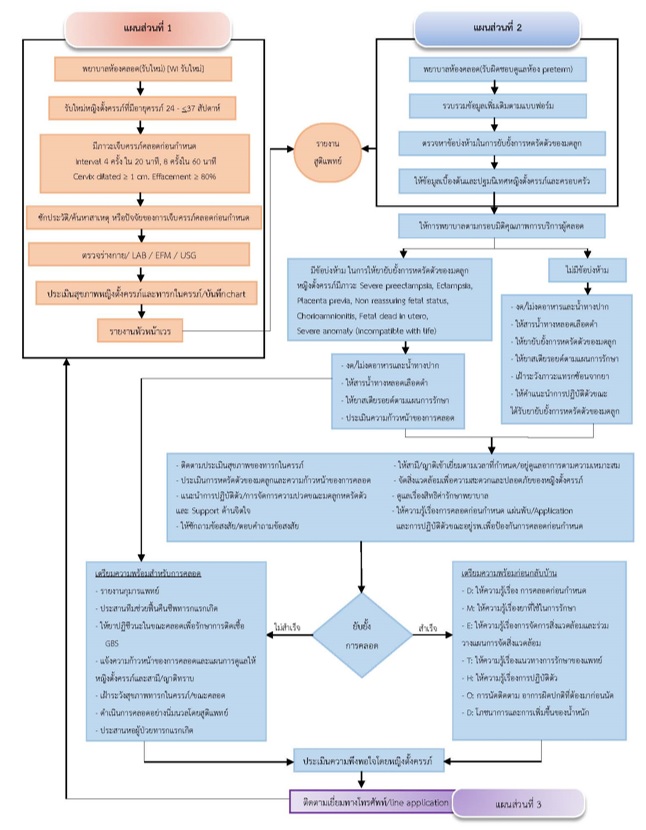
1. รูปแบบการพยาบาลหญิงตั้งครรภ์ที่มีภาวะเจ็บครรภ์คลอดก่อนกำหนด ประกอบไปด้วยการให้ การพยาบาลที่ห้องรับใหม่ การพยาบาลที่ห้องสำหรับหญิงตั้งครรภ์ที่มีภาวะเจ็บครรภ์คลอดก่อนกำหนด และการติดตามเยี่ยมภายหลังจำหน่าย ซึ่งพยาบาลวิชาชีพสามารถใช้รูปแบบการพยาบาลนี้ได้ร้อยละ 100
2. ผลลัพธ์ของรูปแบบการพยาบาลพบว่าหญิงตั้งครรภ์มีพฤติกรรมการดูแลตนเองที่บ้านในภาพรวมระดับปานกลาง (M = 3.32, SD = 0.27) ระยะเวลาในการได้รับการวินิจฉัยเบื้องต้นหลังจากแรกรับร้อยละ 92.31 ใช้เวลาน้อยกว่าค่าเป้าหมายคือ 30 นาที อย่างมีนัยสำคัญทางสถิติที่ระดับ p<.001 (t=8.09, df=90) ส่วนระยะเวลาการได้รับยายับยั้งการหดรัดตัวของมดลูกหลังแพทย์มีคำสั่งการรักษา พบว่าร้อยละ 53.85 ใช้เวลามากกว่าค่าเป้าหมาย (15 นาที) อย่างมีนัยสำคัญทางสถิติที่ระดับ p<.05 (t=2.15, df=76) และพบว่าร้อยละ 90.11 สามารถยืดอายุครรภ์ได้มากกว่า 48 ชั่วโมง ซึ่งมากกว่าค่าเป้าหมายอย่างมีนัยสำคัญทางสถิติที่ระดับ p<.001 (t=10.07, df=90)
รูปแบบการพยาบาลหญิงตั้งครรภ์ที่มีภาวะเจ็บครรภ์คลอดก่อนกำหนดที่พัฒนาขึ้นมีประสิทธิผลในการลดระยะเวลาแรกรับ ช่วยยืดอายุครรภ์ แต่ไม่สามารถลดระยะเวลาในการได้รับยาตามแผนการรักษาได้ เนื่องจากการให้ยาเป็นการทำงานร่วมกันหลายวิชาชีพ ดังนั้นควรมีการพัฒนารูปแบบการพยาบาลหญิงตั้งครรภ์ที่มีภาวะเจ็บครรภ์คลอดก่อนกำหนดโดยความร่วมมือของสหสาขาวิชาชีพ
เอกสารอ้างอิง
AGREE Next Steps Consortium. (2009). The AGREE II Instrument [Electronic version]. Retrieved May 1, 2020, from http://www.agreetrust.org.
Buranabenjasathian, S. (2017). Effective of Preterm Labour Care Process in Maechan Hospital. Chiangrai Medical Journal, 9(2), 41-52. (in Thai).
Bureau of Nursing, Office of Permanent Secretary, Ministry of Public Health. (2011). Nursing Quality Assurance: Quality Assurance of Maternity Nursing Care. Bangkok. Samchareon Phanich (Bangkok) Co., LTD. (in Thai).
Choijorhorm, R., Serisathien, Y., Ratinthorn, A., & Kovavisarach, E. (2019). The Effects of Nursing Therapeutics on Preventive Management of Preterm Labour, Readmission and Gestational Age at Birth in Pregnant Women with Preterm Labor. Journal of Nursing Science, 27(2), 39-48. (in Thai).
Leenhapongsatron, W., & Juntatip, P. (2016). Development of Nursing Practice Guideline for Pregnant Women with Preterm Labour by Evidence Practice in Labour Room at Kingnarai Hospital. Journal of Nursing Division, 43(3Suppl), 46-62. (in Thai).
Maneechot, K., & Nangkala, N. (2017). The Development of Care Model for Pregnant in Labor Pain with Preterm Labor at Maharaj Nakhon Si Thammarat Hospital. Journal of Nursing Division, 44(2): 7-25. (in Thai).
Maternal and Child Health Board 2013-2015. (2015). RTCOG Clinical Practice Guideline: The Management of Preterm Labour and Preterm Premature Rupture of Membranes. Retrieved April 04, 2020 from http://www.rtcog.or.th/home/wp-content/uploads/2017/04/OB_014.pdf. (in Thai).
Medical Record Department Surin Hospital. (2020). Annually Report of Labor Unit Surin Hospital. (in Thai).
Raksatham, C., Kaiphol, T., & Khungtumneam, K. (2018). The Practiced Guideline for Continuing Care of Pregnant Women with Preterm Labor. Journal of The Royal Thai Army Nurses, 19(Supp.), 348-356. (in Thai).
Sangin, S. (2014). Nursing Care of a Mother Experiencing Preterm Labor. The Journal of Faculty of Nursing Burapha University, 22(1), 27-38. (in Thai).
Senthiri, P., Srisong, S., Pomprakai, R., & Permchat, M. (2016). Development of the Nursing Model for Pregnant Women to Prevent Preterm Labour. Journal of Nursing and Health Care, 34(2), 164-173. (in Thai).
Srisaard, B. (1994). Interpretation of Estimation Scale Data Collecting Tool. Journal of Educational Measurement Mahasarakham University, 2(1), 64-70. (in Thai).
Vibulwong, P. (2000). The Effect of Supporting Care on The Compliance of Pregnant Women with Pregnancy Induced Hypertension. A Thesis Submitted in Partial Fulfilment of the Requirement for the Master degree of Maternal and Child Nursing Faculty of Nursing, Mahidol University. (in Thai).
Waichompu, N. & Kongchauy, A. (2015). Development of a Discharge Planning Model for Pregnant Women with Preterm Labor Pain. The Southern College Network Journal of Nursing and Public Health, 2(3), 114-128. (in Thai).
Yusamran, C., Kongjira, A., Sirisomboon, R., Phimon, K., & Chalernchockcharoenkit, A. (2007). Social Support Knowledge and Self-care Ability among Pregnant Women with Premature Labour Pain. Thai Journal of Nursing Council, 22(1), 60 - 71. (in Thai).
ดาวน์โหลด
เผยแพร่แล้ว
ฉบับ
ประเภทบทความ
สัญญาอนุญาต
1. บทความหรือข้อคิดเห็นใด ๆ ที่ปรากฏในวารสารเครือข่าย วิทยาลัยพยาบาลและการสาธารณสุขภาคใต้ ที่เป็นวรรณกรรมของผู้เขียน บรรณาธิการหรือเครือข่ายวิทยาลัยพยาบาลและวิทยาลัยการสาธารณสุขภาคใต้ ไม่จำเป็นต้องเห็นด้วย
2. บทความที่ได้รับการตีพิมพ์ถือเป็นลิขสิทธิ์ของ วารสารเครือข่ายวิทยาลัยพยาบาลและการสาธารณสุขภาคใต้