ผลการฝึกโยคะต่อสมรรถภาพทางกาย ความสุขและทุนจิตวิทยาเชิงบวก ของนักศึกษาระดับปริญญาตรี มหาวิทยาลัยสงขลานครินทร์
คำสำคัญ:
โยคะ, สมรรถภาพกาย, ความสุข, ทุนจิตวิทยาเชิงบวกบทคัดย่อ
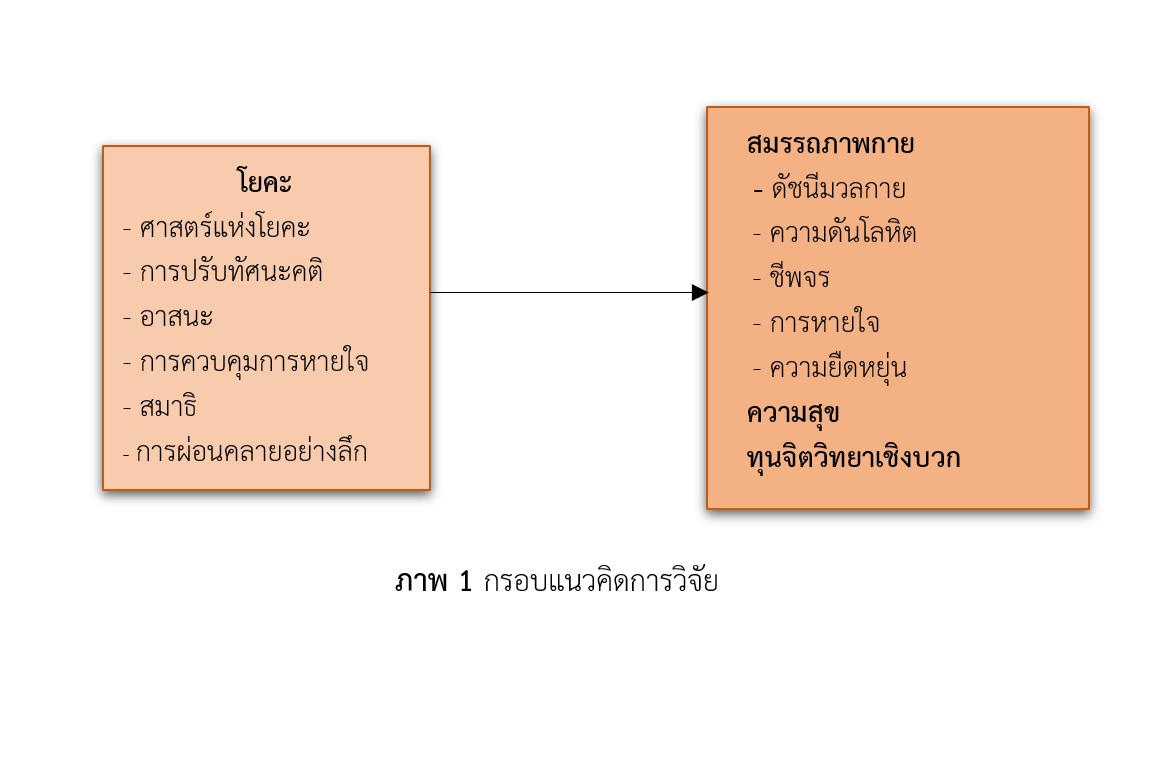
การวิจัยกึ่งทดลองมีวัตถุประสงค์เพื่อศึกษาผลการฝึกปฏิบัติโยคะต่อสมรรถภาพกาย ความสุขและทุนจิตวิทยาเชิงบวกของนักศึกษาระดับปริญญาตรี มหาวิทยาลัยสงขลานครินทร์ กลุ่มตัวอย่างเป็นนักศึกษาที่ลงทะเบียนเรียนวิชาโยคะ จำนวน 76 คน ที่สมัครใจเข้าร่วมการวิจัย โดยฝึกปฏิบัติการโยคะในชั้นเรียนกับครูโยคะครั้งละ 90 นาที สัปดาห์ละ 1 ครั้ง และไปฝึกต่อด้วยตนเอง สัปดาห์ละ 2 ครั้ง เป็นเวลา 8 สัปดาห์ รวบรวมข้อมูลโดยใช้ แบบบันทึกสมรรถภาพทางกาย แบบประเมินความสุขของคนไทยฉบับสั้นของกรมสุขภาพจิต ซึ่งมีค่าเชื่อมั่นสัมประสิทธิ์แอลฟ่าของครอนบาค เท่ากับ .96 และแบบประเมินทุนจิตวิทยาเชิงบวกมีค่าเชื่อมั่นสัมประสิทธิ์แอลฟ่าของครอนบาค เท่ากับ .96 วิเคราะห์ข้อมูลโดยใช้สถิติทดสอบ ร้อยละ ค่าเฉลี่ย ค่าเบี่ยงเบนมาตรฐาน Paired t-test และ Wilcoxon Signed-Rank test ผลการวิจัยพบว่า
1. สมรรถภาพทางกาย ด้านความดันโลหิตซิสโตลิค และอัตราการหายใจ หลังฝึกปฏิบัติโยคะลดลงกว่าก่อนการฝึกปฏิบัติโยคะอย่างมีนัยสำคัญทางสถิติ (p<.05) ส่วนความยืดหยุ่นหลังการฝึกปฏิบัติโยคะมีค่าสูงกว่าก่อนการปฏิบัติโยคะอย่างมีนัยสำคัญทางสถิติ (p<.01)
2. ค่าเฉลี่ยคะแนนความสุขและทุนจิตวิทยาเชิงบวกหลังการฝึกปฏิบัติโยคะมีค่าสูงกว่าก่อนการฝึกปฏิบัติโยคะอย่างมีนัยสำคัญทางสถิติ (p<.01)
ควรส่งเสริมให้มีการฝึกโยคะอย่างต่อเนื่องเพื่อเป็นทางเลือกในการดูแลสุขภาพแบบองค์รวมและเสริมสร้างทุนจิตวิทยาเชิงบวก
เอกสารอ้างอิง
Boonprasert, C., Panuthai, S., & Chintanawat, R. (2016). Effect of hatha yoga exercise on physical fitness among older persons. Nursing Journal, 43 (Supplement December), 35-47. (inThai).
Chuastapanasiri, T. (2017). Designing Your Life. Retrieved December 10, 2019 from https://cf.mahidol.ac.th/th/?p=6789.
Gambheera, H. (2016). Social changes in the 21st century have differentially affected the mental health scenario in the developing world. Indian J Soc Psychiatry, 32 : 238-42
Gard, T., Noggle, J.J., Park, C.L, Vago, D.R., & Wilson, A.(2014). Potential self-regulatory mechanisms of yoga for psychological health. Frontiers in Human Neuscience. 8 (770), 1-20.
Health Science Group, Bureau of Sports Science. (2007). The effects of yoga exercise program for develop Thai health status. Retrieved September 3, 2020 from http://sportscience.osrd.go.th/portResearchDetail.jsp?id=21.(inThai).
Kulvechakit, A., Pawong, T., Seangtrong, P., Pulongpeer, S. & Rachasri, M. (2010). Effect of yoga on happiness and depression in patients with depression. Journal of the Psychiatric Association of Thailand, 55(3), 261-268. (in Thai).
Kuvalyananda, S., & Vinekar, SL. (2010). Yogic therapy: its basic principles and methods. In: Kongpukdeepong, K. translator. Bangkok: Folk Doctor Foundation, 142 pages. (in Thai).
Luthans, F., Youssef, C. & Avolio, B. (2007). Psychological Capital: Developing the Human Competitive Edge: Oxford University Press.
Luthans, B. C., Luthans, K.W., & Jensen, S.M. (2012). The impact of business school students’ psychological on academic performance. Journal of Education for Business, 87, 253-259.
Malone, L.D. (2010). Individual differences and stress reactions as predictors of performance in pilot trainees (Master thesis). Retrieved November 13, 2020 from http://hdl.handle.net/2097/4131.
Mankhoksoong, C. (2011). Effects of hatha yoga practice on health-related physical fitness and stress levels of adults in Sakon Nakhon province. Journal of Liberal Art Prince of Songkla University, 3 (2),88-102. (inThai).
Mason, H., Vandoni, M., Debarbieri, G., Codrons, E.,Ugargol, V., & Bernardi, L. (2013). Cardiovascular and respiratory effect of yogic slow breathing in the yoga beginner: What is the best approach?. Evidence-Based Complementary and Alternative Medicine, 1-7.
Mathad, M. D., Pradhan, B. & Sasidharan, R. (2017). Effect of yoga on psychological functioning of nursing students: a randomized wait list control trial. Journal of Clinical and Diagnostic Research, 11(5), 1-5.
Mongkon, A., Hatthapanom, W., Chetchotsak, P., Chalorkul, W., & Punyoyai, L. (2001). Thai Happiness Indicators (THI – 15). Khonkan: Klungnana Vithtaya Press. Retrieved August 3, 2019 from https://www.dmh.go.th/test/download/files/thi15.pdf .(inThai).
Muijeen, K.(2016). Creating Happiness with Positive Psychology. Journal of Science and Technology, 24(4), 673-681. (in Thai).
Munkham, R., Sutthakorn, W. & Visesku, N. (2014). Effect of yoga exercise on neck and shoulder pain among computer using office staff. Nursing Journal, 41(3), 70-82. (in Thai).
Narasimhan, L., Nagarathna, R., Nagendra, H. (2011). Effect of integrated yogic practices on positive and negative emotions in healthy adults. Int J Yoga, 4(1), 13-19.
Neamsakul, W. (2014). Lived experiences of practicing yoga asana among nursing students. Journal of Nursing Science, 32(2), 71-79. (in Thai).
Norrish, J. M., Williams, P., O’Connor, M., & Robinson, J. (2013). An applied framework for positive education. International Journal of Wellbeing, 3(2), 147-161. doi:10.5502/ijw.v3i2.2.
Pasokchart, K., & Vongjaturapat. (2010). Effects of Iyengar yoga on anxiety and physical fitness of badminton players. Journal of exercise and sport science, 7(1), 18-32. (inThai).
Polit, D.F.& Hungler, B.P.(1999). Nursing research: principle and methods. (6th ed). Philadephia: Lippincott.
Poopattayakorn, A. & Pichairat, D.(2011). The effects of basic yoga on the physical fitness and stress of student nurses of Boromarajonnani College of Nursing, Trang. Prince of Naradhiwas University Journal, 3(2),15-28. (in Thai).
Pornreongwong, W.(2008). Yoga breathing helps optimistic. Retrieved September 10, 2020 from http://oknation.nationtv.tv/blog/health2you.
Roland, K. P., Jakobi, J. M. & Jones, G. R. (2011). Does yoga engender fitness in older adults? A critical review. Journal of Aging and Physical Activity, 19(1), 62–79.
Shashikiran, H.C.,Prashanth, S., Chethan K., & Shivaprasad, S. (2015). Effect of yoga on autonomic functions in medical students: a pilot study. International Journal of Research in Medical Sciences, 3(5), 1046-1051.
Shohani, M., Badfar, G., Nasirkandy, M.P., Kaikhavani S, Rahmati S, Modmeli Y, et al. (2018). The Effect of Yoga on Stress, Anxiety, and Depression in Women. International Journal of Preventive Medicine, 9: 1-6. doi: 10.4103/ijpvm.IJPVM_242_16. eCollection.
Suvanrnarong, K.(2014). The path of yoga: the science challenging nurses’ role. Journal of Nursing Science, 32(4), 15-24. (inThai).
Suvanrnarong, K., Kaesornsamut, P., Kumpalasiri, N., Kongsuriyanavin, W., & Krongthammachart, K.(2013). The Effects of Yoga Program on Happiness, Self-Esteem and Depressive Symptoms in Nursing Students. Journal of Nursing Science, 31(4), 66-78. (inThai).
Suwanakitch, P., Sukted, P., Wongsa, S., Audta, O., & Saengpanya, N.(2010). Effects of the Sahaja Yoga Practice on Blood Pressure, Heart rate and Stress among Hypertension Patients. Journal of Nursing and Health Scienceม 4(2), 28-35. (in Thai).
Thai Yoga Institute. (2012). A hand book of daily yoga practice. Bangkok: Folk Doctor Foundation, 40 pages. (in Thai).
Tsai, T. I., Lee. H. M., & Hsu, C. H. (2012). Assessing the impact of psychological capital on college students majoring in hospitality: A potentially value-added resource? Retrieved November 16, 2020 from http://bai-conference.org/BAI2012proceedings/papers/7.
Vanichbancha, K. (2010). SPSS for window. Bangkok: Tammasarn Press. (in Thai).
Vaishnav, B. S., Vaishnav, S. B., Vaishnav, V. S., & Varma, J. R.(2018). Effect of yoga-nidra on adolescents well-being: A mixed method study. Int J Yoga, 11, 245-248.
Yadav, A., Singh, S., Singh, K. P., & Pai, P. (2015). Effect of yoga regimen on lung functions including diffusion capacity in coronary artery disease patients: A randomized controlled study. International Journal of Yoga, 8(1), 62-67.
Yonglitthipagorn, P., Muansiangsai, S., Wongkhumngern, W., & Siritaratiwat, W. (2017). Efficacy of yoga poses on physical fitness and severity of premenstrual syndrome in Thai female adolescents. Journal of Medical Technology and Physical Therapy, 28(2), 154-164. (in Thai).
Yook, Y., Kang, S. & Park, I. (2017). Effects of physical activity intervention combining a new sport and mindfulness yoga on psychological characteristics in adolescents. International Journal of Sport and Exercise Psychology, 15(2), 109-117.
ดาวน์โหลด
เผยแพร่แล้ว
ฉบับ
ประเภทบทความ
สัญญาอนุญาต
1. บทความหรือข้อคิดเห็นใด ๆ ที่ปรากฏในวารสารเครือข่าย วิทยาลัยพยาบาลและการสาธารณสุขภาคใต้ ที่เป็นวรรณกรรมของผู้เขียน บรรณาธิการหรือเครือข่ายวิทยาลัยพยาบาลและวิทยาลัยการสาธารณสุขภาคใต้ ไม่จำเป็นต้องเห็นด้วย
2. บทความที่ได้รับการตีพิมพ์ถือเป็นลิขสิทธิ์ของ วารสารเครือข่ายวิทยาลัยพยาบาลและการสาธารณสุขภาคใต้