การพัฒนารูปแบบกิจกรรมส่งเสริมพฤติกรรมการเว้นระยะห่างทางสังคมสำหรับนักศึกษาระดับอุดมศึกษาผ่านเกมมิฟิเคชัน
คำสำคัญ:
การเว้นระยะห่างทางสังคม, นักศึกษาระดับอุดมศึกษา, เกมมิฟิเคชั่นบทคัดย่อ
การวิจัยและพัฒนานี้มีวัตถุประสงค์เพื่อศึกษาระดับความรู้การเว้นระยะห่างทางสังคม พัฒนารูปแบบ และประสิทธิผลของรูปแบบกิจกรรมส่งเสริมพฤติกรรมการเว้นระยะห่างทางสังคมสำหรับนักศึกษาระดับอุดมศึกษาผ่านเกมมิฟิเคชั่น ดำเนินการ 3 ขั้นตอน ได้แก่ ขั้นตอนที่ 1 ศึกษาความรู้เกี่ยวกับการเว้นระยะห่างทางสังคมในนักศึกษาระดับอุดมศึกษาจากมหาวิทยาลัยทั่วประเทศ จำนวน 500 คน เครื่องมือที่ใช้เป็นแบบทดสอบความรู้เกี่ยวกับการเว้นระยะห่างทางสังคมค่า IOC เท่ากับ .67 – 1.00 ค่า KR20 เท่ากับ .79 วิเคราะห์ข้อมูลโดยสถิติเชิงพรรณนา ขั้นตอนที่ 2 การพัฒนารูปแบบกิจกรรมส่งเสริมพฤติกรรมการเว้นระยะห่างทางสังคมโดยผู้วิจัยนำผลการวิจัยจากขั้นตอนที่ 1 การทบทวนวรรณกรรมและการสนทนากลุ่มผู้ให้ข้อมูล 10 คน มายกร่างรูปแบบ ผ่านการตรวจสอบจากผู้ทรงคุณวุฒิ 3 ท่าน ขั้นตอนที่ 3 ศึกษาประสิทธิผลของรูปแบบกิจกรรมส่งเสริมพฤติกรรมการเว้นระยะห่างทางสังคม `กลุ่มตัวอย่างเป็นนักศึกษาจำนวน 55 คน เครื่องมือที่ใช้ในการวิจัยคือรูปแบบกิจกรรมส่งเสริมพฤติกรรมการเว้นระยะห่างทางสังคมและแบบประเมินพฤติกรรมการเว้นระยะห่างทางสังคมภายในบ้านและภายนอกบ้าน ได้ค่าความตรง (CVI) .82 และ .85 ค่าสัมประสิทธิ์แอลฟ่าของครอนบาคเท่ากับ .83 และ .88 ตามลำดับ วิเคราะห์ข้อมูลโดยใช้สถิติ Paired t-test ผลวิจัยพบว่า
1. นักศึกษาระดับอุดมศึกษามีค่าเฉลี่ยคะแนนความรู้เกี่ยวกับการเว้นระยะห่างทางสังคม 10.44 คะแนน (SD=2.78) อยู่ในระดับปานกลาง เมื่อแบ่งตามระดับความรู้พบว่ามีนักศึกษาที่มีความรู้อยู่ในระดับสูง ร้อยละ 39.04 ระดับปานกลาง ร้อยละ 42.23 และระดับต่ำ ร้อยละ 18.73 ตามลำดับ
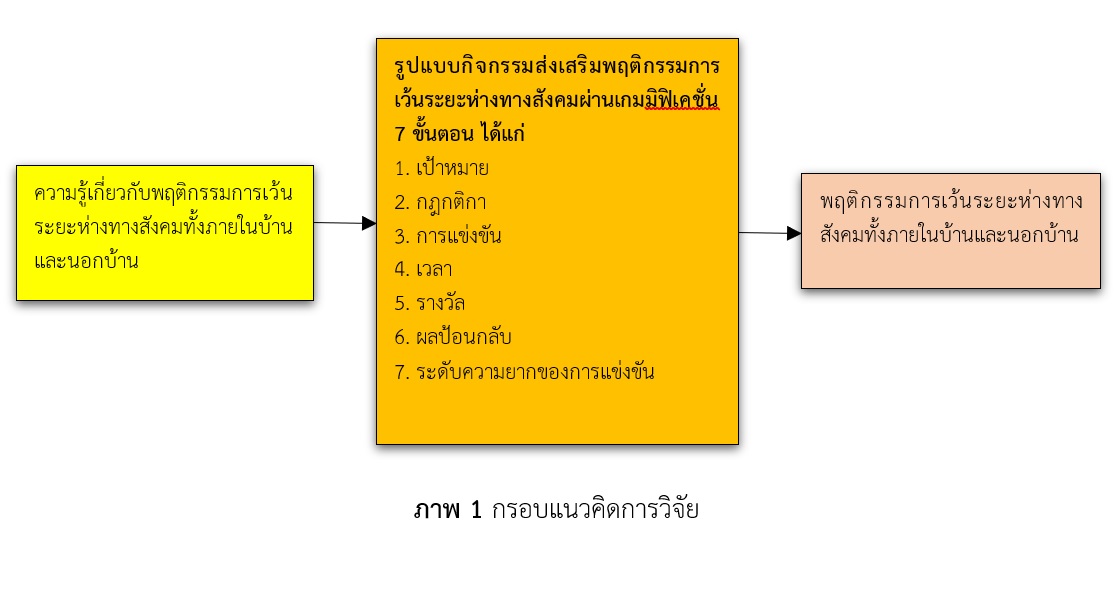
2. รูปแบบกิจกรรมส่งเสริมพฤติกรรมการเว้นระยะห่างทางสังคมสำหรับนักศึกษาระดับอุดมศึกษาประกอบด้วยกิจกรรมส่งเสริมพฤติกรรมการเว้นระยะห่างทางสังคมภายในบ้านและภายนอกบ้านตามกลไกของเกมมิพิเคชั่น 7 ขั้นตอน ได้แก่ 1) เป้าหมาย 2) กฎกติกา 3) การแข่งขัน 4) เวลา 5) รางวัล 6) ผลป้อนกลับ 7) ระดับความยาก
3. หลังใช้รูปแบบ กิจกรรมส่งเสริมพฤติกรรมการเว้นระยะห่างทางสังคมทั้งภายในบ้านและนอกบ้านสูงกว่าก่อนใช้รูปแบบอย่างมีนัยสำคัญทางสถิติที่ระดับ .001 (p<.001)
ข้อเสนอแนะจากการศึกษา ควรให้สถานศึกษานำรูปแบบไปใช้ในการสร้างพฤติกรรมการเว้นระยะห่างทางสังคมเพื่อให้เกิดวิถีใหม่สำหรับกลุ่มวัยรุ่นต่อไป
เอกสารอ้างอิง
Alahäivälä, T., & Oinas-Kukkonen, H. (2016). Understanding Persuasion Contexts in Health Gamification: A Systematic Analysis of Gamified Health Behavior Change Support Systems Literature. International journal of medical informatics, 96(12), 62-70.
Bloom, B. S. (1971). Handbook on Formative and Summative Evaluation of Student Learning New York: McGraw–Hill.
Centers for Disease Control and Prevention. (2020). Social Distancing Keep a Safe Distance to Slow the Spread. Retrieved April 4, 2020. Retrieved from: https://www.cdc.gov/ coronavirus/2019-ncov/prevent-getting-sick/social-distancing.html.
Department of Health. (2020). How Adolescence Live with Social Distancing During Pandemic of COVID-19. Retrieved April 4, 2020 from https://www.anamai.moph.go.th/download /2563/Covid_19/people/Social_distancing%20_%E0%B8%A7%E0%B8%B1%E0%B8%A2%E0%B8%A3%E0%B8%B8%E0%B9%88%E0%B8%99_260363.pdf.
Hervas, R., Ruiz-Carrasco, D., Mondejar, T., & Bravo, J. (2017). Gamification Mechanics for Behavioral Change: a Systematic Review and Proposed Taxonomy. In Proceedings of the 11th EAI International Conference on Pervasive Computing Technologies for Healthcare (pp. 395-404).
Kitisri, C., Nokham, R., & Phetcharat, K. (2017). A smartphone Using Behavior and Health Status Perception of Nursing Students. Journal of Community Health Development Quarterty Khon Kaen University, 5(1), 19-34.
Lertvitayakul, T. (2017). Formative Evaluation of Learning by Game Based. College of Asian Scholars Journal, 7(Special Edition), 104-116.
Ministry of Public Health. (2020). Guideline for COVID-19 Management. Retrieved April 4, 2020 fromhttp://www.oic.go.th/FILEWEB/CABINFOCENTER50/DRAWER060/GENERAL/DATA0001/00001298.PDF
Prime Minister’s Office. (2020). Require Issue Follow 9 Act of Emergency Decree on Public Admistration. Retrieved April 4, 2020 from http://www.ratchakit cha.soc.go.th/ DATA/ PDF/2563/E/076/T_0001.PDF
Robson, K., Plangger, K., Kietzmann, J. H., McCarthy, I., & Pitt, L. (2015). Is It all a Game? Understanding the Principles of Gamification. Business Horizons, 58(4), 411-420.
Singweratham, N. (2019). The Development of an Instructional Model Based on Didactic Teaching by Using VARK Learning Styles on Analytical Thinking on Public Health Program in Community Health. The Southern College Network Journal of Nursing and Public Health, 6(3), 27-40.
Singweratham, N., & Kewsuwwan, N. (2020). Setting Up a Local Quarantine for COVID-19 Outside the Local Hospital: A Case Study from Kanchanabhisek Institute of Medical and Public Health Technology. The Southern College Network Journal of Nursing and Public Health, 7(3), 1-9.
Srisatidnarakul, B. (2010). The Methodology in Nursing Research. (5th Edition.) Bangkok: You and I Intermedia.
World Health Organization. (2020). Coronavirus Disease (COVID-2019) Situation Reports. Situation Report –75. Retrieved April 4, 2020 from https://google.com/covid19map/?hl=th
World Health Organization. (2020). Coronavirus Disease (COVID-2019) Pandemic. Retrieved April 4, 2020 from https://www.who.int/news-room/q-a-detail/q-a-coronaviruses.
ดาวน์โหลด
เผยแพร่แล้ว
ฉบับ
ประเภทบทความ
สัญญาอนุญาต
1. บทความหรือข้อคิดเห็นใด ๆ ที่ปรากฏในวารสารเครือข่าย วิทยาลัยพยาบาลและการสาธารณสุขภาคใต้ ที่เป็นวรรณกรรมของผู้เขียน บรรณาธิการหรือเครือข่ายวิทยาลัยพยาบาลและวิทยาลัยการสาธารณสุขภาคใต้ ไม่จำเป็นต้องเห็นด้วย
2. บทความที่ได้รับการตีพิมพ์ถือเป็นลิขสิทธิ์ของ วารสารเครือข่ายวิทยาลัยพยาบาลและการสาธารณสุขภาคใต้