ความกล้าหาญเชิงจริยธรรมทางการพยาบาล
คำสำคัญ:
ความกล้าหาญเชิงจริยธรรม, การพยาบาล, ปัญหาทางจริยธรรมบทคัดย่อ
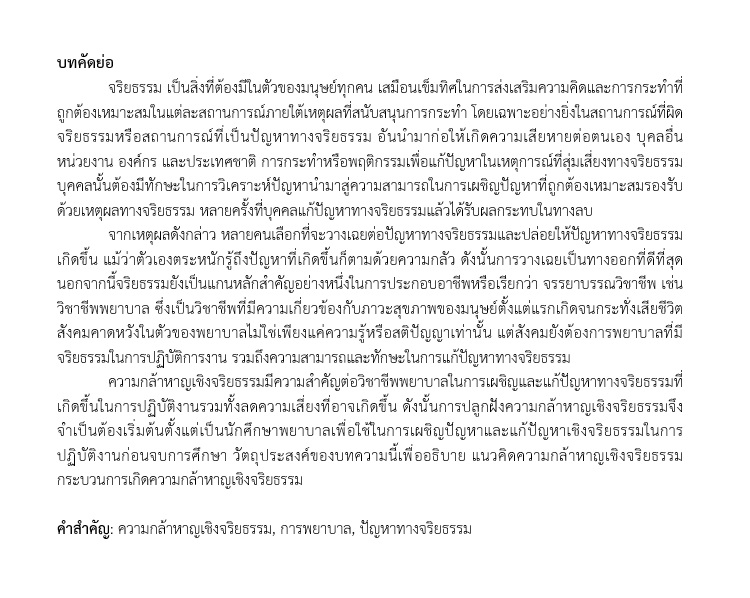
จริยธรรม เป็นสิ่งที่ต้องมีในตัวของมนุษย์ทุกคน เสมือนเข็มทิศในการส่งเสริมความคิดและการกระทำที่ถูกต้องเหมาะสมในแต่ละสถานการณ์ภายใต้เหตุผลที่สนับสนุนการกระทำ โดยเฉพาะอย่างยิ่งในสถานการณ์ที่ผิดจริยธรรมหรือสถานการณ์ที่เป็นปัญหาทางจริยธรรม อันนำมาก่อให้เกิดความเสียหายต่อตนเอง บุคลอื่น หน่วยงาน องค์กร และประเทศชาติ การกระทำหรือพฤติกรรมเพื่อแก้ปัญหาในเหตุการณ์ที่สุ่มเสี่ยงทางจริยธรรม บุคคลนั้นต้องมีทักษะในการวิเคราะห์ปัญหานำมาสู่ความสามารถในการเผชิญปัญหาที่ถูกต้องเหมาะสมรองรับด้วยเหตุผลทางจริยธรรม หลายครั้งที่บุคคลแก้ปัญหาทางจริยธรรมแล้วได้รับผลกระทบในทางลบ
จากเหตุผลดังกล่าว หลายคนเลือกที่จะวางเฉยต่อปัญหาทางจริยธรรมและปล่อยให้ปัญหาทางจริยธรรมเกิดขึ้น แม้ว่าตัวเองตระหนักรู้ถึงปัญหาที่เกิดขึ้นก็ตามด้วยความกลัว ดังนั้นการวางเฉยเป็นทางออกที่ดีที่สุด นอกจากนี้จริยธรรมยังเป็นแกนหลักสำคัญอย่างหนึ่งในการประกอบอาชีพหรือเรียกว่า จรรยาบรรณวิชาชีพ เช่น วิชาชีพพยาบาล ซึ่งเป็นวิชาชีพที่มีความเกี่ยวข้องกับภาวะสุขภาพของมนุษย์ตั้งแต่แรกเกิดจนกระทั่งเสียชีวิต สังคมคาดหวังในตัวของพยาบาลไม่ใช่เพียงแค่ความรู้หรือสติปัญญาเท่านั้น แต่สังคมยังต้องการพยาบาลที่มีจริยธรรมในการปฏิบัติการงาน รวมถึงความสามารถและทักษะในการแก้ปัญหาทางจริยธรรม
ความกล้าหาญเชิงจริยธรรมมีความสำคัญต่อวิชาชีพพยาบาลในการเผชิญและแก้ปัญหาทางจริยธรรมที่เกิดขึ้นในการปฏิบัติงานรวมทั้งลดความเสี่ยงที่อาจเกิดขึ้น ดังนั้นการปลูกฝังความกล้าหาญเชิงจริยธรรมจึงจำเป็นต้องเริ่มต้นตั้งแต่เป็นนักศึกษาพยาบาลเพื่อใช้ในการเผชิญปัญหาและแก้ปัญหาเชิงจริยธรรมในการปฏิบัติงานก่อนจบการศึกษา วัตถุประสงค์ของบทความนี้เพื่ออธิบาย แนวคิดความกล้าหาญเชิงจริยธรรม กระบวนการเกิดความกล้าหาญเชิงจริยธรรม
เอกสารอ้างอิง
Di You., & Bebeau, M. J. (2013). The Independence of James Rest’s Components of Morality: Evidence from a Professional Ethics Curriculum Study. Ethics and Education, 1-14. doi.org/10.1080/17449642.2013.846059.
Panaso, C. (2017). The Perception of Risk to Preserve the Code of Ethics in Nursing for Nurses at Somdechphrapinklao Hospital Naval Medical Department. Public Health & Health Laws Journal, 3(2), 167-179. (in Thai)
Lumjai, P. (2014). The Model of Moral and Ethical Secondary Students Development. Journal of Humanties and Social Sciences University of Phayao, 2(3), 29-41. (in Thai)
Aussawapronwiput, W. (2014). Standards of Nursing Care: Nursing Process and Professional Ethics. Public Health & Health Laws Journal, 2(3), 393-400. (in Thai)
Tipsumanunt, W., Howteerakul, N., Suwannapong, N., & Tipayamonkholgul. M. (2017). Nursing Performance in Relation to Nursing Council Regulations on Professional Ethics of Nurse and Midwifery B.E. 2550 among Professional Nurses in One Tertiary Hospita. Journal of Phrapokklao Nursing College, 28(2), 116-127. (in Thai)
Office of the Education Council. (2018). National Education Standards B.E. 2561. Bangkok: 21 Century Company Limited. (in Thai)
Borhani, F., Jalali, T., Abbaszadeh, A., & Haghdoost, A. (2014). Nurses’ Perception of Ethical Climate and Organizational Commitment. Nursing Ethics, 21(3), 278-288. doi: 10.1177/0969733013493215
Comrie, R. W. (2012). An Analysis of Undergraduate and Graduate Student Nurses’ Moral Sensitivity. Nursing Ethics, 19(1), 116-127.
Duska, R. (2013). Integrity and Moral Courage. Journal of Financial Service Professionals, 67(7), 20-22.
Edmonson, C. (2010). Moral Courage and the Nurse Leader. Online Journal of Issues in Nursing, 15(3), 10-19. DOI: 10.3912/OJIN.Vol15No03Man05
Gallagher, A. (2011). Moral Distress and Moral Courage in Everyday Nursing Practice. Online Journal of Issues in Nursing, 16(2), 8. doi: 10.1177/0969733009106649
Lachman, V. D. (2010). Strategies Necessary for Moral Courage. Online Journal of Issues in Nursing, 15(13), 12E-19E.
Leuter, C., Petrucci, C., Mattei, A., Tabassi, G., & Lancia, L. (2013). Ethical Difficulties in Nursing, Educational Need Attitudes about Using Ethics Resources. Nursing Ethics, 20(3), 348-358.
Lindh, I-B., Barbosa da Silva, A., Berg, A., & Severinsson, E. (2010). Courage and Nursing Practice: A Theoretical Analysis. Nursing Ethics, 17(5), 551-565.
Lutzen, K., Blom, T., Ewalds-Kvist, B., & Winch, S. (2010). Moral Stress, Moral Climate and Moral Sensitivity among Psychiatric Professionals. Nursing Ethics, 17(2), 213-224. doi: http://dx.doi.org/10.1177/0969733009351951
Murray, J. S. (2010). Moral Courage in Healthcare: Action Ethically Even in the Presence of Risk. The Online Journal of Issues in Nursing, 15(3), 1-9. doi: 10.3912/OJIN.Vol15No03Man02
Nather, F. (2013). Exploring the Impact of Formal Education on the Moral Reasoning Abilities of College Students. College Student Journal, 3, 470-477.
Nesje, K. (2015). Nursing Students’ Prosocial Motivation: Does it Predict Professional Commitment and Involvement in the Job? Journal of Advanced Nursing, 71(1), 115-125. doi: 10.1111/jan.12456
Rhein, D. (2013). The Workplace Challenge: Cross-Cultural Leadership in Thailand. ISEA, 14(1), 41-55.
Yeh, M., Wu, S., & Che, H. (2012). Cultural and Hierarchical Influences: Ethical Issues Faced by Taiwanese Nursing Students. Medical Education, 44(5), 475-484.
ดาวน์โหลด
เผยแพร่แล้ว
ฉบับ
ประเภทบทความ
สัญญาอนุญาต
1. บทความหรือข้อคิดเห็นใด ๆ ที่ปรากฏในวารสารเครือข่าย วิทยาลัยพยาบาลและการสาธารณสุขภาคใต้ ที่เป็นวรรณกรรมของผู้เขียน บรรณาธิการหรือเครือข่ายวิทยาลัยพยาบาลและวิทยาลัยการสาธารณสุขภาคใต้ ไม่จำเป็นต้องเห็นด้วย
2. บทความที่ได้รับการตีพิมพ์ถือเป็นลิขสิทธิ์ของ วารสารเครือข่ายวิทยาลัยพยาบาลและการสาธารณสุขภาคใต้