ผลของการใช้รูปแบบ PM-CARE Model ในรายวิชาภาคปฏิบัติ ต่อความสามารถในการใช้กระบวนการพยาบาลของนักศึกษาพยาบาล
คำสำคัญ:
แนวคิดการฝึกหัดทางปัญญา, กระบวนการพยาบาล, นักศึกษาพยาบาล, PM CARE Modelบทคัดย่อ
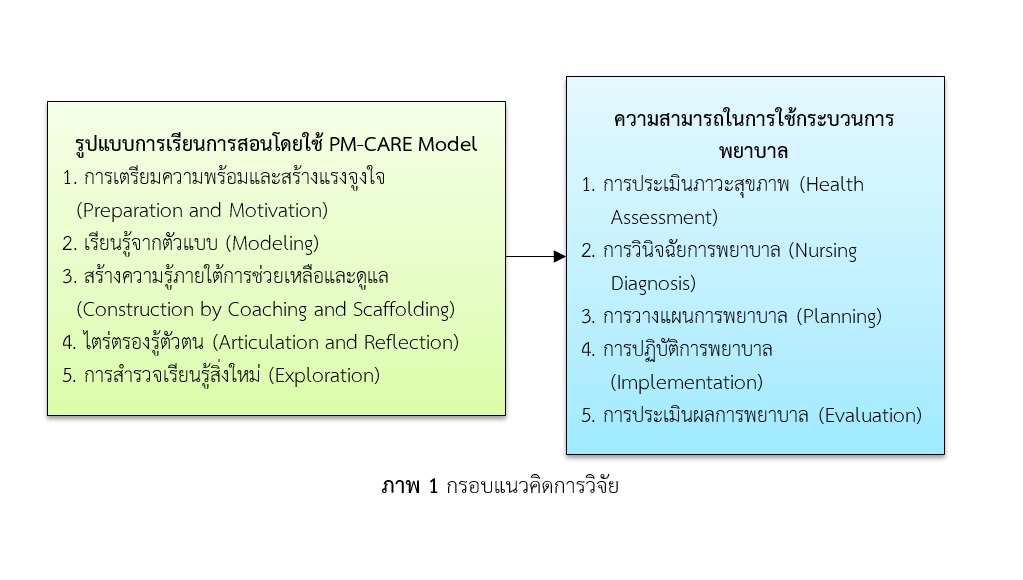
การวิจัยกึ่งทดลองนี้เพื่อเปรียบเทียบความสามารถในการใช้กระบวนการพยาบาลของนักศึกษาพยาบาลภายหลังการใช้รูปแบบ PM-CARE Model ที่พัฒนาจากแนวคิดการฝึกหัดทางปัญญา กลุ่มตัวอย่างเป็นนักศึกษาพยาบาลศาสตร์ ชั้นปีที่ 3 วิทยาลัยพยาบาลบรมราชชนนี เชียงใหม่ ปีการศึกษา 2562 จำนวน 30 ราย เครื่องมือที่ใช้ในการทดลอง คือรูปแบบการเรียนการสอน PM-CARE Model เครื่องมือที่ใช้ในการเก็บรวบรวมข้อมูล คือ 1) แบบประเมินความสามารถในการใช้กระบวนการพยาบาลของนักศึกษาพยาบาล ได้ค่าความตรงเชิงเนื้อหา (IOC) เท่ากับ .67-1.00 หาความเชื่อมั่นโดยใช้สัมประสิทธิ์อัลฟาของครอนบาคโดยรวม ได้เท่ากับ .892 ด้านการประเมินภาวะสุขภาพ มีค่าความเชื่อมั่นเท่ากับ .714 ด้านการวินิจฉัยการพยาบาลมีค่าความเชื่อมั่นเท่ากับ .716 ด้านการวางแผนการพยาบาลมีค่าความเชื่อมั่นเท่ากับ .875 ด้านการปฏิบัติการพยาบาลมีค่าความเชื่อมั่นเท่ากับ .900 และการประเมินผลการพยาบาลมีค่าความเชื่อมั่นเท่ากับ .889 และ 2) ความพึงพอใจในการใช้รูปแบบ เป็นแบบสอบถามเชิงคุณภาพ การวิเคราะห์ข้อมูลโดยใช้สถิติพรรณนาและสถิติทดสอบ Paired t-test วิเคราะห์ข้อมูลเชิงคุณภาพโดยวิเคราะห์เชิงเนื้อหาผลการวิจัยพบว่า
1. หลังเรียนโดยใช้รูปแบบ PM CARE Model นักศึกษามีความสามารถในการใช้กระบวนการพยาบาลสูงกว่าก่อนเรียนอย่างมีนัยสำคัญทางสถิติที่ระดับ .001 (p<.001)
2. นักศึกษาส่วนใหญ่พึงพอใจการเรียนการสอนรูปแบบ PM-CARE Model เพราะทำให้ปฏิสัมพันธ์ที่ดีระหว่างนักศึกษากับอาจารย์และพยาบาล บรรยากาศกลุ่มสำคัญรู้สึกเป็นทีมเดียวกัน อยากทำได้เหมือนพยาบาลและอาจารย์ แม้ว่ากระบวนการพยาบาลเป็นเรื่องเครียด
การศึกษาครั้งนี้ผู้สอนสามารถนำการเรียนการสอนโดยใช้รูปแบบ PM CARE Model พัฒนานักศึกษาพยาบาลให้สามารถสร้างความรู้โดยเฉพาะการใช้กระบวนการพยาบาลเพื่อแก้ปัญหาผู้ป่วย
เอกสารอ้างอิง
Boromarajonani College of Nursing, Chiang Mai. (2019). Seminar on Practical Training Course for Adult Nursing Practice 2, Academic Year 2018. Chiang Mai: Boromarajonani College of Nursing Chiang Mai. (in Thai)
Chansakul, S. (2018). The Relationship Between Attitude Toward Nursing Profession, Factors Affecting Intention and The Nursing Professional Intention of Nurse Students in Eastern Asia University. Journal of Nursing, Siam University, 19(37), 119-134. (in Thai)
Chidnayee, S. (2017). Cognitive Apprenticeship: Instructional Model to Construct Knowledge. Boromarajonani College of Nursing Uttaradit Journal, 9(2), 128-139. (in Thai)
Chidnayee, S., & Kaewurai, W. (2018). The Development of an Instructional Model Based on Cognitive Apprenticeships to Enhance Critical Thinking in Nursing Process Abilities for Nursing Students. Journal of Education Naresuan University, 20(4), 191-205. (in Thai)
Insan, P., & Phoyen, K. (2017). The Development of an Instructional Model Using Cognitive Apprenticeship with Cooperative Learning to Enhance Analytical Reading Ability of Upper Secondary School Student. Suan Dusit Graduate School Academic Journal, 13(2), 53-64. (in Thai)
Lyons, K., McLaughlin, J. E., Khanova, J., & Roth, M. T. (2017). Cognitive Apprenticeship in Health Sciences Education: A Qualitative Review. Advance in Health Science Education, 22(3), 723–739.
Merritt, C., Daniel, M., Munzer, B. W., Nocera, M., Ross, J. C., & Santen, S. A. (2018). A Cognitive Apprenticeship-Based Faculty Development Intervention for Emergency Medicine Educators. The Western Journal of Emergency Medicine, 19(1), 198-204.
Roth, W. M., & Bowen, G. M. (1995). Knowing and Interacting: A Study of Culture, Practices, and Resources in a Grade 8 Open-Inquiry Science Classroom Guided by a Cognitive Apprenticeship Metaphor. COGNITION AND INSTRUCTION, 13(1), 73-128.
Saadati, F., Ahmad Tarmizi, R., Mohd Ayub, A. F., & Abu Bakar, K. (2015). Effect of Internet-Based Cognitive Apprenticeship Model (i-CAM) on Statistics Learning among Postgraduate Students. PLoS ONE, 10(7), e0129938.
Singweratham, N. (2019). The Development of an Instructional Model Based on Didactic Teaching by Using VARK Learning Styles on Analytical Thinkingon Public Health Programin Community Health. The Southern College Network Journal of Nursing and Public Health, 6(3), 27-40. (in Thai)
Stalmeijer, R. E., Dolmans, D. H. J. M., Snellen-Balendong, H. A. M., van Santen-Hoeufft, M., Wolfhagen, I. H. A. P., & Scherpbier, A. J. J. A. (2013). Clinical Teaching Based on Principles of Cognitive Apprenticeship. Academic Medicine, 88(6), 861-865.
Taylor, K. L., & Care, D. W. (1999). Nursing Education as Cognitive Apprenticeship. Nurse Educator, 24(4), 31-36.
Thailand Nursing and Midwifery Council. (2019). Thailand Nursing and Midwifery Council Announcement Regarding Nursing Standards B.E.2562. (in Thai)
Vibulchai, N., & Boranmoon, G. (2014). Problems and Obstacles in Implementation of Nursing Students of Srimahasarakham Nursing College. Journal of Boromarajonani College of Nursing, Bangkok, 30(3), 26-34. (in Thai)
Vitoonmetha, M., Niputhuttapong, S., Iemsam-Ang, M., & Tejangkura, L. (2016). Development of aGuideline to Enhance Nursing Students’ Abilities in Utilizing Nursing Process. Thai Journal of Cardio-Thoracic Nursing, 27(2), 100-113. (in Thai)
Weeks, K. W., Clochesy, J. M., Hutton, B. M., & Moseley, L. (2013). Safety in Numbers 4: The Relationship Between Exposure to Authentic and Didactic Environments and Nursing Students’ Learning of Medication Dosage Calculation Problem Solving Knowledge and Skills. Nurse Education in Practice, 13(2), 43–54.
Woolley, N. N., & Jarvis, Y. (2007). Situated Cognition and Cognitive Apprenticeship: A Model for Teaching and Learning Clinical Skills in a Technologically Rich and Authentic Learning Environment. Nurse Education Today, 27, 73–79.
Young, J. E., Williamson, M. I., & Egan, T. G. (2016). Students’ Reflections on the Relationships Between Safe Learning Environments, Learning Challenge and Positive Experiences of Learning in a Simulated GP Clinic. Advances in Health Sciences Education, 21, 63–77.
ดาวน์โหลด
เผยแพร่แล้ว
ฉบับ
ประเภทบทความ
สัญญาอนุญาต
1. บทความหรือข้อคิดเห็นใด ๆ ที่ปรากฏในวารสารเครือข่าย วิทยาลัยพยาบาลและการสาธารณสุขภาคใต้ ที่เป็นวรรณกรรมของผู้เขียน บรรณาธิการหรือเครือข่ายวิทยาลัยพยาบาลและวิทยาลัยการสาธารณสุขภาคใต้ ไม่จำเป็นต้องเห็นด้วย
2. บทความที่ได้รับการตีพิมพ์ถือเป็นลิขสิทธิ์ของ วารสารเครือข่ายวิทยาลัยพยาบาลและการสาธารณสุขภาคใต้