ความรอบรู้ทางสุขภาพในการป้องกันโรคมะเร็งเต้านมและโรคมะเร็งปากมดลูก: กรณีศึกษาการสร้างเสริมความรอบรู้ทางสุขภาพของสตรีวัยเจริญพันธุ์ในเขตกรุงเทพมหานคร
คำสำคัญ:
ความรอบรู้ทางสุขภาพ, การป้องกันโรคมะเร็งเต้านมและโรคมะเร็งปากมดลูก, สตรีวัยเจริญพันธุ์บทคัดย่อ
การวิจัยเชิงคุณภาพแบบวิธีวิจัยเฉพาะกรณีนี้ มีวัตถุประสงค์เพื่ออธิบายเงื่อนไขการสร้างความรอบรู้ทางสุขภาพในการป้องกันโรคมะเร็งเต้านมและโรคมะเร็งปากมดลูกของสตรีวัยเจริญพันธุ์ ผู้ให้ข้อมูล คือ สตรีวัยเจริญพันธุ์ที่อาศัยอยู่ในกรุงเทพมหานคร อายุ 25-59 ปี จำนวน 17 คน เลือกผู้ให้ข้อมูลแบบเจาะจง โดยมีคะแนนความรอบรู้ทางสุขภาพในระดับสูง ที่ประเมินจากแบบวัดความรอบรู้ทางสุขภาพในการป้องกันโรคมะเร็งปากมดลูกและโรคมะเร็งเต้านมของกลุ่มสตรีวัยเจริญพันธุ์ รวบรวมข้อมูลด้วยวิธีการสัมภาษณ์เชิงลึกร่วมกับการสังเกต เครื่องมือที่ใช้เป็นแบบสัมภาษณ์แบบกึ่งโครงสร้าง ทำการวิเคราะห์ข้อมูลด้วยการวิเคราะห์เนื้อหา ผลการวิจัยพบว่า
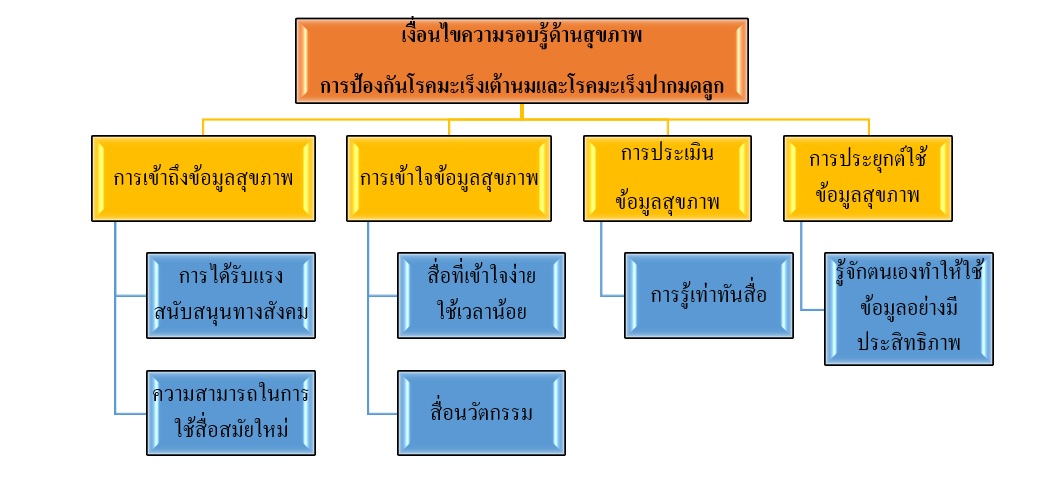
เงื่อนไขที่สำคัญของการสร้างความรอบรู้ทางสุขภาพในการป้องกันโรคมะเร็งเต้านมและโรคมะเร็งปากมดลูก ประกอบด้วย 1) การเข้าถึงข้อมูลสุขภาพ ได้แก่ การได้รับแรงสนับสนุนทางสังคม ความสามารถในการ ใช้สื่อสมัยใหม่ 2) การเข้าใจข้อมูลสุขภาพ สื่อที่เข้าใจง่าย และใช้เวลาน้อย และสื่อนวัตกรรม 3) การประเมินข้อมูลสุขภาพ เช่น การรู้เท่าทันสื่อ 4) การประยุกต์ใช้ข้อมูลสุขภาพ เช่น รู้จักตนเองทำให้เลือกใช้ข้อมูลอย่างมีประสิทธิภาพ
ข้อค้นพบนี้สามารถนำไปใช้ในการส่งเสริมความรอบรู้ทางสุขภาพในการป้องกันโรคมะเร็งปากมดลูกและโรคมะเร็งเต้านมของกลุ่มสตรีวัยเจริญพันธุ์ต่อไป
เอกสารอ้างอิง
American Cancer Society. (2021). Cervical Cancer. Retrieved January 20, 2021 from https://www.cancer.org/cancer/cervical-cancer/about/key-statistics.html.
Brabers, A. E. M., Rademakers, J. J. D. J. M., Groenewegen, P. P., Dijk, L. V., & Jong, J. D. D. (2017). What Role Does Health Literacy Play in Patients’ Involvement in Medical Decision-Making. PLoS One, 12(3), 1-12.
Bray, F., Ferlay, J., Soerjomataram, I., Siegel, R. L., Torre, L. A., & Jemal A, J. (2018). Global Cancer Statistics 2018: GLOBOCAN Estimates of Incidence and Mortality Worldwide for 36 Cancers in 185 Countries. Cancer Journal for Clinicians, 68(6), 394-424.
Cancer Research UK. (2020). Breast Cancer. Retrieved January 20, 2021 from https://www.cancerresearchuk.org/ health-professional/cancer-statistics/statistics-by-cancer-type/breast-cancer/incidence-invasive#heading-One.
Health Education Division. (2018). Promoting and Assessing Health Literacy and Health Behavior. Bangkok: Ministry of Public Health. (in Thai)
International Agency for Research on Cancer. (2019). Thailand Source: Globocan 2018. Retrieved May 23, 2019 from https://gco.iarc.fr/today/data/factsheets/populations/ 764-thailand-fact-sheets.pdf/.
Juntawong, N., Tridech, P., Siri, S., & Tridech, C. (2017). Factors Related to Receiving Cervical Cancer Screening Services among Women Aged 30-60 Years in Muang District, Pathumthani Province. Journal of Phrapokklao Nursing College, 28(1), 63-79.
Kandula, N. R., Nsiah-Kum, P. A., Makoul, G., Sager, J., Zei, C. P., Glass, S., et al. (2009). The Relationship Between Health Literacy and Knowledge Improvement After a Multimedia Type 2 Diabetes Education Program. Patient Education and Counseling, 75(3), 321-327.
Kiatlertdecha, T., Chiangkhong, A., Thongsri, P., & Sarachan, A. (2019). Development and Validation of a Scale Measuring Health Literacy for Breast and Cervical Cancer Prevention with Women’s Reproductive in Bangkok Metropolitan. Vajira Medical Journal, 63(Supple), S31-42.
Kim, K., Xue, Q. L., Moss, B. W., Nolan, M. T., & Han, H. R. (2018). Decisional Balance and Self-Efficacy Mediate the Association among Provider Advice, Health Literacy and Cervical Cancer Screening. European Journal of Oncology Nursing, 32, 55-62.
Levin-zamir, D., & Bertschi, I. (2018). Media Health Literacy, Health Literacy, and the Role of the Social Environment in Context. International Journal of Environmental Research and Public Health, 15(8), 1643.
Li, C., Matthews, A. K., & Dong, X. (2018). The Influence of Health Literacy and Acculturation on Cancer Screening Behaviors among Older Chinese Americans. Gerontology & Geriatric Medicine, 4, 1-8.
Liu, Y., Hou, P., Xue, H., Mao, X., & Li, Y. (2019). Social Support, Health Literacy, and Health Care Utilization among Older Adults. Asia Pacific Journal Public Health, 31(1), 359-366.
Miles, M. B., & Huberman, A. M. (1994). Qualitative Data Analysis. An Expanded Sourcebook 55 (2nd ed). Thousand Oaks,CA: Sage Publications.
Rakhshkhorshid, M., Navaee, M., Nouri, N., & Safarzaii, F. (2018). The Association of Health Literacy with Breast Cancer Knowledge, Perception and Screening Behavior. European Journal of Breast Health, 14(3), 144-147.
Sorensen, K., Broucke, S. V., Fullam, J., Doyle, G., Pelikan, J., Slonska, Z., et al. (2012). Health Literacy and Public Health: A Systematic Review and Integration of Definitions and Models. BMC Public Health, 12(80), 1-13.
Yadollahi, M., Siavashi, E., & Mostaghim, S. (2018). The Relationship Between Health Literacy and Patient Participation in Medical Decision Making among Breast Cancer Patients. Archives of Breast Cancer, 5(4), 183-188.
Yilmazel, G. (2019). Low Health Literacy, Poor Knowledge, and Practice among Turkish Women Patients Undergoing Cervical Cancer Screening. Journal of Cancer Research and Therapeutics, 15(6), 1276-1281.
ดาวน์โหลด
เผยแพร่แล้ว
ฉบับ
ประเภทบทความ
สัญญาอนุญาต
1. บทความหรือข้อคิดเห็นใด ๆ ที่ปรากฏในวารสารเครือข่าย วิทยาลัยพยาบาลและการสาธารณสุขภาคใต้ ที่เป็นวรรณกรรมของผู้เขียน บรรณาธิการหรือเครือข่ายวิทยาลัยพยาบาลและวิทยาลัยการสาธารณสุขภาคใต้ ไม่จำเป็นต้องเห็นด้วย
2. บทความที่ได้รับการตีพิมพ์ถือเป็นลิขสิทธิ์ของ วารสารเครือข่ายวิทยาลัยพยาบาลและการสาธารณสุขภาคใต้