
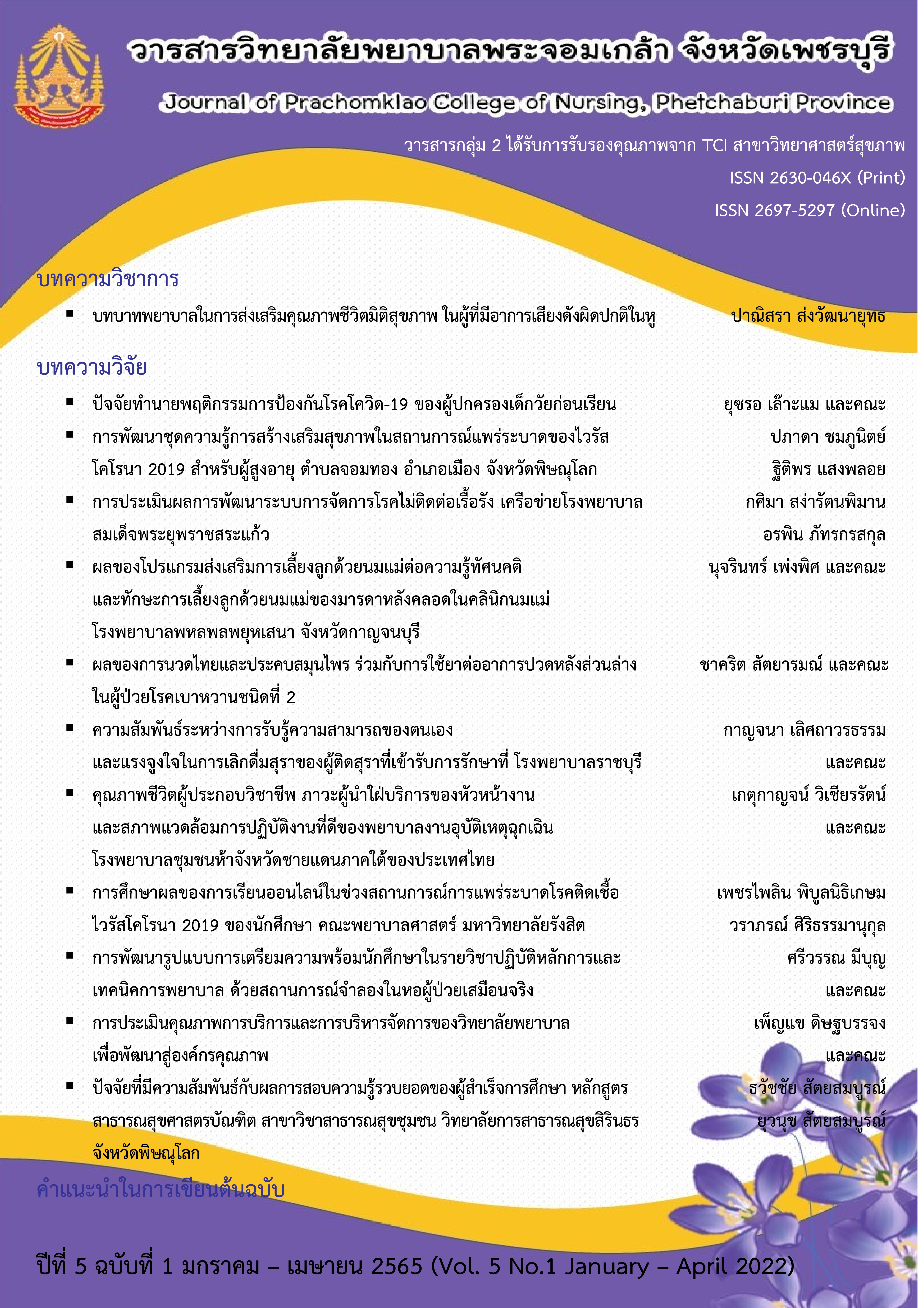
Effects of Breastfeeding Promotion Program on Knowledge, Attitude, and Skills Related to Breastfeeding of Postpartum Mothers in Breastfeeding Clinic, Phahon Phon Phayuhasena Hospital, Kanchanaburi Province
Article Sidebar
Main Article Content
Abstract
The purpose of this quasi-experimental research is to study the effect of a breastfeeding promotion program on knowledge, attitudes, and skills on breastfeeding of postpartum mothers in the breastfeeding clinic of Phahon Phon Phayuhasena Hospital, Kanchanaburi Province. The samples consist of 60 people that have been divided into 1) an experimental group of 30 people and 2) a control group of 30 people. Data were collected by using a set of knowledge questionnaires on breastfeeding attitudes and parenting skills. The confidence value of Cronbach's alpha coefficient is .72. The data were analyzed by using descriptive statistics. and paired t-test, as well. The results, then, show that:
1. The experimental group has higher mean scores on knowledge, attitude, and breastfeeding skills after participating in the breastfeeding promotion program than before participating in the program. Statistically significant at .05, the t-test values are 14.61, 8.25, and 6.99, respectively.
2. The experimental group and the control group have average knowledge scores. The statistical difference in breastfeeding attitudes and skills is .05. The t-test values are 9.43, 2.79, and 3.84, respectively.
Therefore, nursing administrators should implement breastfeeding promotion programs. It is the standard of nursing in the agency and is ready to support the arrangement of the facilities.
Downloads
Article Details

This work is licensed under a Creative Commons Attribution-NonCommercial-NoDerivatives 4.0 International License.
Content and information published in the Journal of Prachomklao College of Nursing, Phetchaburi Province are the comment and responsibility of the authors. Articles, information, images, etc. published in this journal are the copyright of the Journal of Prachomklao College of Nursing, Phetchaburi Province. If any person or entity wants to take all or part of it for publication for any purposes, please reference the Journal of Prachomklao College of Nursing, Phetchaburi Province.
References
นวลจันทร์ ไพบูลย์บรรพต, และ สร้อย อนุสรณ์ธีรกุล. (2558). ผลของโปรแกรมส่งเสริมการเลี้ยงลูกด้วยนมแม่ต่อความรู้ ทัศนคติ และทักษะการเลี้ยงลูกด้วยนมแม่ของมารดาหลังคลอด. วารสารพยาบาลศาสตร์และสุขภาพ,38(1), 41-52.
นิพรรณพร วรมงคล. (2553). คู่มือการอบรมผู้เชี่ยวชาญการเลี้ยงลูกด้วยนมแม่ (พิมพ์ครั้งที่ 2). สำนักส่งเสริมสุขภาพ กระทรวงสาธารณสุข.
เปมิกา บุตรจันทร์, สมเสาวนุช จมูศรี, และ กชพร สิงหะหล้า. (2559). ผลของโปรแกรมการส่งเสริมการเลี้ยงลูกด้วยนมแม่ต่อการรับรู้สมรรถนะแห่งตน และพฤติกรรมการส่งเสริมการเลี้ยงลูกด้วยนมแม่ของสมาชิกครอบครัวในชุมชน. วารสารการพยาบาลและการดูแลสุขภาพ, 34(4), 97-105.
โรงพยาบาลพหลพลพยุหเสนา. (2562). รายงานประจำปีโรงพยาบาลพหลพลพยุหเสนา. โรงพยาบาลพหลพลพยุหเสนา.
วิลาวัลย์ บุญเดช, ประทุมา ฤทธิ์โพธิ์, และ ชมนาด วรรณพรศิริ. (2557). ผลของโปรแกรมสมรรถนะแห่งตนต่อการเลี้ยงลูกด้วยนมแม่ของมารดาวัยรุ่น จังหวัดกำแพงเพชร. วารสารการพยาบาลและสุขภาพ, 8(3), 65-79.
ศิริวรรณ ทุมเชื้อ, และ อัญญา ปลดเปลื้อง. (2558). การพัฒนาโปรแกรมส่งเสริมการเลี้ยงลูกด้วยนมแม่โดยการสนับสนุนของครอบครัว. วารสารศูนย์การศึกษาแพทยศาสตร์คลินิก โรงพยาบาลพระปกเกล้า, 32(1), 6-17.
ศุภวดี แถวเพีย, วิไลลักษณ์ เผือกพันธุ์, และ อักษราณัฐ ภักดีสมัย. (2560). พฤติกรรมการเลี้ยงบุตรด้วยนมแม่ในหญิงไทยหลังคลอด. วารสารเครือข่ายวิทยาลัยพยาบาลและการสาธารณสุขภาคใต้, 4(2), 123-139.
ศุภวิทย์ มุตตามระ, กุสุมา ชูศิลป์, อุมาพร สุทัศน์วรวุฒิ, วราภรณ์ แสงทวีสิน, และ ยุพยง แห่งเชาวนิช (บ.ก.). (2555). ตำราการเลี้ยงลูกด้วยนมแม่. สำนักพิมพ์ไอยรา.
สาโรช สมชอบ. (2537). เอกสารการสอนชุดวิชาการบริหารและจัดการวัดและประเมินผลการศึกษาหน่วยที่ 1-7. มหาวิทยาลัยสุโขทัยธรรมมาธิราช.
สำนักส่งเสริมสุขภาพ กระทรวงสาธารณสุข. (2563). คู่มือการเลี้ยงลูกด้วยนมแม่. โรงพิมพ์ชุมนุมสหกรณ์การเกษตรแห่งประเทศไทย.
Altuntas, N., Turkyilmaz, C., Yildiz, H., Kulali, F., Hirfanoglu, I., Onal, E., Ergenekon, E., Koç, E. & Atalay, Y. (2014). Validity and reliability of the infant breastfeeding assessment tool, the mother baby assessment tool, and the LATCH scoring system. Breastfeeding Medicine, 9(4), 191-195.
Bandura, A. (1986). Social foundations of thought and action: A social cognitive theory. Prentice-Hall.
Faul, F., Erdfelder, E., Lang, A. G., & Buchner, A. (2007). G*Power 3: A flexible statistical power analysis program for the social, behavioral, and biomedical sciences. Behavior Research Methods, 39(2), 175–191.
Khresheh, R., Suhaimat, A., Jalamdeh, F., & Barclay, L. (2011). The effect of a postnatal education and support program on breastfeeding among primiparous women: A randomized controlled trial. International Journal of Nursing Studies, 48(9), 1058-1065.
Lemeshow, S., Hosmer, D. W., Klar, J., Lwanga, S. K., & World Health Organization. (1990). Adequacy of sample size in health studies. Wiley.
Schwartz, N. E. (1975). Nutrition, knowledge, attitude, and practice of high school graduates. W. B. Saunders.
UNICEF. (2020). Breastfeeding practices worldwide. https://data.unicef.org/resources/world-breastfeeding-week-2020/
World Health Organization. (n.d.). Breastfeeding.https://www.who.int/health-topics/ breastfeeding#tab=tab_1
