
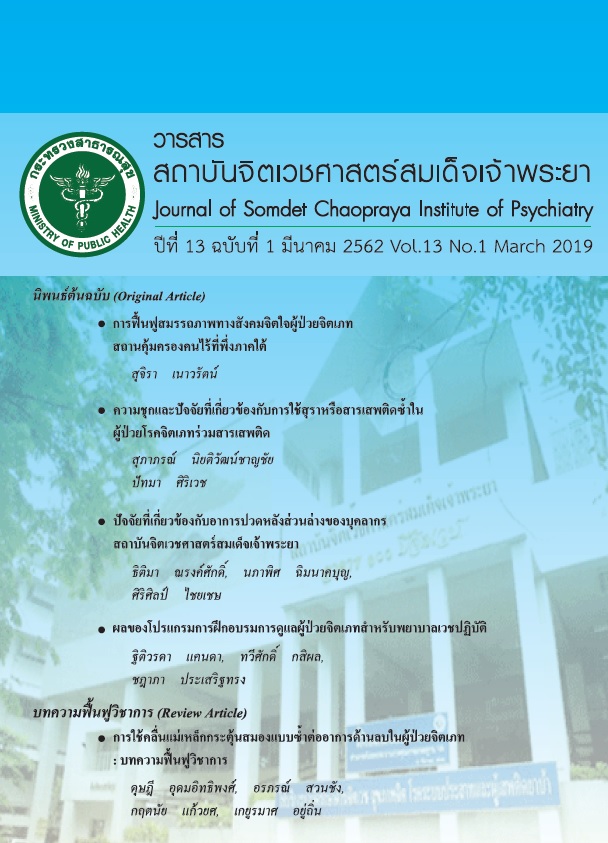
THE USE OF REPETITIVE TRANSCRANIAL MAGNATIC STIMULATION FOR NEGATIVE SYMPTOMS IN SCHIZOPHRENIA
Keywords:
repetitive transcranial magnetic stimulation, schizophrenia, negative symptomsAbstract
Objective: To review the literature using repetitive transcranial magnetic stimulation (rTMS) on negative
symptoms in schizophrenia.
Material and Methods: Literature review for this article was conducted via PubMed, google, Web of
Science and other medical online-databases articles and textbooks including public articles both Thai
and English language using. The search was carried out using the terms rTMS, repetitive transcranial
magnetic stimulation, negative symptoms and schizophrenia.
Results: Eleven studies based on rTMS for negative symptoms in schizophrenia (eight experimental
studies, two meta-analysis, and one review article) met eligibility criteria. These findings indicated that
active rTMS was considered an effective, safe and well-tolerated treatment option. High-frequency of 10
Hz setting applied over the left dorsolateral prefrontal cortex (DLPFC), at least 3 consecutive weeks of
treatment and using 8 years as a cutoff for duration of illness were found to be better than sham rTMS in
alleviating negative symptoms of schizophrenia.
Conclusion: rTMS was considered another useful and safe treatment which was able to improve negative
symptoms of schizophrenia. This review article suggested the need for future studies with larger sample
sizes and other factors affecting treatment.
References
World Health Organization. Schizophrenia [online]. Available from: http://www. who.int/mental_health/management/ schizophrenia/en/ [2016 June 29].
Saha S, Chant D, Welham J, McGrath J. A systematic review of the prevalence of schizophrenia. PLoS Med 2005; 2: 413-33.
รัชตะ รัชตะนาวิน. ผู้ป่วยจิตเวชไทยพุ่งทะลุล้าน โรคจิตเภทสูงสุดกว่า 4 แสนราย วันสุขภาพจิตโลก 10 ตุลาคม 2557. [online]. Available from: http://www.manager.co.th/Home/ViewNews.aspx?NewsID=9570000117185 [2016 June 30].
มาโนช หล่อตระกูล, ปราโมทย ์ สุคนิชย์. จิตเวชศาสตร์รามาธิบดี. พิมพ์ครั้งที่ 8. กรุงเทพ: สวิชาญการพิมพ์, 2546.
Shamsi S, Lau A, Lencz T, Burdick KE, DeRosse P, Brenner R, et al. Cognitive and symptomatic predictors of functional disability in schizophrenia. Schizophr Res 2011; 126(1-3): 257-64.
Hansbauer M, Wobrock T, Kunze B, Langguth B, Landgrebe M, Eichhammer P, et al. Efficacy of high-frequency repetitive transcranial magnetic stimulation on PANSS factors in schizophrenia with predominant negative symptoms – results from an exploratory re-analysis. Psychiatry Res 2018; 263: 22-9.
Cernovsky Z. Quality of life in persons with schizophrenia. Ment Illn 2017; 9(1): 7052.
Buchanan RW, Kreyenbuhl J, Kelly DL, Noel JM, Boggs DL, Fischer BA, et al. The 2009 schizophrenia PORT psycho-pharmacological treatment recommendations and summary statements. Schizophrenia Bull 2010; 36: 71-93.
Erhart SM, Marder SR, Carpenter WT. Treatment of schizophrenia negative symptoms: future prospects. Schizophrenia Bull 2006; 32: 234-7.
Leucht S, Arbter D, Engel RR, Kissling W, Davis JM. How effective are second-generation antipsychotic drugs? A meta-analysis of placebocontrolled trials. Molecular Psychiatry. 2009; 14: 429-47.
Graziano B, Kaskie RE, Ferrarelli F. Transcranial magnetic stimulation (TMS) as a treatment tool in schizophrenia: A review. J Brain Neurol 2017; 1(1): 14-23.
Moller HJ. Management of the negative symptoms of schizophrenia: new treatment options. CNS Drugs 2003; 17: 793-823.
Wang RZ, Zhang JX, Yuan W, Tang JS, Liu JT, Li X, et al. A study of insist and psychopathology vignettes in patients with schizophrenia. Shandong Jing Shen Yi Xue 2001; 14(4): 237-40.
ภารดี เอื้อวิชญาแพทย์, ธวัชชัย กฤษณะประกรกิจ. การกระตุ้นแม่เหล็กไฟฟ้าผ่านกะโหลก. ศรีนครินทร์เวชสาร 2552; 24(3): 148-53.
Machii K, Cohen D, Ramos-Estebanez C, Pascual-Leone A. Safety of rTMS to non-motor cortical areas in healthy participants and patients. Clin Neurophysiol 2006; 117: 455-71.
Khurshid K, Janicak P. Other than depression: using transcranial magnetic stimulation. Psychiatr Ann 2005; 35(2): 147-58.
Becker JE, Maley C, Shultz E, Taylor WD. Update on transcranial magnetic stimulation for depression and other neuropsychiatric illnesses. Psychiatr Ann 2016 ; 46(11): 637-41.
Slotema CW, Blom JD, Hoek HW, Sommer IE. Should we expand the toolbox of psychiatric treatment methods to include repetitive transcranial magnetic stimulation (rTMS)? A meta-analysis of the efficacy of rTMS in psychiatric disorders. J Clin Psychiatry 2010; 71: 873-84.
Fitzgerald PB, Herring S, Hoy K, McQueen S, Segrave R, Kulkarni J, et al. A study of the effectiveness of bilateral transcranial magnetic stimulation in the treatment of the negative symptoms of schizophrenia. Brain Stimul 2008; 1(1): 27-32.
Sayar GH, Bulut H, Tarhan N. Use of repetitive transcranial magnetic stimulation in treatment of negative symptoms of schizophrenia. J Neurol Sci Disord 2015; 1(1): 017-021.
Cohen E, Bernardo M, Masana J, Arrufat FJ, Navarro V. Repetitive transcranial magnetic stimulation in the treatment of chronic negative schizophrenia: a pilot study. J Neurol Neuro Surg Psychiatry 1999; 67: 129-30.
Rollnik JD, Huber TJ, Mogk H, Siggelkow S, Kropp S, Dengler R , et al. High frequency repetitive transcranial magnetic stimulation (rTMS) of the dorsolateral prefrontal cortex in schizophrenic patients. Neuroreport 2000; 18(11): 4013-5.
Hajak G, Marienhagen J, Langguth B, Werner S, Binder H, Eichhammer P. High-frequency repetitive transcranial magnetic stimulation in schizophrenia: a combined treatment and neuroimaging study. Psychol Med 2004; 34(7): 1157-63.
Dlabac-de Lange JJ, Knegtering R, Aleman A. Repetitive transcranial magnetic stimulation for negative symptoms of schizophrenia: review and meta-analysis. J Clin Psychiatry 2010; 71: 411-8.
Zhao S, Kong J, Li S, Tong Z, Chanjuan Y, Huaqing Z. Randomized controlled trial of four protocols of repetitive transcranial magnetic stimulation for treating the negative symptoms of schizophrenia. Shanghai Arch Psychiatry 2014; 26: 15-21.
Zheng LN, Guo Q, LI H, LI CB, Wang JJ. Effects of repetitive transcranial magnetic stimulation with different paradigms on the cognitive function and psychotic symptoms of schizophrenia patients. Beijing Da Xue Xue Bao 2012; 44(5): 732-6.
Wobrock T, Guse B, Cordes J, Wolwer W, Winterer G, Landgrebe M, et al. Left prefrontal high frequency repetitive transcranial magnetic stimulation for the treatment of schizophrenia with predominant negative symptoms: a sham-controlled, randomized multicenter trial. Biol Psychiatry 2015; 77: 979-88.
Prikryl R, Ustohal L, Prikrylova Kucerova H, Kasparek T, Venclikova S, Ceskova E. A detailed analysis of the effect of repetitive transcranial magnetic stimulation on negative symptoms of schizophrenia: a double-blind trial. Schizophr Research 2013; 149: 167-73.
Prikryl R, Kasparek T, Skotakova S, Ustohal L, Kucerova H, Ceskova E. Treatment of negative symptoms of schizophrenia using repetitive transcranial magnetic stimulation in a doubleblind, randomized controlled study. Schizophr Res 2007; 95(1-3): 151-57.
Levkovitz Y, Rabany L, Harel EV, Zangen A. Deep transcranial magnetic stimulation add-on for treatment of negative symptoms and cognitive deficits of schizophrenia: a feasibility study. Int J Neuropsychopharmacol 2011; 14(7): 991-6.
Shi C, Yu X, Cheunge E, Shum D, Chana R. Revisiting the therapeutic effect of rTMS on negative symptoms in schizophrenia: A meta analysis. Psychiatry Res 2014; 215(3): 505-13.
Downloads
Published
How to Cite
Issue
Section
License
The articles published are copyright of Journal of Somdet Chaopraya Institute of Psychiatry.


