
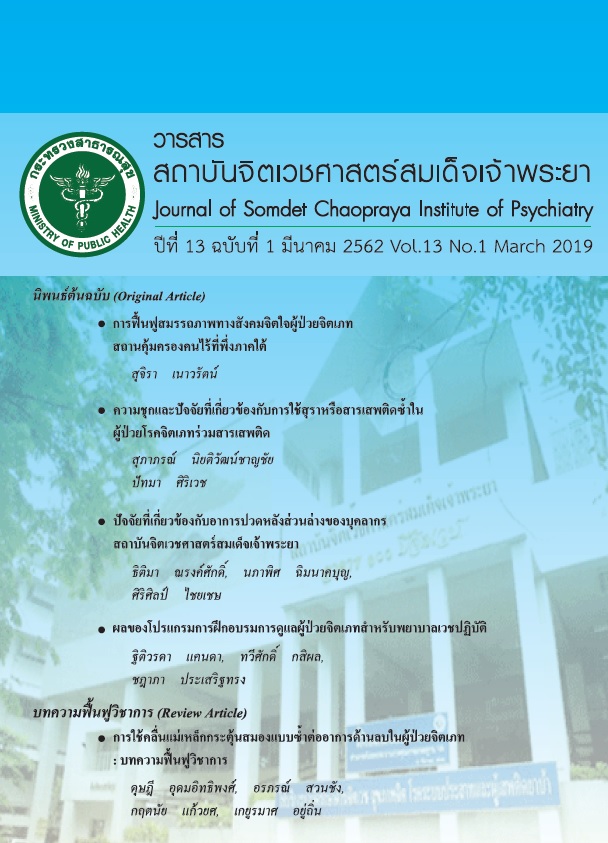
PREVALENCE AND ASSOCIATED FACTORS OF RELAPSE OF ALCOHOL OR SUBSTANCE USE IN SCHIZOPHRENIA COMORBIDITY
Keywords:
relapse of substance use disorder, schizophrenia comorbidityAbstract
Objective: To study prevalence and factors associated with relapse of alcohol or substance use in
schizophrenic comorbidity.
Material and Methods: This study is a cross-sectional study obtained data from interview alcohol or
substance use in schizophrenic inpatients in Somdet Chaopraya Institute of Psychiatry during July 1st,
2017 to October 31th, 2017 in total number of 138 cases. The data was collected by tools created by the
researchers to collect information on the factors to be studied. Percentage, mean, standard deviation, and
chi-square test were used as statistical analysis.
Results: Mean age of patients was 35.64 ± 8.49 years. Prevalence of relapse of alcohol or substance use
in schizophrenic inpatients was 64.5%. The most commonly used were tobacco products (83.3%). More
than half (50.7%) of patients had joined to substance used disorder rehabilitation program. Factors associated with relapse of alcohol or substance use were social factors in term of peer pressure to be part of the group (61.8%) and coping factors in term of relieving tension and stress (77.5%).
Conclusion: Factors associated with relapse of alcohol or substance use in schizophrenic inpatients in
Somdet Chaopraya Institute of Psychiatry were age, tobacco use, history of joined the substance use
disorder rehabilitation programs, social factors in term of peer pressure and to be part of a group and
coping factors in term of relieving tension and stress.
References
นันทิกา ทวิชาชาติ, ธงชัย ทวีชาชาติ, อรพรรณ เมฆสุภะ, สุขเจริญ ตั้งวงษ์ไชย, อรรถพล สุคนธาภิรมย์, พวงสร้อย วรกุล. การสำรวจทางระบาดวิทยาของความผิดปกติทางจิตและความรู้เจตคติทักษะการปฏิบัติตนเกี่ยวกับสุขภาพจิตของประชาชนในเขตกรุงเทพมหานคร. จดหมายเหตุทางแพทย์ แพทยสมาคมแห่งประเทศไทยในพระบรมราชูปถัมภ์ 2544; 84: S118-S26.
อนุรักษ์ บัณฑิตย์ชาติ, ภัคนพิน กิตติรักษนนท์, วรวรรณ จุฑา. ระบาดวิทยาของความผิดปกติทางจิตของประชาชนไทย. วารสารสมาคมจิตแพทย์แห่งประเทศไทย 2544; 46(4): 335-43.
Whiteford HA, Degenhardt L, Rehm J, Baxter AJ, Ferrari AJ, Erskine HE, et al. Global burden of disease attributable to mental and substance use disorders: findings from the Global Burden of Disease Study 2010. Lancet 2013; 382(9904): 1575-86.
CJL Murray AL. The Global burden of disease : a comprehensive assessment of mortality and disability from diseases, injuries, and risk factors in 1990 and projected to 2020: Geneva: World Health Organization; 1996.
Thirthalli J, Benegal V. Psychosis among substance users. Curr Opin Psychiatry 2006; 19(3): 239-45.
Gottlieb JD, Mueser KT, Glynn SM. Family therapy for schizophrenia: co-occurring psychotic and substance use disorders. J Clin Psychol 2012; 68(5): 490-501.
Cantor-Graae E, Nordström LG, McNeil TF. Substance abuse in schizophrenia: a review of the literature and a study of correlates in Sweden. Schizophr Res 2001; 48(1): 69-82.
Curran C, Byrappa N, Mcbride A. Stimulant psychosis: systematic review. Br J Psychiatry 2004; 185(3): 196-204.
Harris D, Batki SL. Stimulant psychosis: symptom profile and acute clinical course. A m J Addict 2000; 9(1): 28-37.
McKetin R, McLaren J, Lubman DI, Hides L. The prevalence of psychotic symptoms among methamphetamine users. Addiction 2006; 101(10): 1473-8.
Scott JC, Woods SP, Matt GE, Meyer RA, Heaton RK, Atkinson JH, et al. Neurocognitive effects of methamphetamine: a critical eeview and Metaanalysis. Neuropsychol Rev 2007; 17(3): 275-97.
Green AI, Drake RE, Brunette MF, Noordsy DL. Schizophrenia and co-Occurring substance use disorder. Am J Psychiatry 2007; 164(3): 402-8.
Compton MT, Weiss PS, West JC, Kaslow NJ. The associations between substance use disorders, schizophrenia-spectrum disorders, and Axis IV psychosocial problems. Soc Psychiatry Psychiatr Epidemiol 2005; 40(12): 939-46.
Donald M, Dower J, Kavanagh D. Integrated versus non-integrated management and care for clients with co-occurring mental health and substance use disorders: a qualitative systematic review of randomized controlled trials. Soc Sci Med 2005; 60(6): 1371-83.
Halter MJ. Foundations of psychiatric mental health nursing. 7th ed. Saunders; 2013.
Tsuang J, Fong TW, Lesser I. Psychosocial treatment of patients With Schizophrenia and substance abuse disorders. Addict Disord Their Treat 2006; 5(2): 53-66.
เอกอุมา อิ้มคำ. การบำบัดด้านจิตสังคมในผู้ป่วยโรคจิตเภทที่ใช้สารเสพติด การใช้หลักฐานเชิงประจักษ์. วารสารวิทยาศาสตร์และเทคโนโลยี 2556; 7: 697-710.
Thornton LK, Baker AL, Lewin TJ, Kay-Lambkin FJ, Kavanagh D, Richmond R, et al. Reasons for substance use among people with mental disorders. Addict Behav 2012; 37(4): 427-34.
ธนิตา หิรัญเทพ. ปัจจัยที่สัมพนั ธ์กับการไม่เสพยาเสพติดซ้ำในผู้เข้ารับการบำบัดในระบบบังคับบำบัด. วารสารสมาคมจิตแพทย์แห่งประเทศไทย 2556; 58: 157-64.
Xie H, McHugo GJ, Fox MB, Drake RE. Substance abuse relapse in a ten-year prospective follow-up of clients with mental and substance use disorders. Psychiatr Serv 2005; 56(10): 1282-7.
Bhandari S, Dahal M, Neupane G. Factors associated with drug abuse relapse: A study on the clients of rehabilitation centers. Al Ameen J Med Sci 2015; 8(4): 293-8.
Downloads
Published
How to Cite
Issue
Section
License
The articles published are copyright of Journal of Somdet Chaopraya Institute of Psychiatry.


