
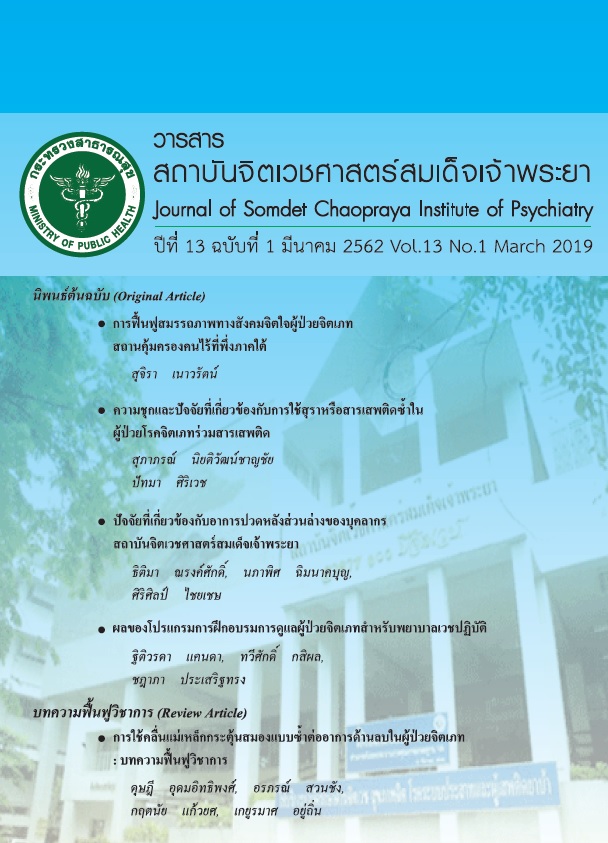
PSYCHOSOCIAL REHABILITATION OF SCHIZOPHRENIC PATIENT IN A HOMELESS PROTECTION CENTER, SOUTHERN
Keywords:
psychosocial rehabilitation, schizophrenic patientAbstract
Objective: To study psychosocial rehabilitation of schizophrenic patient in a homeless protection center,
Southern.
Material and Methods: The quasi-experiment, pre-post one group design was carried out in a homeless
protection center, Sichon, Nakhon Si Thammarat. All 47 patients with schizophrenia were recruited to
the study. The research instruments were psychosocial rehabilitation program, assessing overall ability,
rehabilitation program for psychiatric patients in the community evaluation form, and International
Classification of Functioning, Disability and Health assessment (ICF). Using techniques of descriptive
statistics, the researcher analyzed the data collected in terms of frequency distribution, percentage, and
mean.
Results: After psychosocial rehabilitation program, 8 from 47 patients passed the assessment and
attended the level 3 and it was found that after the program , 8 patients had higher average scores on
assessing overall ability, rehabilitation for psychiatric patie nts and International Classification of
Functioning, Disability and Health assessment (ICF) than before receiving the program.
Conclusion: The psychosocial rehabilitation program could improve in schizophrenic cases however
consistency of practice is essential in order to pass higher levels and to see more patients attending. In
addition to developing diversity model, psychosocial rehabilitation program of homeless schizophrenia
patients should also be created.
References
Lortrakul M. Sukanich P. Textbook of Ramathibodi psychiatry. 3rd ed. Bangkok: Beyond Enterprise; 2009.
Phanthunane P, Vos T, Whiteford H, Bertram M, Udomratn P. Schizophrenia in Thailand: prevalence and burden of disease. Popul Health Metr 2010; 8: 24-35.
Wattanasiri O, Sripusito S. The development of process of continuity care in schizophrenia patient by inderdisciplinary team and care giver network of Kamphaeng Phet hospital. J Nurs Division 2013; 40(1): 67-83.
Robinson D, Woerner MG, Alvir J, Bilder R. Predictors of relapse following response from a first episode of schizophrenia or schizoaffective disorders. Arch Gen Psychiatr 1999; 56: 241-47.
Sooksompong S, Udomittipong D, Losatiankij P. Factors associated with relapse in first episode psychosis. J Psychiatr Assoc Thailand 2016; 61(4): 331-40.
สถานคุ้มครองคนไร้ที่พึ่งภาคใต้ (สิชล). รายงานสถิติจำนวนผู้ป่วยสถานคุ้มครองคนไร้ที่พึ่งภาคใต้ (สิชล) ปี 2558 – 2559. นครศรีธรรมราช: 2559.
Jaroensan J, Chaichumni N. The development of psychosocial rehabitation case management model for the complicated schizophrenic patients. J Psychiatr Nurs Ment Health 2017; 31(2): 64-77.
เสาวลักษณ์ สุวรรณไมตรี, ชิดชนก โอภาสวัฒนา, ชลลดา จารุศิริชัยกุล. คู่มือการดูแลผู้ป่วยจิตเวชที่มีความเสี่ยงสูงต่อการก่อความรุนแรง สำหรับสถาบัน / โรงพยาบาล สังกัดกรมสุขภาพจิต. กรุงเทพฯ: พรอสเพอรัสพลัส; 2561.
เกียรติภูมิ วงศ์รจิต, พิทักษ์พล บุญยมาลิก, สุพัฒนา สุขสวา่ ง, ศิริลกั ษณ์ สวา่ งวงศส์ ิน. รายงานการวิจัย เรื่องรูปแบบ/กิจกรรมการพัฒนาศักยภาพผู้ป่วยจิตเวชในระดับชุมชน. นนทบุรี: โรงพยาบาลศรีธัญญา; 2550.
Farkas M, Cohen M, Memce P. Psychiatric rehabilitation programs: putting concepts into practice. Community Ment Health J 2010; 22(2): 114-29.
Kern RS, Glynn SM, Horan P, Marder R. Psychosocial treatments to promote functional recovery in schizophrenia. Schizophr Bull 2009; 35(2): 347-61.
Downloads
Published
How to Cite
Issue
Section
License
The articles published are copyright of Journal of Somdet Chaopraya Institute of Psychiatry.


