
The Association between Physical Activity during the Third Trimester of Pregnancy and Newborn Birth Weight in Ko kha Hospital, Lampang
Keywords:
Physical activity during pregnancy, Birth weight, Exercise in pregnancyAbstract
The new born birth weight is an important indicator of the child's health. Many studies claim that doing physical activity during pregnancy resulted in normal birth weight of a newborn. Although some Thai people believe that exercise or heavy physical activity while pregnancy, especially during the 3rd trimester of pregnancy, may cause negative effects on mothers and babies. This descriptive study aims to investigate the correlation between physical activity of pregnant women and newborn birth weight at Ko Kha Hospital, Lampang Province. The samples were pregnant women who sought a medical assistance at Ko Kao Hospital from November 2019 to January 2020. The physical activity questionnaire for pregnant and lactating woman, PAQ-PL (Thai version) was a research tool and the data was analyzed by descriptive statistics such as percentage, mean and standard deviation. The analysis of the relationship between physical activity and birth weight of a newborn using Chi-square test.
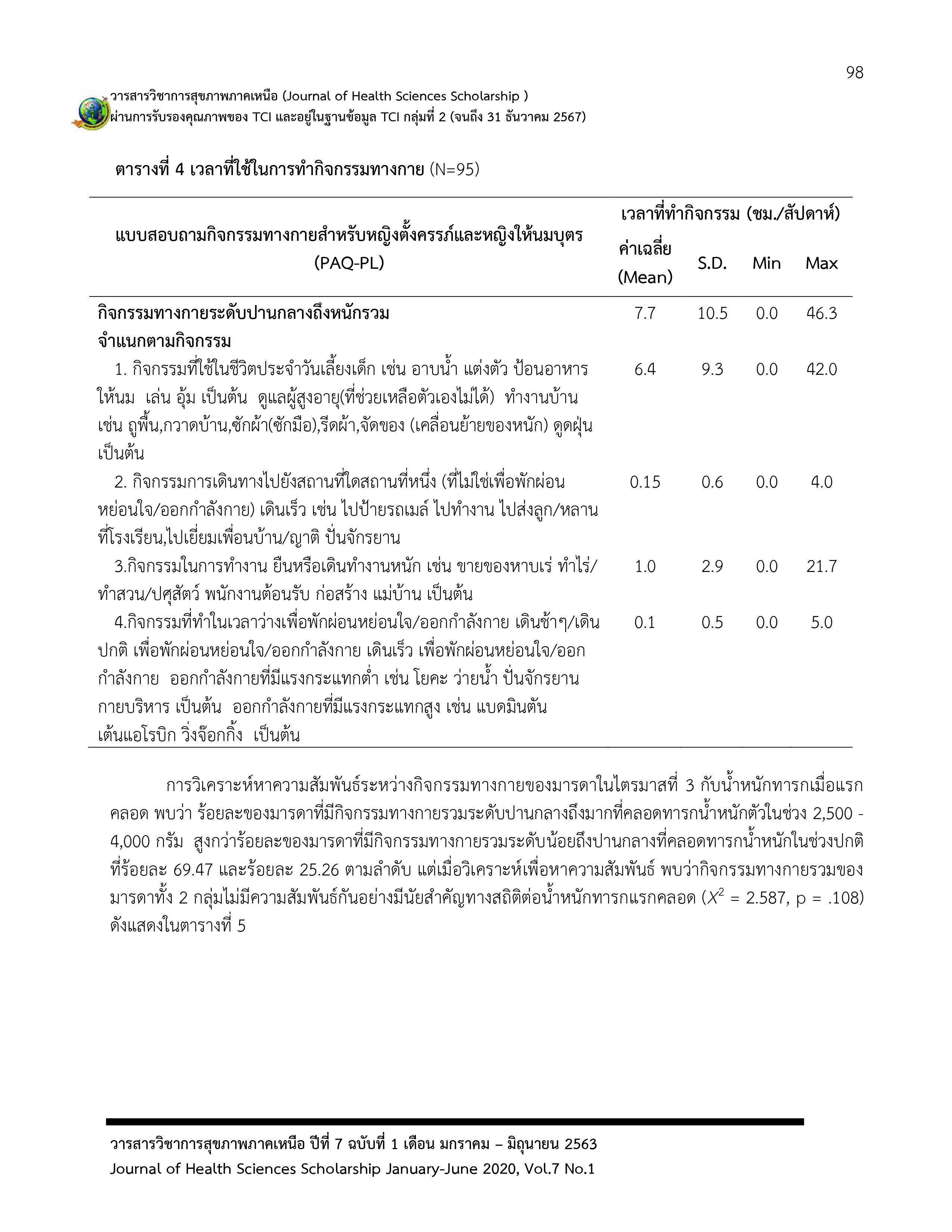
The result showed that the percentage of mothers with moderate to high intensity of physical activity deliver babies with birth weight in the range of 2,500 - 4,000 grams was higher than the percentage of mothers with low to moderate intensity at 69.47 percent and 25.26 percent, respectively. However the physical activity of both groups of mothers was no significantly correlation with newborn birth weight.
The researcher would recommend that the next study should include other factors that have an effect on the weight of the newborn and compare the relationship between physical activities during pregnancy in all trimesters.
References
Baena-García, L. et al. (2019). Association of sedentary time and physical activity during pregnancy with maternal and neonatal birth outcomes. The GESTAFIT Project. Scandinavian Journal of Medicine & Science in Sports, 29(3), 407-414. doi:10.1111/sms.13337.
Beetham, K. S. et al. (2019). The effects of vigorous intensity exercise in the third trimester of pregnancy: a systematic review and meta-analysis. BMC pregnancy and childbirth, 19(1), 281.
Beta, J. et al. (2019). Maternal and neonatal complications of fetal macrosomia: systematic review and meta-analysis. Ultrasound Obstet Gynecol, 54(3), 308-318. doi:10.1002/uog.20279.
Huang, L. et al.(2018). The mediating role of placenta in the relationship between maternal exercise during pregnancy and full-term low birth weight. The Journal of Maternal-Fetal & Neonatal Medicine, 31(12), 1561-1567.
Koutsospyros, D., & Epstein, L. (2019). Pain in Pregnancy and Labor 39. Academic Pain Medicine: A Practical Guide to Rotations, Fellowship, and Beyond, 305.
Lotgering, F. K. (2014). 30+ Years of Exercise in Pregnancy. In Advances in fetal and neonatal physiology (pp. 109-116): Springer.
Mottola et al. (2018). Canadian guideline for physical activity throughout pregnancy. British Journal of Sports Medicine, 52(21), 1339-1346. doi:10.1136/bjsports-2018-100056.
Obstetricians, A. C. o., & Gynecologists. (2015). ACOG Committee Opinion No. 650: Physical activity and exercise during pregnancy and the postpartum period. Obstet Gynecol, 126(6), e135-142.
Teerapong, K., & mangkorn, p. (2017). Thailand recommwndation on physical activity, non-sedentary lifestyles and sleeping for pregnan and postpartum women ministry of public health. (in Thai).
Parent-Vachon, M. et al. (2019). The Effects of Exercise on Pain and Reproductive Performance in Female Pregnant Mice With Neuropathic Pain. Biological research for nursing, 1099800419857812.
Perales, M. et al. (2015). Exercise during pregnancy attenuates prenatal depression: a randomized controlled trial. Evaluation & the health professions, 38(1), 59-72.
Sefat, M., Mohammadi, N., & Sadeghi, A. (2019). Physical Activity and Nutritional Status in Females With Vaginal Delivery and Cesarean Section in Razi Hospital, Qazvin. The Journal of Qazvin University of Medical Sciences, 23(3), 238-249.
Srichan, W. et al. (2019). physical activity questionnaire for pregnant and lactating women, PAQ-PL. (in Thai).
Vargas-Terrones, M. et al. (2019). Physical exercise programme during pregnancy decreases perinatal depression risk: a randomised controlled trial. Br J Sports Med, 53(6), 348-353.
WHO. (2014). Global Nutrition Targets 2025: Low birth weight policy brief. [Online]. Available from
https://www.who.int/nutrition/publications/globaltargets2025_policybrief_lbw/en/.
(2018, March, 15). (in thai).
Downloads
Published
Issue
Section
License
Articles, information, images, etc., published in the Journal of Health Sciences Scholarship is the copyright of the Journal of Health Sciences Scholarship. If any person or entity wants to bring all or part of it to publish or to do any action must be authorized by a letter from the Journal of Health Sciences Scholarship. The content and information in the article published in the Journal of Health Sciences Scholarship is considered and the responsibility of the author of the article directly, which editorial journals, no need to agree or share any responsibility.
Messages and Comments The author of the article. This is not the opinion of the journal, and the journal does not need to agree with the text and any comments of the author. The magazine reserves the right to consider publication as appropriate include the correct or refine the language to meet the criteria.

