Effectiveness of Development Emotional Quotient and Reinforce Positive to Improve Discipline in Early Childhood Programs base on Family Participation in Pua District, Nan Province
Keywords:
Early childhood, reinforce positive to improve discipline in early childhood programsAbstract
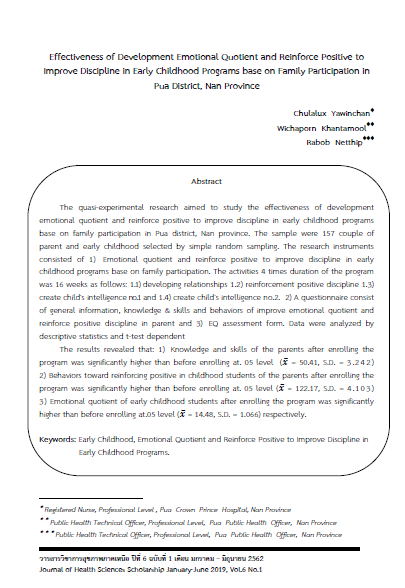
The quasi-experimental research aimed to study the effectiveness of development emotional quotient and reinforce positive to improve discipline in early childhood programs base on family participation in Pua district, Nan province. The sample were 157 couple of parent and early childhood selected by simple random sampling. The research instruments consisted of 1) Emotional quotient and reinforce positive to improve discipline in early childhood programs base on family participation. The activities 4 times duration of the program was 16 weeks as follows: 1.1) developing relationships 1.2) reinforcement positive discipline 1.3) create child's intelligence no.1 and 1.4) create child's intelligence no.2. 2) A questionnaire consist of general information, knowledge & skills and behaviors of improve emotional quotient and reinforce positive discipline in parent and 3) EQ assessment form. Data were analyzed by descriptive statistics and t-test dependent
The results revealed that: 1) Knowledge and skills of the parents after enrolling the program was significantly higher than before enrolling at. 05 level ( = 50.41, S.D. = 3.242) 2) Behaviors toward reinforcing positive in childhood students of the parents after enrolling the program was significantly higher than before enrolling at. 05 level ( = 122.17, S.D. = 4.103) 3) Emotional quotient of early childhood students after enrolling the program was significantly higher than before enrolling at.05 level ( = 14.48, S.D. = 1.066) respectively.
References
จาก http://www. anamai.moph.go.th.
กรมสุขภาพจิต. (2008). แบบประเมินความฉลาดทางอารมณ์เด็ก 3- 5 ปี (ฉบับย่อ). สืบค้นเมื่อ 9 พ.ย. 2561, จาก http://www.mhc10.go.th/download/35.pdf
กรมสุขภาพจิต. (2560). รักและผูกพัน สร้างสรรค์เด็กไทย. สืบค้นเมื่อ 2 ธ.ค. 2561, จาก
http://www.rajanukul.go.th/new/index.php?mode=download&group=&page=13
ชดาพิมพ์ เผ่าสวัสดิ์. (2559). การเสริมสร้างความผูกพันทางอารมณ์ สำหรับเด็กวัยแรกเกิด-5ปี ด้วยกิน กอด เล่น เล่า.
กรุงเทพฯ: โรงพิมพ์ชุมนุมสหกรณ์การเกษตรแห่งประเทศไทย.
นพวรรณ ศรีวงค์พานิช. (2557). คู่มือพัฒนาความฉลาดทางอารมณ์เด็กปฐมวัย สำหรับพ่อแม่ ผู้ปกครอง. กรุงเทพฯ: โรงพิมพ์ชุมนุมสหกรณ์การเกษตรแห่งประเทศไทย.
วิจิตร จันดาบุตร, วิทยา อยู่สุข และวิโรจน์ เซมรัมย์. (2561). การพัฒนาแนวทางการส่งเสริมพัฒนาการเด็กปฐมวัยในศูนย์พัฒนา
เด็กเล็ก เทศบาลตำบลสีวิเชียร อำเภอน้ำยืน จังหวัดอุบลราชธานี. วารสารวิจัยทางการศึกษา คณะศึกษาศาสตร์
มหาวิทยาลัยศรีนครินทรวิโรฒ. 13(1): 208-219.
สถาบันพัฒนาการเด็กราชนครินทร์ กรมสุขภาพจิต กระทรวงสาธารณสุข. (2561). โปรแกรมการส่งเสริมพัฒนาการและสร้างวินัย
เชิงบวกโดยครอบครัวมีส่วนร่วม. สืบค้นเมื่อ 9 พ.ย. 2561, จากhttps://www.dmh.go.th/bp/files/modelkid.pdf
สำนักงานกองทุนสนับสนุนการสร้างเสริมสุขภาพ. (2562). สิ่งเล็ก ๆ ที่สร้างลูก. สืบค้นเมื่อ 30 มี.ค. 2562, จาก
http://resource.thaihealth.or.th/system/files/documents/khuumuue_singelkthiisraangluuk
_final.pdf
อุดมลักษณ์ กุลพิจิตร และพัชราภรณ์ พุทธิกุล. (2560). การวิเคราะห์สถานการณ์ของการอบรมเลี้ยงดูเด็กปฐมวัย
โดยผู้ปกครองที่ไม่ใช่พ่อแม่และการนำเสนอนวัตกรรมเสริมสร้างความผูกพันในครอบครัว. วารสารครุศาสตร์, 45(3), 188-205.
Downloads
Published
Issue
Section
License
Articles, information, images, etc., published in the Journal of Health Sciences Scholarship is the copyright of the Journal of Health Sciences Scholarship. If any person or entity wants to bring all or part of it to publish or to do any action must be authorized by a letter from the Journal of Health Sciences Scholarship. The content and information in the article published in the Journal of Health Sciences Scholarship is considered and the responsibility of the author of the article directly, which editorial journals, no need to agree or share any responsibility.
Messages and Comments The author of the article. This is not the opinion of the journal, and the journal does not need to agree with the text and any comments of the author. The magazine reserves the right to consider publication as appropriate include the correct or refine the language to meet the criteria.

