
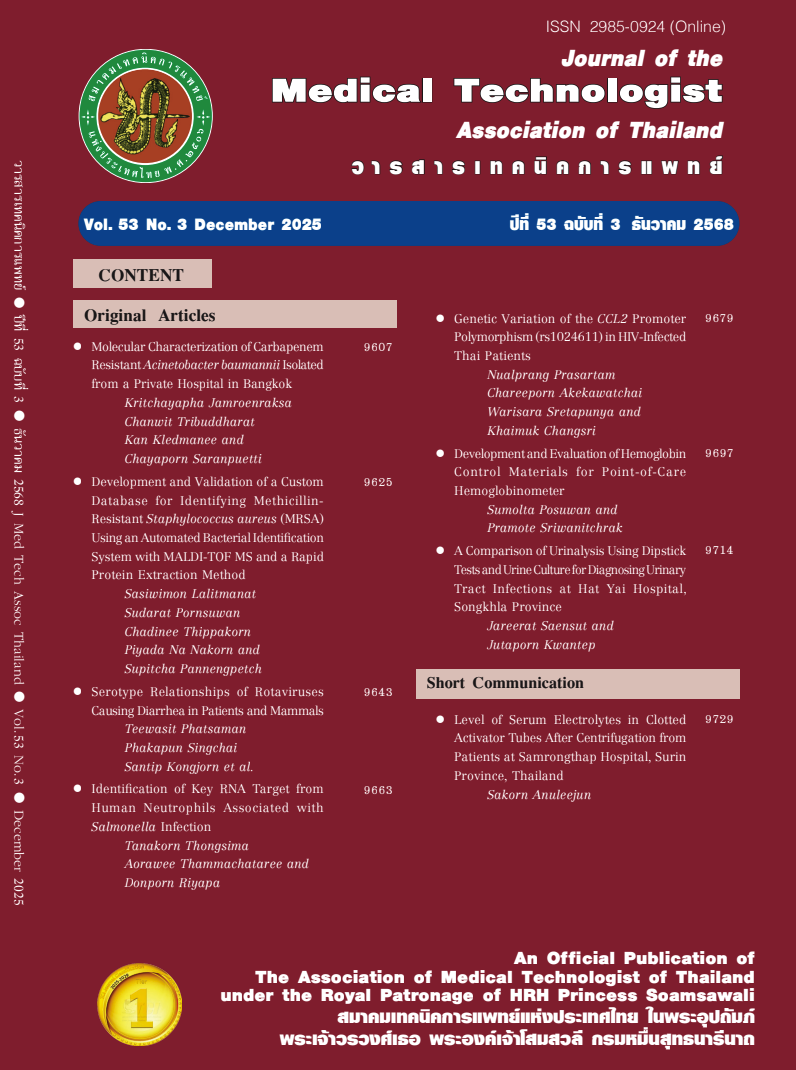
Level of Serum Electrolytes in Clotted Activator Tubes After Centrifugation from Patients at Samrongthap Hospital, Surin Province, Thailand
Keywords:
Electrolytes , Stability, Serum, Community HospitalAbstract
The measurement of electrolyte levels (Na+, K+, Cl-, and CO2) is a critical process supporting patient diagnosis and treatment. In some cases, additional testing is required from the original clotted activator (primary tube) after blood collection for other initial tests. However, delayed analysis may affect result accuracy. This study aimed to investigate electrolyte stability in serum samples from 90 patients. Levels of Na+, K+, Cl-, and CO2 were measured in serum after blood centrifugation at room temperature at 0, 60, 120, 180, and 240 minutes. Results at 60, 120, 180, and 240 minutes were compared to baseline (0 minute) values using a paired t-test with a significance level of 0.05. Findings revealed no significant differences in Cl- levels at 60 and 120 minutes compared to baseline (p>0.05). Similarly, Na+ and K+ levels at 60, 120, 180, and 240 minutes showed no significant changes (p>0.05). In contrast, CO2 levels significantly decreased at all the time points compared to baseline (p<0.05). However, when evaluated against the total allowable error limit (TEa), all electrolyte values (Na+, K+, Cl-, and CO2) at 60, 120, 180, and 240 minutes remained within clinically acceptable ranges. This study suggests that serum samples stored in clotted activator tubes can be analyzed for Na+, K+, Cl-, and CO2 levels up to 240 minutes post-centrifugation without clinically significant deviations. These findings support practical guidelines for extending the allowable processing time for electrolyte testing in routine clinical settings.References
Hall JE, & Guyton, AC. Textbook of medical physiology (14th ed.). Elsevier, 2020
Chayananunukoon W, Pipatchaiaurak T, Musigwan P. A comparison of serum electrolytes in commercial and self-prepared reagents using a Beckman CX-3 delta automatic analyzer. Songkla Medl J 2007;25:295-301.
Sinan Y, Hilal BU, Mücahit A, et al. Comparison of different methods for measurement of electrolytes in patients admitted to the intensive care unit. Saudi Med J 2016;37:262-7.
Zavorsky G, Wijk XMRV, Gasparayan S, Stollenwerk NS, Brooks RA. Stability of whole blood electrolyte specimens at room temperature vs. slushed ice conditions. Appl Lab Med 2022;7:541-54.
Reece WO, Trampel DW, Koehlert KJ. Effect of storage time and temperature after blood sampling from turkeys on plasma concentrations of potassium, sodium and chloride. Poult Sci 2006;85:1095-7.
Dimeski G, Clague AE, Hickman PE. Correction and reporting of potassium results in haemolysed samples. Ann Clin Biochem. 2005;42:119-23.
Kayal S, Mandal P, Chakrabarti P, Das B, Sahoo A, Rout JK. Effects of air exposure, time, temperature, and humidity on different serum electrolytes. Natl J Physiol Pharm Pharmacol 2023;13:363-6.
Aziz F, Sam R, Lew SQ, et al. Tzamaloukas AH. Pseudohyponatremia: Mechanism, Diagnosis, Clinical Associations and Management. J Clin Med 2023;12:4076.
Burtis CA. Ashwood ER. Bruns DE. Tietz Textbook of Clinical Chemistry and Molecular Diagnostics. 5th Edition. Elsevier Health, 2012. Sciences.
Westgard SA. Westgard, JO. Quality control: Practical approaches for analytical testing (5th ed.). Westgard QC, 2023.
Chusaengsong P, Musigwan P, Wilairat B, Naphthiboon P. Changes in levels of biochemical in centrifuged blood after being left to stand at room temperature. Songkla Med J 2011;29:203-14.
Data Innovations. Total Allowable Error Table (Updated June 2024). [Internet] [cited 2025 Jan 12]. Available from: https://www.datainnovations.com/allowable-total-error-table
Palmer J, Galior K. Defining allowable total error limits in the clinical laboratory. Adv Clin Chem 2024;118:205-23
Habibzadeh F. Data Distribution: Normal or Abnormal? J Korean Med Sci 2024;39:1-8
Meepradapsuk P, Kangwantrakul W, Trakulthong J, Promdee L. Stability of heparinized plasma contacting heparin with cell for clinical chemistry assays. J Med Tech Physical Ther 2012;24:41-50.
Dash P, Tiwari R, Nayak S, Mangaraj M. Impact of Time Delay in the Analysis of Serum Ionized Calcium, Sodium, and Potassium. J Lab Physicians 2022;14:373-6.
Fauziah AN, Martsiningsih MA, Setiawan B. Electrolytes levels (Na, K, Cl) in serum stored at 4°C temperature. Ind J Med Lab Sci Tech 2021;3:90-8.
Bowen R A, Remaley AT, Hortin GL. Interferences from blood collection tube components on clinical chemistry assays. Biochemia Medica 2005;15:145–59.
Lippi G, Mattiuzzi C, Guidi GC. The importance of total allowable error in clinical laboratory testing. Clin Chem Lab Med 2017; 55:1–3.
Narayanan S. The pre-analytic phase. An important component of laboratory medicine. Am J Clin Pathol 2000;113:429-52.
Boyanton BL Jr, Blick KE. Stability studies of twenty-four analytes in human plasma and serum. Clin Chem 2002;48:2242-7.
Zhang DJ, Elswick RK, Miller WG, Bailey JL. Effect of serum-clot contact time on clinical chemistry laboratory results. Clin Chem 1998;44:1325-33.
Downloads
Published
How to Cite
Issue
Section
License
Copyright (c) 2025 Journal of the Medical Technologist Association of Thailand

This work is licensed under a Creative Commons Attribution-NonCommercial-NoDerivatives 4.0 International License.


