
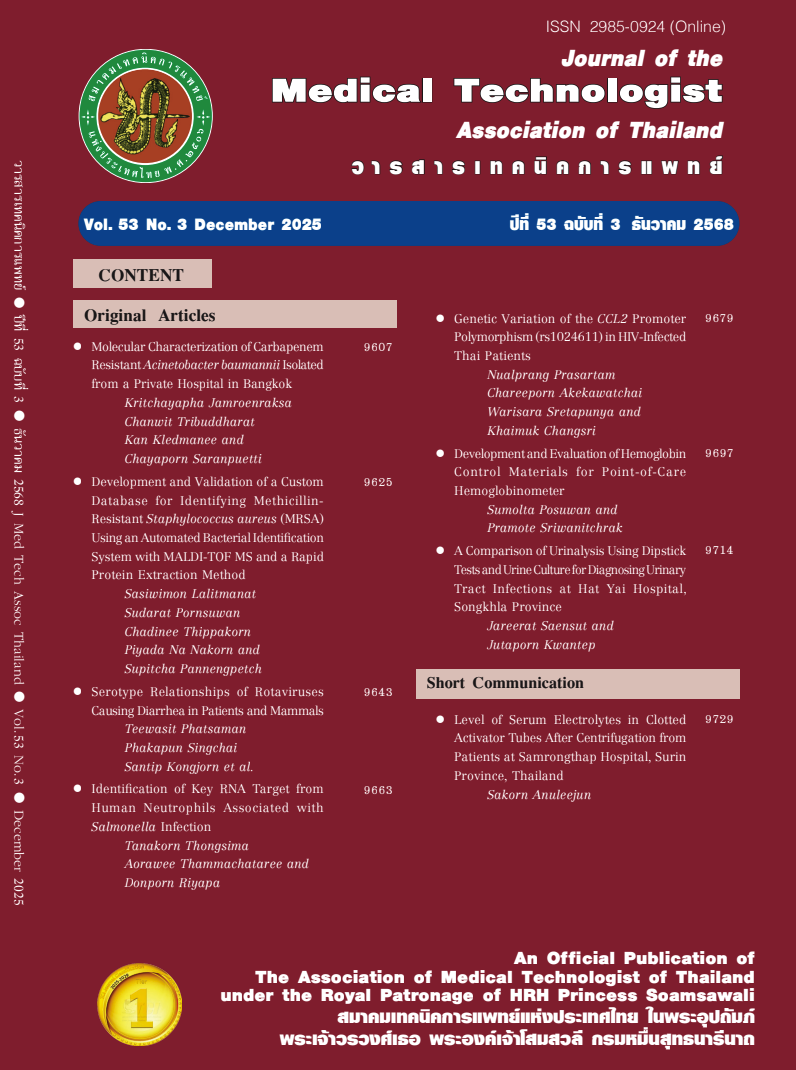
Identification of Key RNA Target from Human Neutrophils Associated with Salmonella Infection
Keywords:
Neutrophils, Salmonella, Diacylglycerol O-acyltransferase 2, DGAT2Abstract
Salmonella enterica serovar Typhimurium (S. Typhimurium) typically causes food-borne gastroenteritis which is a major impact on global public health issues. The pathological hallmark of S. Typhimurium-induced enterocolitis in humans is associated with a massive neutrophil influx into the intestine. Uncontrolled activation and infiltration of neutrophils lead to dysregulation of inflammatory responses and tissue damage. Currently, numerous studies in the field of transcriptomics have been conducted, leading to a growing database of research output and resource for transcriptomic analyses. The aim of this study was identification of key RNA target from human neutrophils associated with Salmonella infection among an RNA collection of public transcriptome database. The obtained data was subsequently processed with simple arrangement of significant neutrophil genes. The results demonstrated that diacylglycerol O-acyltransferase 2 (DGAT2) was selected among 137 significant neutrophil genes relevant to Salmonella infection compared to healthy controls. Moreover, this target also highly rated for its novelty which has never been studied in relation to Salmonella or neutrophils. Thus, the selection of this novel gene was suitable to be applied for further study. To investigate a role of neutrophil DGAT2 in bacterial killing in vitro study, human neutrophils isolated from healthy subjects were infected with S. Typhimurium in the presence or absence of DGAT2 inhibitor and intracellular survival of bacteria was counted. The results indicated that the numbers of intracellular bacteria were significantly higher in the presence of DGAT2 inhibitor (177.17 ± 46.52 CFU/ml) than in the absence of DGAT2 inhibitor (77.33 ± 23.72 CFU/ml) at 60 minutes post-incubation, suggesting that targeted DGAT2 plays an important role in improving efficiency of neutrophil-mediated killing. This research utilizes and extracts various collected data, which can be applied to in vitro experiments for further studies to create valuable new knowledge related to the pathogenesis of infectious diseases.
References
Burn GL, Foti A, Marsman G, Patel DF, Zychlinsky A. The Neutrophil. Immunity 2021; 54: 1377-91.
Kolaczkowska E, Kubes P. Neutrophil recruitment and function in health and inflammation. Nat Rev Immunol 2013; 13: 159-75.
Leliefeld PH, Wessels CM, Leenen LP, Koenderman L, Pillay J. The role of neutrophils in immune dysfunction during severe inflammation. Crit Care 2016; 20: 73.
Eng SK, Pusparajah P, Ab Mutalib NS, Ser HL, Chan KG, Lee LH. Salmonella: A review on pathogenesis, epidemiology and antibiotic resistance. Front Life Sci 2015; 8: 284-93.
Menard S, Lacroix-Lamande S, Ehrhardt K, Yan J, Grassl GA, Wiedemann A. Cross-talk between the intestinal epithelium and Salmonella Typhimurium. Front Microbiol 2022; 13: 906238.
Gül E, Enz U, Maurer L, Abi Younes A, Fattinger SA, Nguyen BD, et al. Intraluminal neutrophils limit epithelium damage by reducing pathogen assault on intestinal epithelial cells during Salmonella gut infection. PLoS Pathog 2023; 19: e1011235.
Broz P, Ohlson MB, Monack DM. Innate immune response to Salmonella typhimurium, a model enteric pathogen. Gut Microbes 2012; 3: 62-70.
Hohmann EL. Nontyphoidal salmonellosis. Clin Infect Dis 2001; 32: 263-9.
Aviello G, Knaus UG. ROS in gastrointestinal inflammation: Rescue or Sabotage? Br J Pharmacol 2017; 174: 1704-18.
Ramalho J, Correia J. Non-typhoidal Salmonella severe sepsis in an immunocompetent young woman. BMJ Case Rep 2013; bcr2012008773.
Kudo K, Ohara J, Sano C, Ohta R. Salmonella bacteremia in an older patient with no specific Entry: A case report. Cureus 2023; 15: e49194.
Worley MJ. Salmonella Bloodstream Infections. Trop Med Infect Dis 2023; 8 :487.
Schürmann N, Forrer P, Casse O, Li J, Felmy B, Burgener AV, et al. Myeloperoxidase targets oxidative host attacks to Salmonella and prevents collateral tissue damage. Nat Microbiol 2017; 2: 16268.
Burton NA, Schürmann N, Casse O, Steeb AK, Claudi B, Zankl J, et al. Disparate impact of oxidative host defenses determines the fate of Salmonella during systemic infection in mice. Cell Host Microbe 2014; 15: 72-83.
Gill N, Ferreira RB, Antunes LC, Willing BP, Sekirov I, Al-Zahrani F, et al. Neutrophil elastase alters the murine gut microbiota resulting in enhanced Salmonella colonization. PLoS One 2012; 7: e49646.
Kozlyuk N, Monteith AJ, Garcia V, Damo SM, Skaar EP, Chazin WJ. S100 Proteins in the innate immune response to pathogens. Methods Mol Biol 2019; 1929: 275-90.
Riyapa D, Rinchai D, Muangsombut V, Wuttinontananchai C, Toufiq M, Chaussabel D, et al. Transketolase and vitamin B1 influence on ROS-dependent neutrophil extracellular traps (NETs) formation. PLoS One 2019; 14: e0221016.
Chaussabel D, Rinchai D. Using 'collective omics data' for biomedical research training. Immunol 2018; 155: 18-23.
Chiu HC, Kulp SK, Soni S, Wang D, Gunn JS, Schlesinger LS, et al. Eradication of intracellular Salmonella enterica serovar Typhimurium with a small-molecule, host cell-directed agent. Antimicrob Agents Chemother 2009; 53: 5236-44.
Pankla R, Buddhisa S, Berry M, Blankenship DM, Bancroft GJ, Banchereau J, et al. Genomic transcriptional profiling identifies a candidate blood biomarker signature for the diagnosis of septicemic melioidosis. Genome Biol 2009; 10: R127.
Rinchai D, Kewcharoenwong C, Kessler B, Lertmemongkolchai G, Chaussabel D. Increased abundance of ADAM9 transcripts in the blood is associated with tissue damage. F1000Res 2015; 4: 89.
Futatsugi K, Kung DW, Orr ST, Cabral S, Hepworth D, Aspnes G, et al. Discovery and optimization of imidazopyridine-based inhibitors of diacylglycerol acyltransferase 2 (DGAT2). J Med Chem 2015; 58: 7173-85.
Pabst B, Futatsugi K, Li Q, Ahn K. Mechanistic characterization of long residence time inhibitors of diacylglycerol acyltransferase 2 (DGAT2). Biochem 2018; 57: 6997-7010.
Jin Y, McFie PJ, Banman SL, Brandt C, Stone SJ. Diacylglycerol acyltransferase-2 (DGAT2) and monoacylglycerol acyltransferase-2 (MGAT2) interact to promote triacylglycerol synthesis. J Biol Chem 2014; 289: 28237-48.
Monson EA, Trenerry AM, Laws JL, Mackenzie JM, Helbig KJ. Lipid droplets and lipid mediators in viral infection and immunity. FEMS Microbiol Rev 2021; 45: fuaa066.
Monson EA, Crosse KM, Duan M, Chen W, O'Shea RD, Wakim LM, et al. Intracellular lipid droplet accumulation occurs early following viral infection and is required for an efficient interferon response. Nat Commun 2021; 12: 4303.
Feingold KR, Shigenaga JK, Kazemi MR, McDonald CM, Patzek SM, Cross AS, et al. Mechanisms of triglyceride accumulation in activated macrophages. J Leukoc Biol 2012; 92: 829-39.
Castoldi A, Monteiro LB, van Teijlingen Bakker N, Sanin DE, Rana N, Corrado M, et al. Triacylglycerol synthesis enhances macrophage inflammatory function. Nat Commun 2020; 11: 4107.
Bosch M, Sánchez-Álvarez M, Fajardo A, Kapetanovic R, Steiner B, Dutra F, et al. Mammalian lipid droplets are innate immune hubs integrating cell metabolism and host defense. Science 2020; 370: eaay8085.
Reichert I, Lee JY, Weber L, Fuh MM, Schlaeger L, Rößler S, et al. The triglyceride-synthesizing enzyme diacylglycerol acyltransferase 2 modulates the formation of the hepatitis C virus replication organelle. PLoS Pathog 2024; 20: e1012509.
Anand P, Cermelli S, Li Z, Kassan A, Bosch M, Sigua R, et al. A novel role for lipid droplets in the organismal antibacterial response. Elife 2012; 1: e00003.
Zimmer AM, Pan YK, Chandrapalan T, Kwong RWM, Perry SF. Loss of function approaches in comparative physiology: is there a future for knockdown experiments in the era of genome editing? J Exp Biol 2019; 222: jeb175737.
Downloads
Published
How to Cite
Issue
Section
License
Copyright (c) 2025 Journal of the Medical Technologist Association of Thailand

This work is licensed under a Creative Commons Attribution-NonCommercial-NoDerivatives 4.0 International License.


